Where to Find Licensed & Public-Domain Footage for Recaps
How to get movie clips for recap videos legally: a source-by-source directory of licensed and public-domain footage, rated by cost and copyright risk.
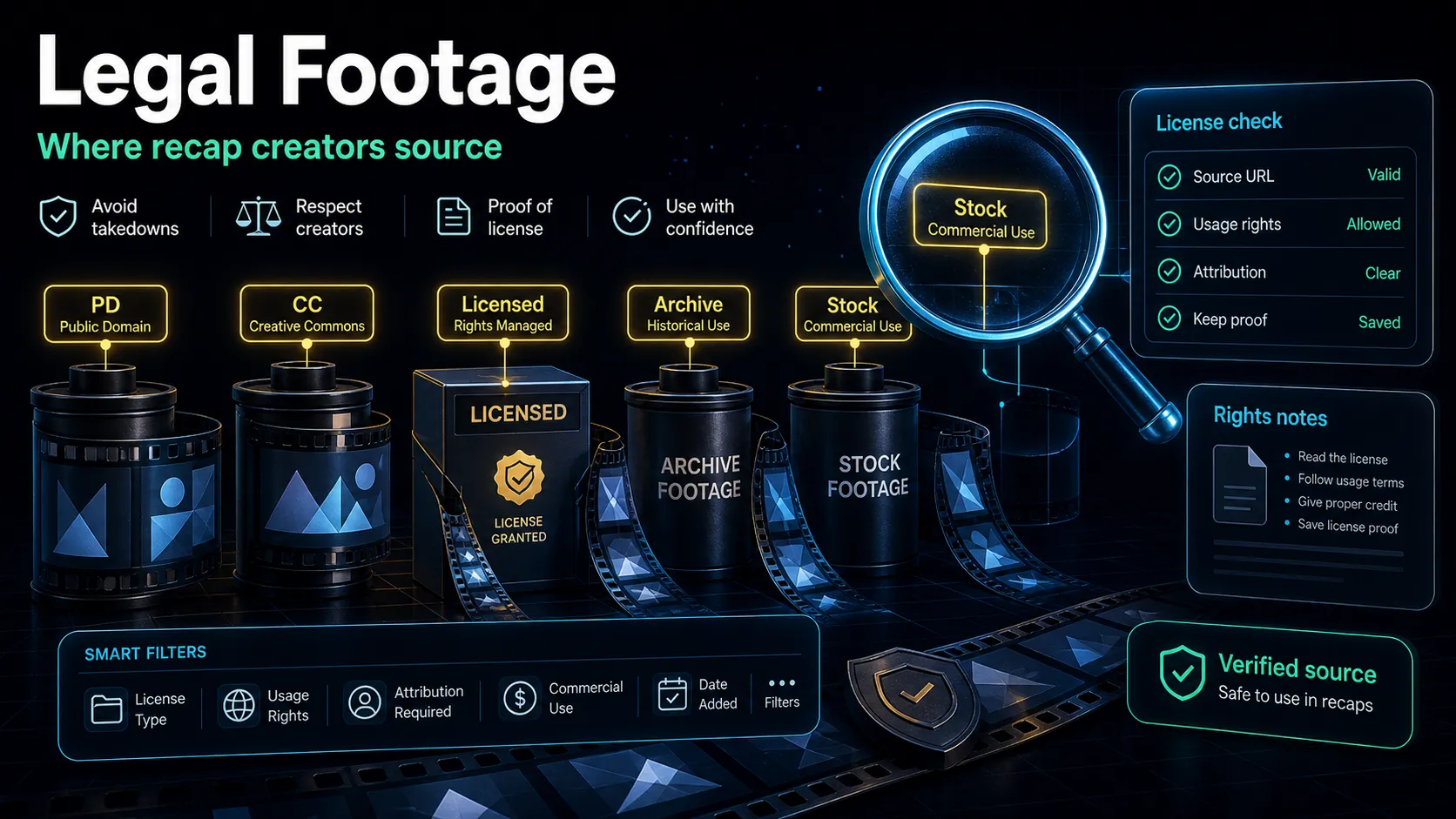
You can get movie clips for recap videos legally, and it comes down to three buckets: footage that is already in the public domain, footage you license, and footage released under an open license like Creative Commons. If you searched how to get movie clips for recap videos legally and landed on a page listing recap channels, a generic stock site, or yet another "top editing app" post, you already felt the problem — nobody actually answers the question with real sources. This is the directory those results are missing: a source-by-source list of where to find licensed and public-domain footage, rated by cost and copyright risk, plus a fast method to tell whether a clip is truly free to use and a record-keeping habit that keeps you out of trouble months later.
Two honest framings first. "Copyright free movie recap footage" almost always means public domain — genuinely free of copyright — and that pool is narrower than most creators expect. And no source list makes your finished video automatically safe; how you use the clips still matters, which is why this piece pairs with fair use for movie recap videos. Sourcing legally is step one. Using it transformatively is step two.
Key Takeaways
What "legal footage" actually means: three buckets
Almost every legitimate clip you can put in a recap falls into one of three categories. Knowing which bucket a file belongs to tells you exactly what you're allowed to do with it.

| Public domain | Copyright expired or waived; owned by no one | Use freely, including commercially, no permission needed | You must confirm it's truly PD — old ≠ public domain | Licensed | You pay (or agree to terms) for permission | Use within the license scope | Costs money or has usage limits; read the terms | Open license (CC, etc.) | Owner pre-grants use under set conditions | Use if you follow the license (attribution, etc.) | The uploader must have actually held the rights they granted |
Notice what's not on this list: the studio's current theatrical release, a streaming rip, or a file from a "download full movie" site. Those belong to no bucket — they're just copyrighted material you don't have rights to. Everything below lives inside these three buckets.
How to tell if footage is really public domain
"Copyright free movie recap footage" is the phrase creators chase, but plenty of clips labeled "public domain" online are mislabeled. Run this five-step check before you trust anything:

- Check the year against the US 95-year rule. For US works, copyright generally runs 95 years from publication. As of 2026, works published in 1930 or earlier are in the public domain, and that line advances one year every January 1. So 1920s and early-1930s films are the obvious hunting ground.
- Watch for layered rights. A film can be public domain while its musical score, a restored soundtrack, a colorized version, or newly added narration is separately protected. Use the cleanest original element you can find and swap in your own or licensed music.
- Confirm it's US public domain, not just "old abroad." Foreign films can still be protected in the US under copyright-restoration rules even when they're old in their home country. Country of origin matters.
- Prefer sources that state provenance. Institutions like the Library of Congress and Internet Archive usually label a title's rights status; a random re-upload with no rights statement tells you nothing.
- When in doubt, treat it as copyrighted. "I couldn't find the owner" is not a legal status. Absence of a visible copyright notice is not permission.
If a clip survives all five, it's genuinely safe to build on. If it fails even one, move it to the "license it or skip it" pile.
The legal source directory: how to get movie clips for recaps, rated by cost and risk
Here is the answer the SERP keeps dodging. Each row is a real category of legitimate source, rated on typical cost and copyright risk when used correctly. "Risk" here means the odds the footage itself triggers a copyright problem — not how you edit it.

| US public-domain films | Internet Archive, Prelinger Archives | Free | Very low (if truly PD) | Classic-era recaps, vintage B-roll | Government & institutional footage | Library of Congress, National Archives, NASA | Free | Very low (US federal works aren't copyrighted) | Historical, space, archival cutaways | Open-license media | Wikimedia Commons, Vimeo (CC filter), YouTube (CC filter) | Free with attribution | Low–moderate (verify the exact license and that the uploader held rights) | Indie shorts, contextual B-roll | Free stock B-roll | Pexels, Pixabay | Free (check current license) | Low | Generic cutaways, mood shots, filler | Paid stock & news archives | Getty Images, AP Archive, Reuters | Paid (per-clip or subscription) | Low (you hold a license) | Specific real-world, news, or event footage | Studio clip-licensing desks | Studio licensing / clip-clearance departments | Paid, negotiated | Low but slow and often costly | Legitimately using scenes from a specific modern film | Official trailers, EPKs, press assets | Studio press pages, official channels | Free to access | Moderate — still copyrighted; you're leaning on fair use, not a license | Illustrating commentary on a current release |
The single most important line in that table: official trailers are not "free footage." Studios post them to promote the film, but they remain copyrighted. Using a trailer in a monetized recap is a fair-use bet, not a granted license — treat it the same way you'd treat any borrowed clip, and keep it short and purposeful.
Public-domain archives worth bookmarking
If you want copyright-free material with the lowest friction, the public-domain and government tier is where you live. It's free, it's genuinely rights-clear when the item is properly labeled, and it's deep enough to build entire faceless channels around classic and historical content.
A practical note: this tier is unbeatable for B-roll and era-appropriate footage, but it will not hand you clips of a 2024 blockbuster. For a current film you're reviewing, you'll rely on the licensing or fair-use paths instead.
Creative Commons and free stock for filler
The gap between "the specific scene I'm analyzing" and "the shots I use to keep the video visually alive" is where Creative Commons and free stock earn their keep. You rarely need the studio's footage for establishing shots, mood cutaways, or transitions — generic B-roll does the job and carries almost no risk.
The trap with open-license media is second-hand rights. Someone can upload a studio clip and tag it "Creative Commons," but they can't license rights they never held. If a "CC" clip is obviously ripped from a commercial film, the tag is meaningless — skip it.
Licensing desks: when you need the actual clip, legitimately
Sometimes only the real scene will do, and you want it fully licensed rather than relying on fair use. That's what licensing desks are for. This path is how professionals get licensed movie footage for YouTube videos without gambling on a claim.
Rule of thumb: if a monetized project genuinely depends on a specific copyrighted clip and fair use is a stretch, license it. The fee is almost always cheaper than a strike, a dispute, or a takedown.
Red flags: "sources" to skip entirely
Only legal sources belong in your workflow. These are the patterns that get channels claimed, demonetized, or struck — none of them belong in any bucket above:
| "Download full movie" / torrent sites | That's the copyrighted theatrical release, full stop | Re-upload channels & shared cloud-drive links | Passing around studio files doesn't grant rights | "Copyright free" packs of current blockbusters | Current studio films aren't copyright-free; the label is bait | Screen-recorded streaming rips | Still the protected work, just captured differently | "4K movie clip packs" sold for editing | Reselling doesn't launder the underlying copyright |
If a source promises brand-new, high-resolution studio content for free with "no copyright," that promise is the tell. Genuine public-domain material is old, government-produced, or explicitly waived — never a fresh release.
Log every license, then build the recap
The habit that separates channels that survive from channels that scramble during a dispute is boring: keep a source log. For every clip, record where it came from, its rights status (PD, license ID, or CC license type), and the date. A simple spreadsheet is enough. If a claim ever lands, you can respond with evidence instead of memory.
Once your footage is sourced and logged, the build itself is fast in a browser-based workspace — no installs, and files up to 6GB per task cover long source reels. Recapo handles the production loop end to end:
- Map only the beats you need. Feed your source into the scene breakdown generator to pinpoint the exact moments your commentary references, so you pull short, purposeful excerpts instead of long stretches. Sourcing less is both safer and cleaner.
- Grab clean stills for covers and reference. Use the keyframe screenshot tool to lift sharp frames from footage you have the rights to — useful for thumbnails, on-screen references, and marking which shots you'll actually cut.
- Layer in your own value. Transcribe and caption, add original narration or AI voiceover, and drop in your public-domain or stock B-roll so the borrowed material stays lean and your commentary carries the video.
- Reframe and export per platform. Resize to vertical for Shorts, TikTok, and Reels or keep it wide for YouTube, add a cover, and export.
If you're building a repeatable operation around this, how to start a faceless movie recap channel walks through the full production loop that sits on top of a clean sourcing pipeline.
FAQ
How do I get movie clips for recap videos legally? Pull from one of three buckets: public-domain footage (from archives like Internet Archive or the Library of Congress), licensed footage (from stock/news archives or a studio clearance desk), or open-license footage (Creative Commons on Vimeo, YouTube, or Wikimedia Commons). Verify the rights status before you use anything, and keep short, purposeful excerpts. Using an unlicensed ripped copy of a current film is not one of the legal options.
Is there such a thing as copyright-free movie footage? Yes, but it's narrower than it sounds. "Copyright free" means public domain — usually US works published in 1930 or earlier, plus US government footage that was never copyrighted. Current studio films are not copyright-free, and any site claiming to offer free clips of new blockbusters is not a legal source.
Where can I download movie clips for YouTube without a claim? For B-roll and filler, free stock sites (Pexels, Pixabay) and Creative Commons libraries work well. For actual film scenes, either use public-domain classics or license the clip through a stock/news archive or the studio's licensing desk. There's no legitimate site that hands out claim-proof clips of copyrighted current films.
Are official trailers free to use in my recap? No. Trailers are promotional but still copyrighted. Studios post them to market the film, not to grant a reuse license. Putting a trailer in a monetized video is a fair-use bet, not a license — keep the clip short, tie it to genuine commentary, and understand you're relying on fair use, not permission.
Do I really need to license footage, or is fair use enough? It depends on the use. For transformative criticism with short, purposeful clips, fair use may cover you — see the companion guide on fair use. But fair use is a defense decided case by case, not a guarantee. When a monetized project depends on a specific copyrighted clip and the fair-use case is thin, licensing it is the safer, cheaper choice than risking a strike.
Legal sourcing isn't a limitation — it's what lets a recap channel scale without living in fear of the next claim. Build a habit of pulling from public-domain archives, licensing when you need a specific scene, using Creative Commons and stock for the connective tissue, and logging every source. Recapo gives you a browser-based place to break down only the beats you need, grab clean frames, add captions and voiceover, reframe, and export for YouTube, TikTok, Shorts, or Reels — all in one workspace. Create a free account and build your next recap on footage you can actually stand behind.