How to Write a Movie Recap Script (Structure + Hook Templates)
Three-act structure templates and five opening-hook formulas for movie recap scripts, with pacing rules and an AI-drafting workflow.
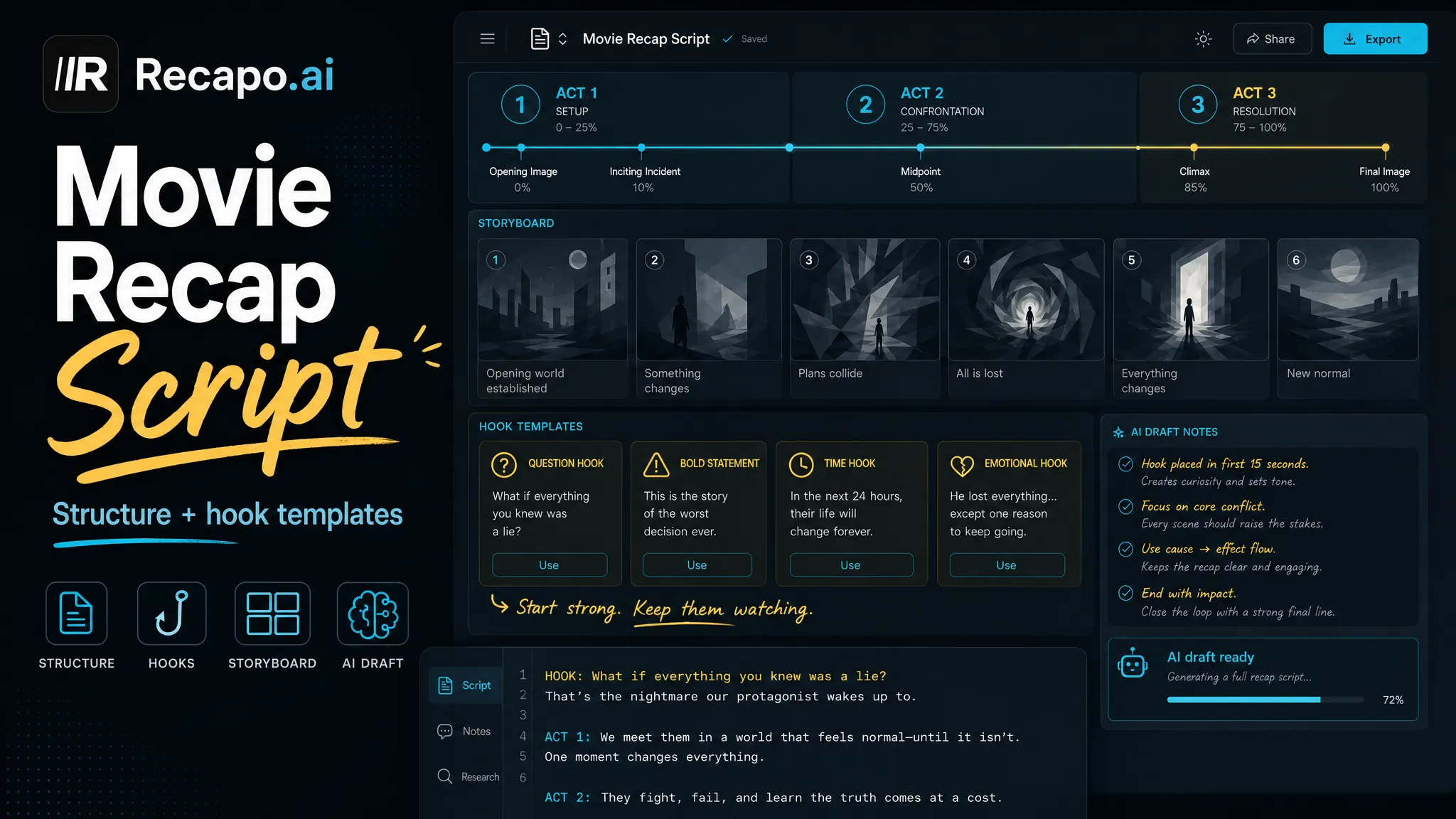
Writing a movie recap script comes down to one formula: a three-act structure underneath (suspense opening → main-plot compression → closing take), plus one hook to protect the first three seconds. When viewers click on a recap, they are not there to learn what happened — they want to see how you tell it. This guide gives you structure templates you can copy as-is, five opening hooks, a pacing benchmark, and a workflow for splitting the drafting work with AI.
Viewers Come for the Telling, Not the Plot Summary
Dozens of channels can recap the same film. The plot points are identical, yet the numbers are worlds apart. The gap is never the movie — it is the telling: the angle you choose, the pace you release information, the take you close on.
So before writing a word, adopt one principle: the plot is raw material; the telling is the product. Any script that simply retells the story — however smoothly — is a play-by-play, not a recap.
The Three-Act Structure Template
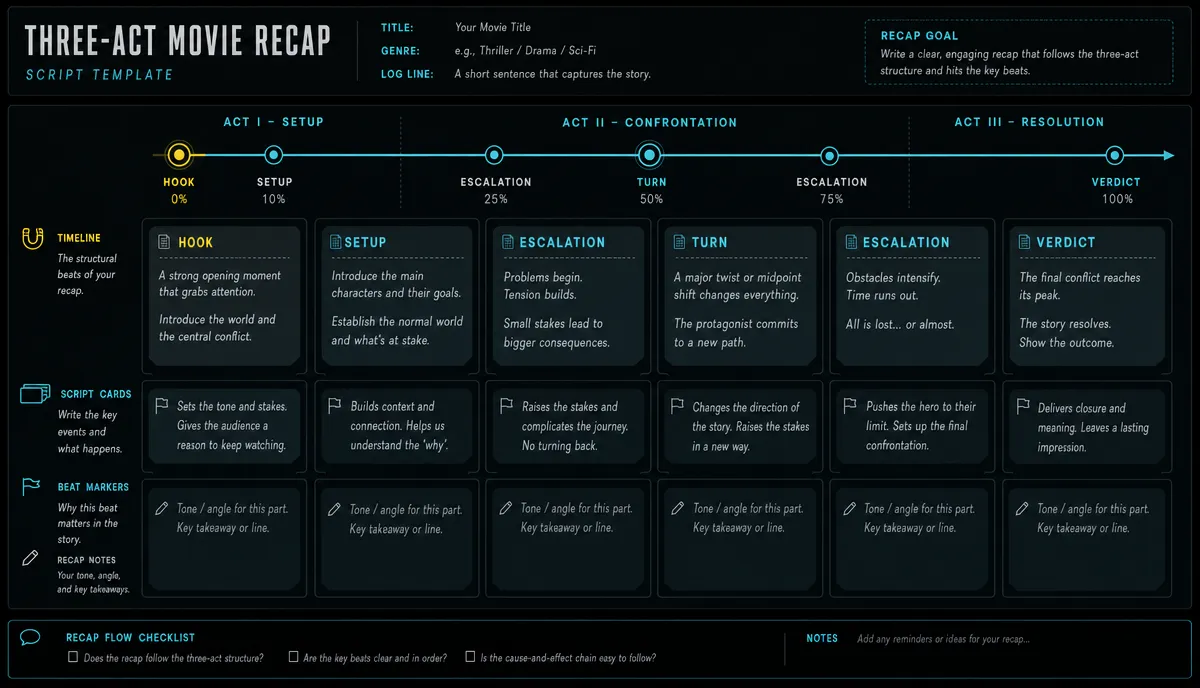
- Suspense opening (first 15 seconds). Throw out a question or a contradiction — no backstory. "A man who was never late in his life just missed the last train on purpose" works far better than "Today I'm going to tell you about a thriller."
- Main-plot compression (the middle). Cover only the 6–8 beats that drive the main plot, with a single transition sentence between beats. The cut test is blunt: if viewers can still follow the story without a section, cut it. Subplots, side characters' backstories, worldbuilding lore — anything that doesn't push the main plot forward goes.
- Closing take (last 30 seconds). End with a stance, not a summary. Judge a character's motives, or offer a different reading of the ending. Your take is allowed to be controversial — controversy is what fills a comment section.
Five Hooks for the First Three Seconds
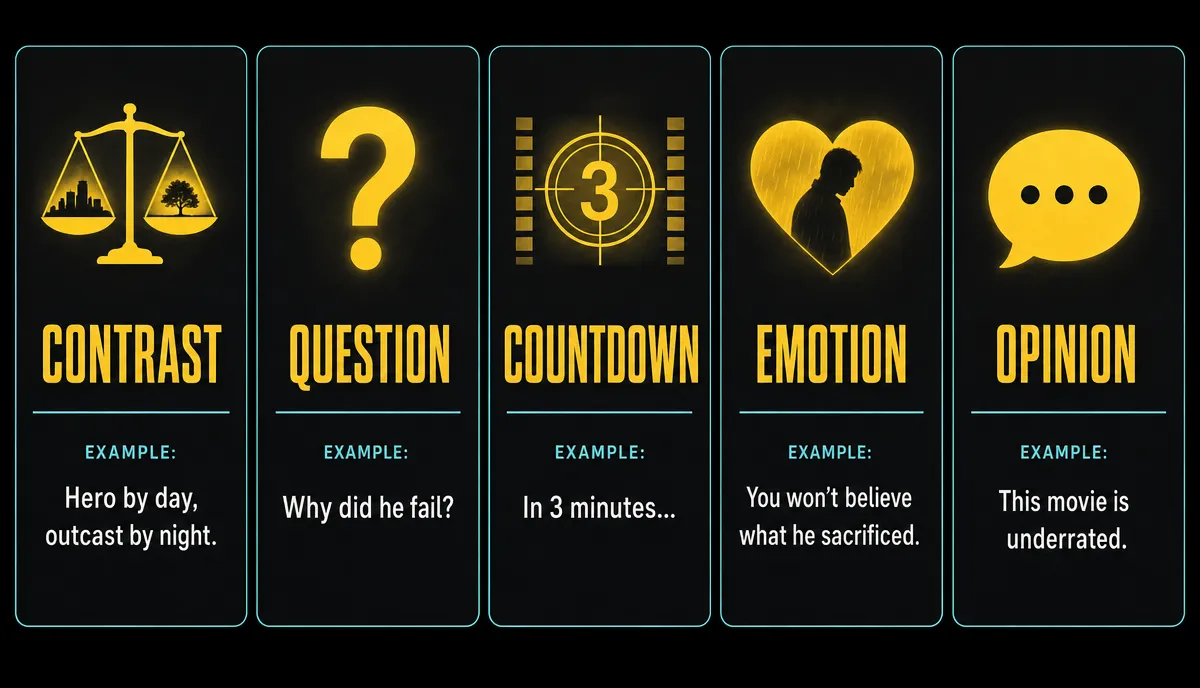
All examples below are original; the sentence patterns are yours to reuse:
- The suspense hook — leave one knot untied: "She confessed to a murder that hadn't happened yet."
- The contrast hook — collide two facts that shouldn't share a frame: "The town's only firefighter turned out to be its only arsonist."
- The question hook — force viewers to pick a side: "If turning in your own brother would save a stranger's life, would you do it?"
- The ending-first hook — reveal the ending, then work backwards: "In the final scene, the detective arrests himself — and he's right to."
- The second-person hook — drop the viewer straight into the scene: "You wake up in your own bed, but every photo in the house shows a stranger's face."
One hook per video is enough; mixing them only dilutes each one.
Pacing and Information Density
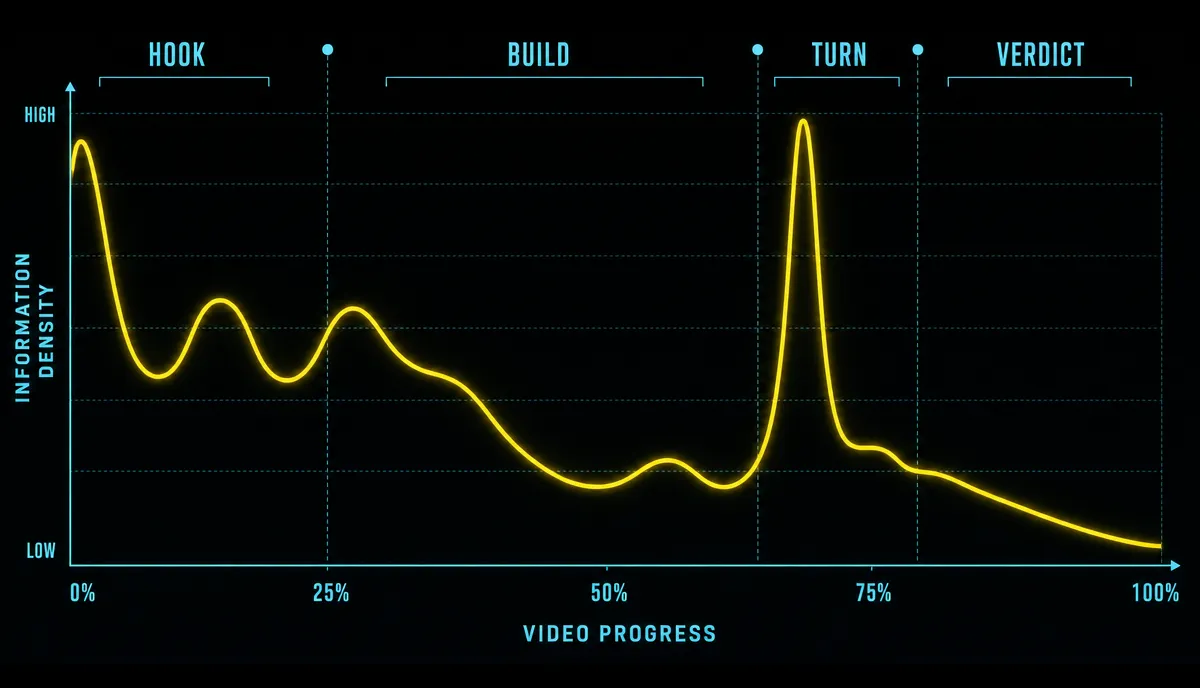
English narration runs at roughly 140–160 words per minute, so a 3-minute recap comes to about 420–480 words. If you're over, cut content — never speed up the read. Once narration accelerates, viewers and captions both fall behind.
Two concrete habits:
- Split long sentences. If a sentence leaves you out of breath, break it in two — wherever the narration stumbles, the listener stumbles with it.
- Plant a small jolt every 30–40 seconds: a fresh question, a reversal, or a one-line take. Whichever section can't sustain that density is the section to cut.
An AI-Drafting Workflow
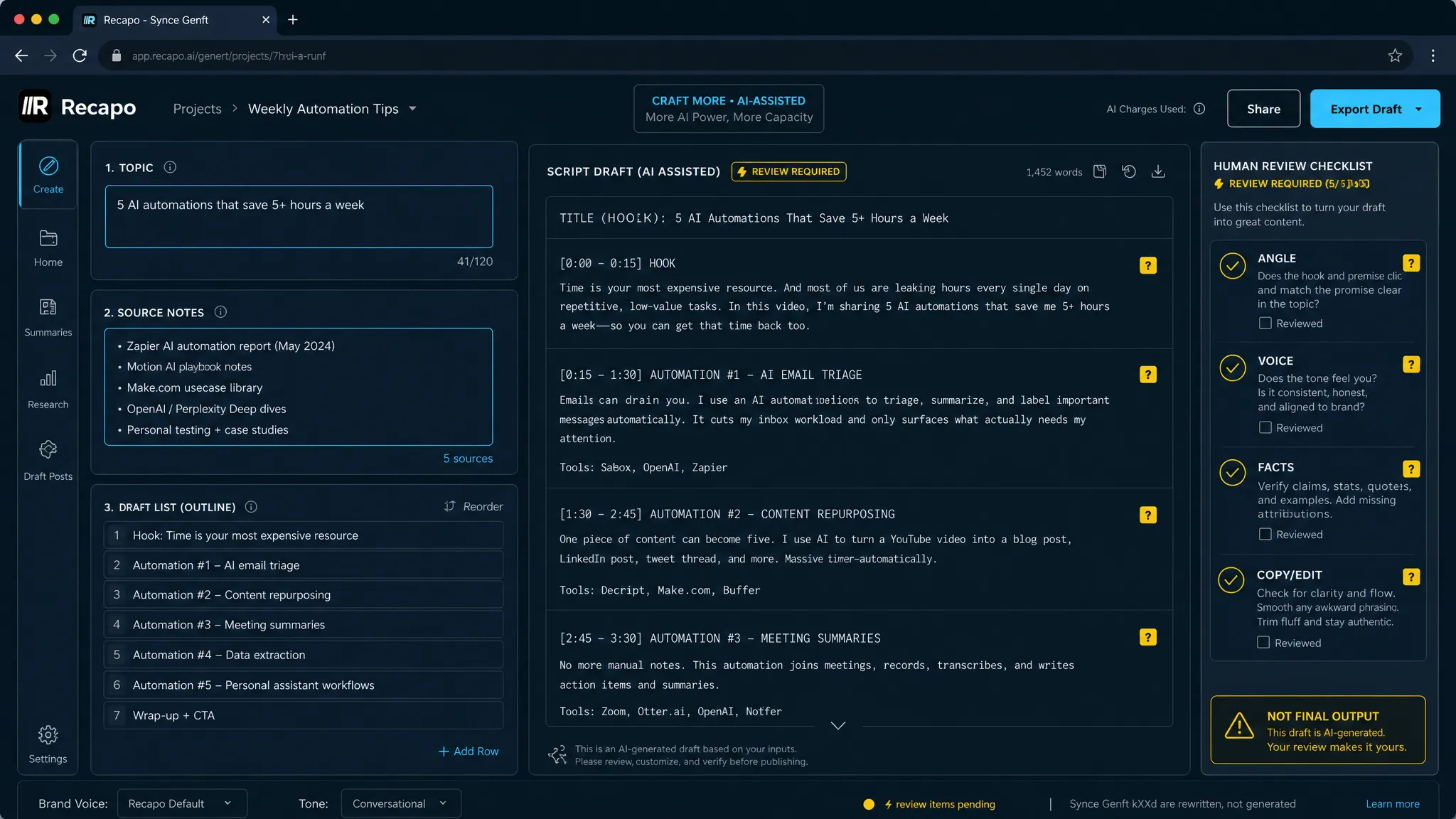
Division of labor: AI does the grunt work; you make the judgment calls.
- Run the source film through a plot summary tool first to produce a factual base draft — characters, beats, cause and effect — so you never misremember the plot. If the source is your own long-form footage, a video summarizer surfaces the throughline the same way.
- Hand the three-act skeleton and the beat list to AI and have it draft the narration section by section — it's faster than you here, and the quality holds up.
- Rewrite the opening and the ending yourself, always. For the opening, draft several options and rework them into your own voice; the closing take is something AI cannot give you — it will only summarize, safely and blandly.
An honest note: publish raw AI drafts as-is and every script fills up with lines like "But then, he discovers a shocking secret" — interchangeable with everyone else's. And YouTube's inauthentic content policy, in effect since July 2025, explicitly disqualifies mass-produced, purely AI-generated content from monetization. Choosing the topic, forming the take, rewriting by hand — these aren't optional extras; they're the baseline.
Counter-Example: Two Ways to Write the Same Opening
The play-by-play version (bad): "Today I want to tell you about a suspense film. The story takes place in a small town. The main character is a police officer, and one day he receives an emergency call…" The first twenty words carry zero new information; viewers swipe away within three seconds.
The hook version (rewritten): "The caller reported his own death. When the officer arrived, the man who'd made the call was sitting at the front door, waiting for him." Same plot — but the most abnormal fact hits the viewer first, and the backstory gets filled in later.
The difference between the two isn't writing talent; it's information order. Moving the strangest fact to the front of the sentence is one of the cheapest, fastest-paying edits you can make.
For everything that comes after the script — voiceover, captions, and the final cut — see how to make a movie recap video; for how the whole toolchain fits together, see AI video editing explained.
FAQ
Does a recap script need to be written word for word?
Yes — write the full script. Narration is far more demanding on rhythm than it looks; record from an outline and you'll stall and circle the moment the mic goes on. A verbatim script also doubles as your caption base, which saves real time on transcription cleanup later.
Won't the three-act structure make every video feel the same?
A shared skeleton doesn't mean shared content. Your distinctiveness comes from the hook and the take, not the structure. What actually makes videos interchangeable is publishing raw AI drafts — not the fact that everyone uses three acts.
Can a recap script spoil the ending?
Depends on the hook type. The ending-first hook literally runs on "spoiling" — viewers stay to see how the story gets there. Just don't dump every twist in the middle section; keep one or two knots tied until the very end.
What should I know about copyright for recap footage?
Not legal advice. The film footage used in recaps is copyrighted material; YouTube's Content ID automatically matches source films, and a match can lead to the rights holder claiming the revenue or blocking the video. On the script side, the practical lever is raising the share of your own analysis and viewpoint; for footage-use rules, defer to the platform's official documentation.
Writing the script is only the upstream half of the recap pipeline. Recapo is a browser-based AI video editing workspace: upload your source footage (MP4, MOV and other common formats, up to 6GB of material per task), then run plot summary, recap script, transcribed captions and AI voiceover on the same page. Create an account and run this playbook on the film you're working on right now.