7 OpusClip Alternatives for Auto-Clipping (2026)
Seven OpusClip alternatives compared honestly: clip accuracy criteria, captions, vertical reframing, free plans and export quality — plus how to test them.
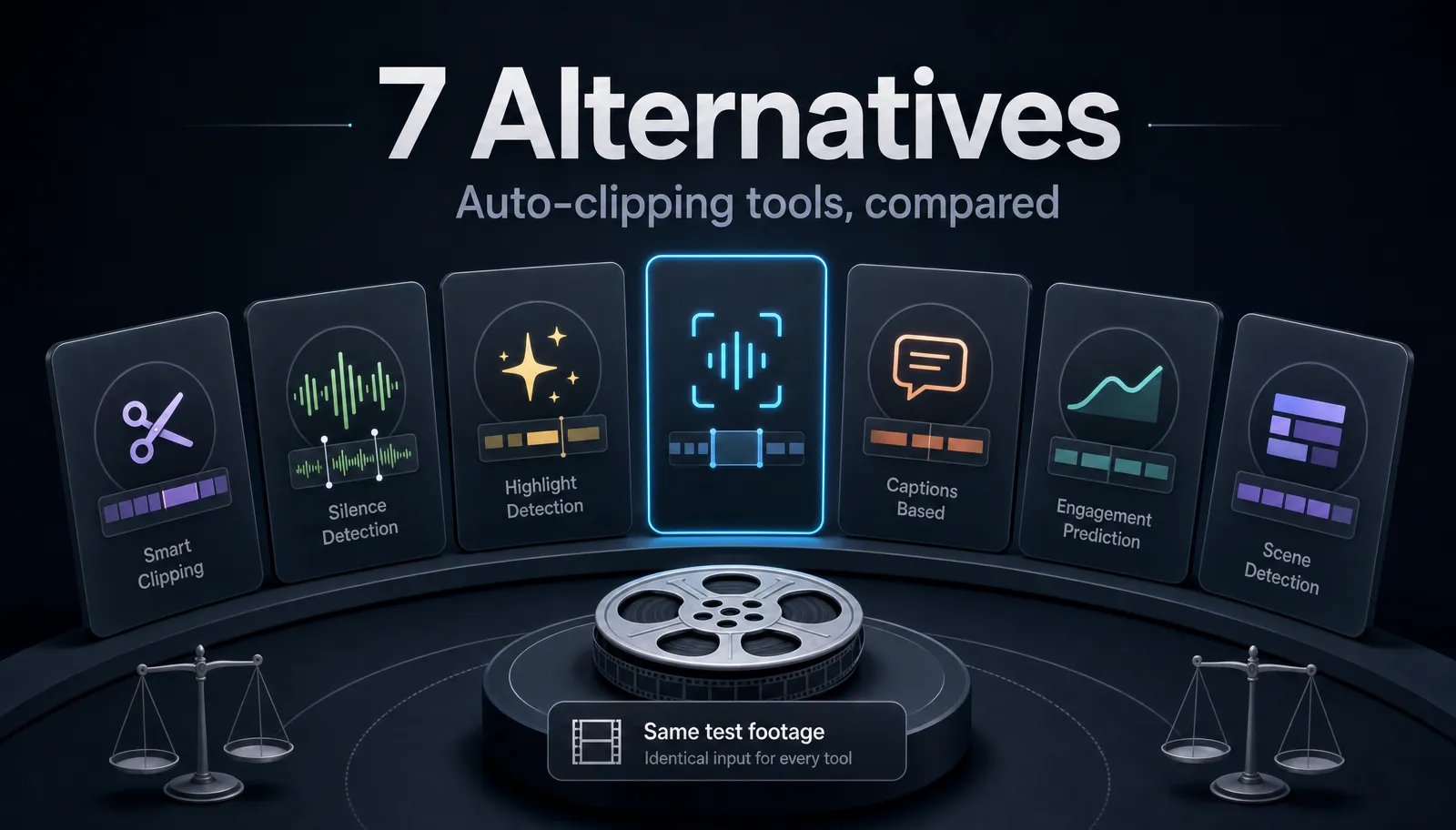
If OpusClip's pricing, quotas, or single-purpose workflow no longer fit the way you publish, you have solid alternatives. This guide compares seven of them — Vizard, Klap, Quso, Choppity, Descript, Veed, and Recapo — against the five criteria that actually change your output, and gives you a one-video method to test any of them yourself. The right pick depends on your content type, not on anyone's feature page.
Should you switch at all?
Honest starting point: OpusClip is a strong, dedicated auto-clipping tool. The whole product is built around one job — finding short-form moments in long videos — and its virality-scoring approach to ranking candidate clips is a genuine strength. If it fits your volume and budget, staying with it is a legitimate choice.
Creators typically start shopping for three reasons:
If one of those is you, read on.
The five criteria that decide it
Feature lists won't settle this. These five things will.
1. Clip-selection accuracy on your content type
Every tool here picks segments from a transcript, then ranks them. That works differently on a two-person podcast than on a commentary track or a four-hour livestream VOD. A tool that nails interviews can whiff on gameplay. The only metric that matters is your keeper rate: out of ten proposed clips, how many would you actually publish?
2. Caption quality and languages
Captions get burned into most shorts you post to TikTok, YouTube Shorts, or Instagram Reels, so transcription errors become on-screen errors. Judge accuracy on your accent and vocabulary, styling control, and coverage of every language you publish in — support varies widely between tools and changes often .
3. Vertical reframing quality
Converting 16:9 to 9:16 is where automation visibly succeeds or fails. Does the tool track the active speaker, handle two people on screen, and avoid slicing through faces or on-screen text? You can only judge this by looking at real output.
4. Free plan usefulness
Most tools here offer a free tier or trial, but upload minutes, watermarks, and export caps differ — and change frequently . Treat free tiers as testing budget, not production capacity.
5. Export quality and limits
Resolution caps, monthly export quotas, and watermark rules on paid tiers . Boring details, until a 720p ceiling or a spent quota blocks a scheduled post.
Test them yourself: the one-video method
No review — this one included — can tell you your keeper rate. Run this instead:
- Pick one representative 20-minute video from your channel. A typical one, not your best.
- Run the same file through each candidate's free tier.
- Record three numbers per tool: keeper clips out of total proposed, caption corrections per keeper, and minutes from upload to a publishable vertical export.
- Cut any tool with a weak keeper rate immediately. Selection accuracy doesn't improve on a paid plan; caption styling does.
The whole exercise takes an afternoon and produces better data than any comparison article. If you're still designing the pipeline around the tool, the guide on how to make YouTube Shorts from long videos covers those steps. 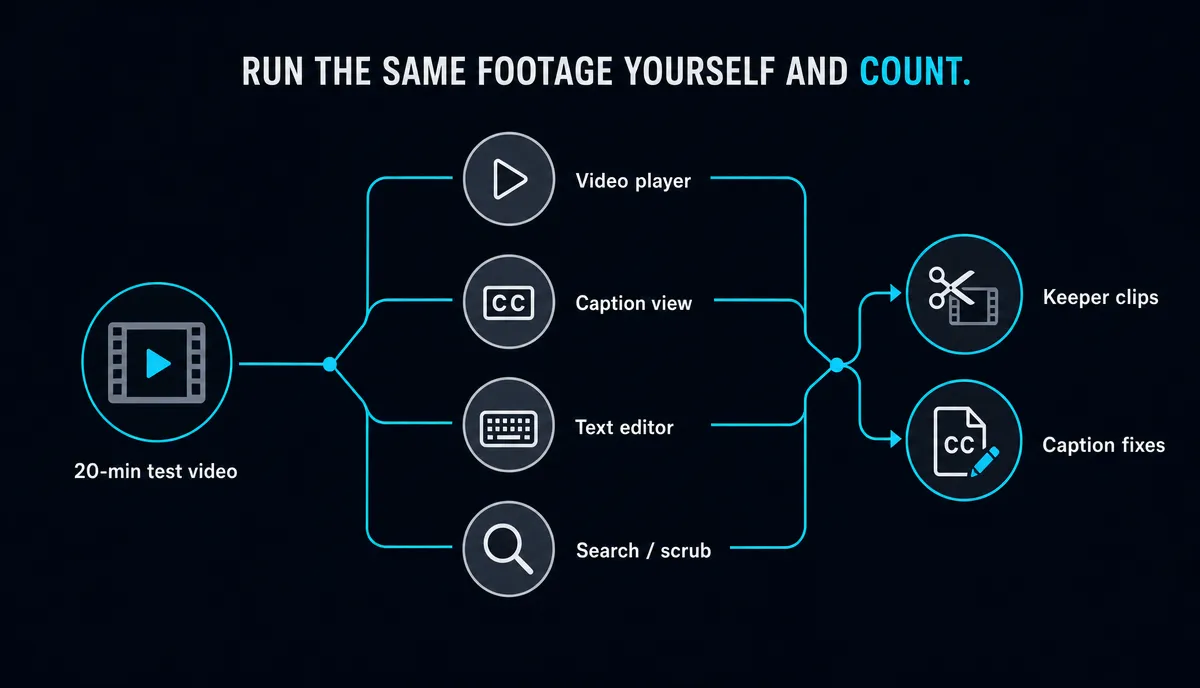
The seven alternatives
1. Vizard
Vizard is a dedicated auto-clipping tool oriented toward talk-heavy content — podcasts, interviews, webinars — with captions and social-ready exports built in . A free tier exists, with monthly limits .
Best for: podcast and interview publishers who want a focused, dedicated clipper.
2. Klap
Klap is a dedicated clipper aimed squarely at turning long YouTube videos into Shorts, TikToks, and Reels, with a paste-a-link workflow that keeps setup near zero .
Best for: YouTube-first creators who want the shortest path from link to vertical clips.
3. Quso
Quso (formerly vidyo.ai ) positions itself wider than pure clipping: clips, captions, and social scheduling in one product .
Best for: solo creators who want clipping and publishing under one roof.
4. Choppity
Choppity is a clipping tool with a text-first angle: you refine clips by editing the transcript rather than scrubbing a timeline . It's less widely known than the others here, so lean harder on your own test before committing.
Best for: creators who think in transcripts and want fast, text-driven trims.
5. Descript
Descript is an editor first — a full audio and video editing suite built around text-based editing, with clip generation as one feature inside the larger product . More control than any one-click clipper, and more learning curve.
Best for: podcasters who already edit every episode and want clips from the same project.
6. Veed
Veed is a browser-based general video editor — captions, templates, recording, and a broad toolkit — with clipping capabilities inside it . A reasonable pick when clipping is a feature you need rather than the whole job.
Best for: teams that want one general-purpose online editor for many small video tasks.
7. Recapo
Disclosure: Recapo is our product. Weigh this section accordingly, and hold it to the same one-video test as everything above.
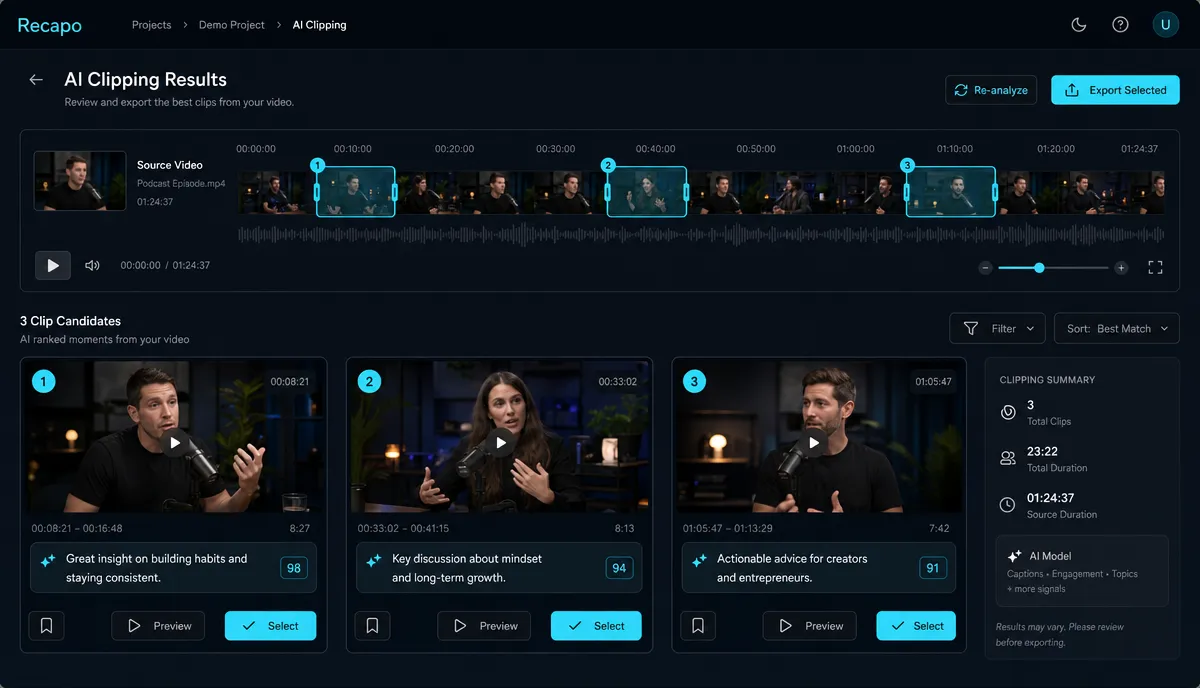
Recapo is not a dedicated clipping specialist. It's a browser-based AI video workspace where clipping sits alongside the rest of a short-form pipeline: transcription and subtitles, summaries and scripts, AI voiceover, vertical resizing, covers, and export. You upload a long video — MP4, MOV, and similar formats, up to 6GB per task — and the AI clip generator proposes candidate segments with subtitles for you to curate, reframe, and export. The same workspace covers the broader long-video-to-short conversion workflow when you're working through a backlog.
The honest trade-off: a specialist may be more polished at ranking moments. Recapo's case is fewer tools in the chain when your output includes scripts, voiceover, or recap-style videos — not just cut-downs. For a feature-by-feature look, see the Recapo vs OpusClip comparison. Current plans are listed on the pricing page.
Best for: creators whose pipeline includes scripting, voiceover, or multi-format output beyond clips.
Dedicated clipper, integrated workspace, or editor?
A short decision tree beats another feature grid:
Unsure what "AI editing" even covers beyond clipping? AI video editing explained breaks the categories down. 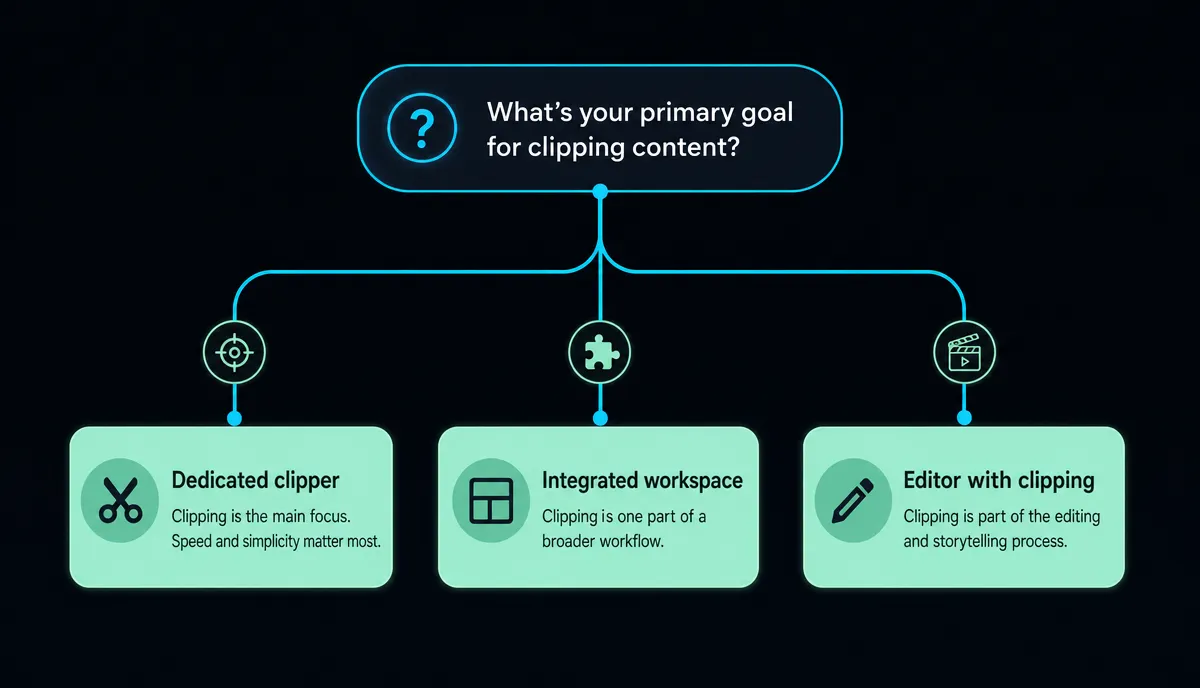
FAQ
Is OpusClip worth replacing at all?
Often, no. It's a strong dedicated clipper; if the pricing and workflow fit, switching buys you a learning curve and little else. Switch when your pipeline outgrows single-purpose clipping, or when the plan shape stops matching your volume.
What is the best affordable OpusClip alternative?
Do not choose an OpusClip alternative from a static price alone. Free allowances, watermarks, minute caps, and export limits change frequently. Estimate your real monthly source minutes and exports, shortlist tools whose billing unit fits that volume, and use each free tier as a test budget. The lowest headline price is not affordable if keeper rate is poor. Learn more
Can one tool cover TikTok, YouTube Shorts, and Instagram Reels?
Yes. All three take 9:16 vertical video, so one clean export usually serves all of them. Platform differences — length caps, caption conventions, covers — are publish-time decisions, not clipping-tool decisions.
Do these tools work for non-English content?
All claim some level of multilingual support; depth varies between transcription, caption styling, and UI . Testing with your actual language and accent settles it faster than any spec sheet.
What if my source videos are very long or large?
Long VODs hit per-file limits first, so check upload caps before subscribing . For reference, Recapo accepts files up to 6GB per task.
Run the test with Recapo as one of your candidates: create an account, upload one long video, and count how many of the proposed clips you'd genuinely publish. If clipping plus subtitles, scripts, and voiceover in a single browser workspace matches how you work, one afternoon will show it.
Which OpusClip alternative is best for podcasts?
For podcast-only clipping, start by testing dedicated tools such as OpusClip and Vizard on the same episode. Choose Recapo when podcast repurposing also includes summaries, scripts, voiceover, covers, or several output formats. Measure keeper rate, caption corrections, and review time; the best choice depends more on your format than on a generic ranking. Learn more
Which OpusClip alternative is best for webinars and multi-speaker videos?
For webinars and multi-speaker recordings, shortlist tools that handle transcript-based selection and provide a fast review screen, such as OpusClip, Vizard, or Descript. Include Recapo when the workflow also needs summaries, scripts, or voiceover. Test crosstalk, speaker changes, captions, and vertical framing on one real webinar before subscribing. Learn more