AI Song or Instrumental: Choose for the Listening Task
Choose an AI song or instrumental by the listening task, with three fictional production scenarios, language checks, and a practical audition decision log.
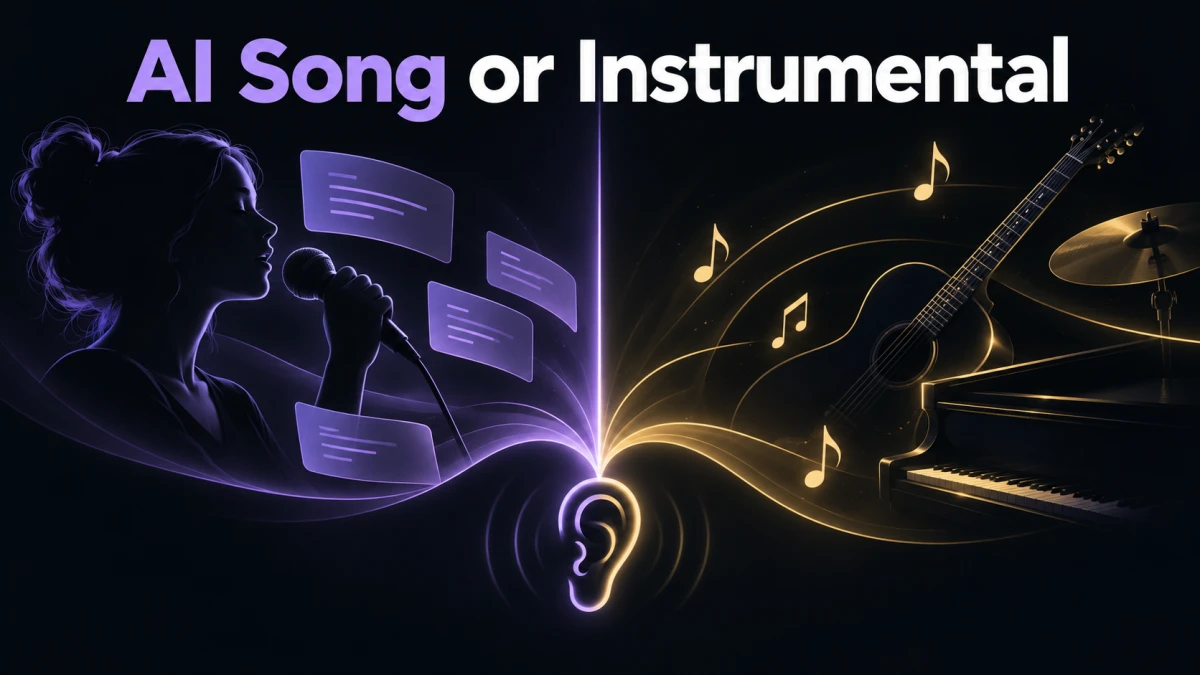
A vocal song can give a project a memorable identity, but it also introduces words, a performer, and a point of view. An instrumental removes the lyrics, not necessarily the distraction. A busy melody or dramatic instrumental climax can compete with the message just as effectively as a singer.
The useful AI song vs instrumental decision starts with the listening task. Choose a vocal direction when the song itself carries an intended message or occupies a clear foreground moment. Prefer an instrumental direction when speech, repeated interaction, or flexible editing needs most of the audience's attention. Then test the actual candidate in context; neither category is universally better.
This guide uses three original fictional production scenarios. Their briefs and evaluation plans are constructed examples, not results from generated tracks or blind listening tests.
Compare what each choice adds to the project
A vocal song contributes lyrical meaning, pronunciation, phrasing, and a vocal identity. Those can be assets when the music is the main event. They also create more things to review: whether the words fit the message, whether the language suits the audience, whether the delivery remains clear, and whether the vocal direction is appropriate.
An instrumental contributes rhythm, harmony, texture, and melody without a lyrical message. That can leave more freedom for narration and language versions. However, a strong lead instrument can still behave like a foreground voice. Treat “instrumental” as a starting category, not a guarantee of unobtrusive background music.
Wordless vocals sit between the categories for some production decisions. They may not carry explicit lyrics, yet they can suggest a human presence and attract attention. If the brief requires no vocal texture, say so rather than relying on “no words.” Review the delivered audio for that distinction.
The choice can also vary within one project. A short sung identifier might precede a spoken podcast introduction, followed by an instrumental bed or silence. That is a designed sequence, not a reason to play the full vocal song beneath every spoken section.
Use a task-first comparison table
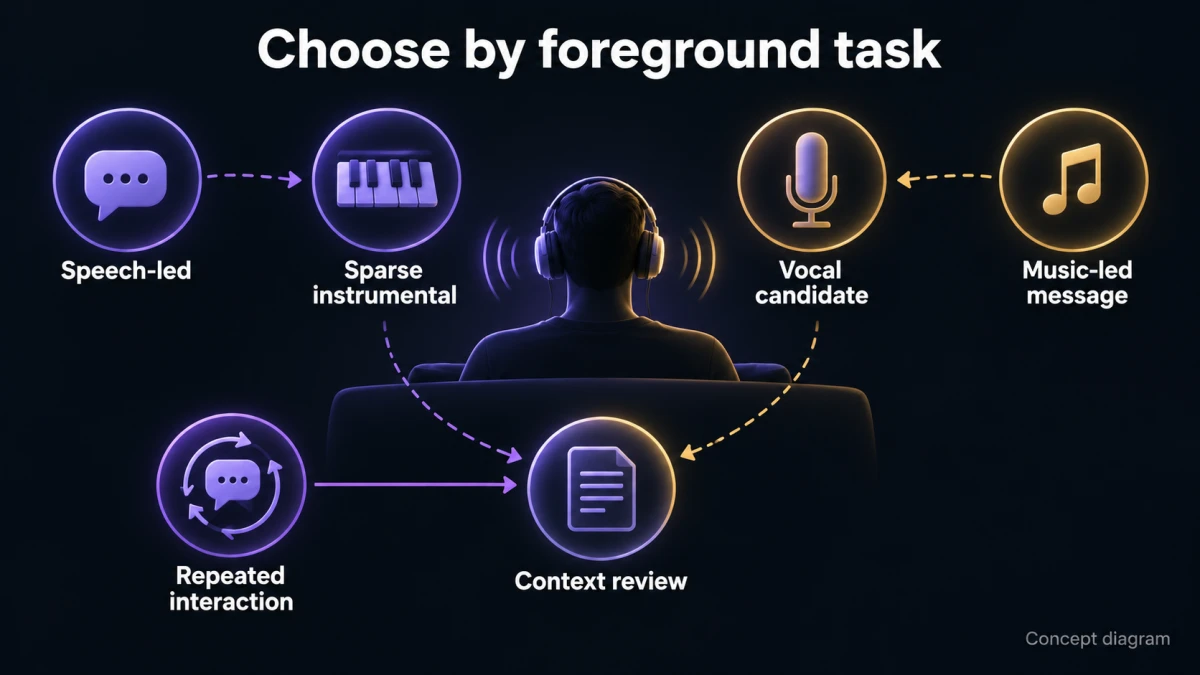
Concept diagram; not a product-interface screenshot.
| Production need | Vocal direction can help when | Instrumental direction can help when | Review the actual output for |
|---|---|---|---|
| Narrated video | The song has a separate foreground section or intentional lyrical role | Speech carries the essential message | Competition with key words, sudden leads, and emotional mismatch |
| Podcast opening | A concise sung phrase is part of the intended identity | The host needs a flexible entrance and repeatable intro | Collision between the last lyric and the first spoken sentence |
| Repeating game background | Vocal repetition is an intentional feature of the experience | Long or variable play sessions need a less verbally specific bed | Fatigue, obvious endings, loop seams, and interaction cues |
| Multilingual project | Lyrics are deliberately reviewed for each audience | One nonverbal arrangement should support several language tracks | Unwanted vocals and culturally inappropriate associations |
| Music-led film or montage | Lyrics and performance are part of the story | Images should remain open to interpretation | Whether lyrical meaning contradicts the picture |
These are decision prompts, not performance rankings. A particular instrumental may fail a spoken video while a carefully placed vocal phrase works. The question is what the chosen candidate does in the actual edit.
Scenario one: a narrated orientation video
Imagine a fictional forty-five-second orientation for the Vela print studio. A narrator explains where visitors leave bags, how they identify their booked session, and whom to ask for help. The final sentence gives the next action. The music is not intended to communicate separate information.
The initial choice record favors a sparse instrumental because the voice carries the practical message throughout. A vocal song would introduce another sequence of words to coordinate, and there is no planned silent section where those words have a clear job.
That does not mean any instrumental will do. A prominent melody could still draw attention away from the booking instructions. The brief should therefore specify a restrained supporting role, limited melodic activity under dense speech, no sung or wordless vocal lead, and a simple ending.
SCENARIO: Vela studio orientation — fictional
Foreground task: understand spoken visitor instructions.
Initial selection: sparse instrumental direction.
Reason: the video has continuous practical narration and no
separate music-led message.
What would change the choice: a redesigned opening with a short,
intentional sung identifier and a clean transition before speech.
Actual-output checks: instructions remain intelligible; no unwanted
vocals; no prominent new motif under the closing action.
Current evidence: a brief decision only; no track has been tested.
If the first candidate is distracting, do not conclude that instrumental music as a category has failed. Identify whether density, level, melody, or timing caused the problem. Revise the relevant direction or use silence for a section if that serves the video better.
Scenario two: a podcast with a short musical identity
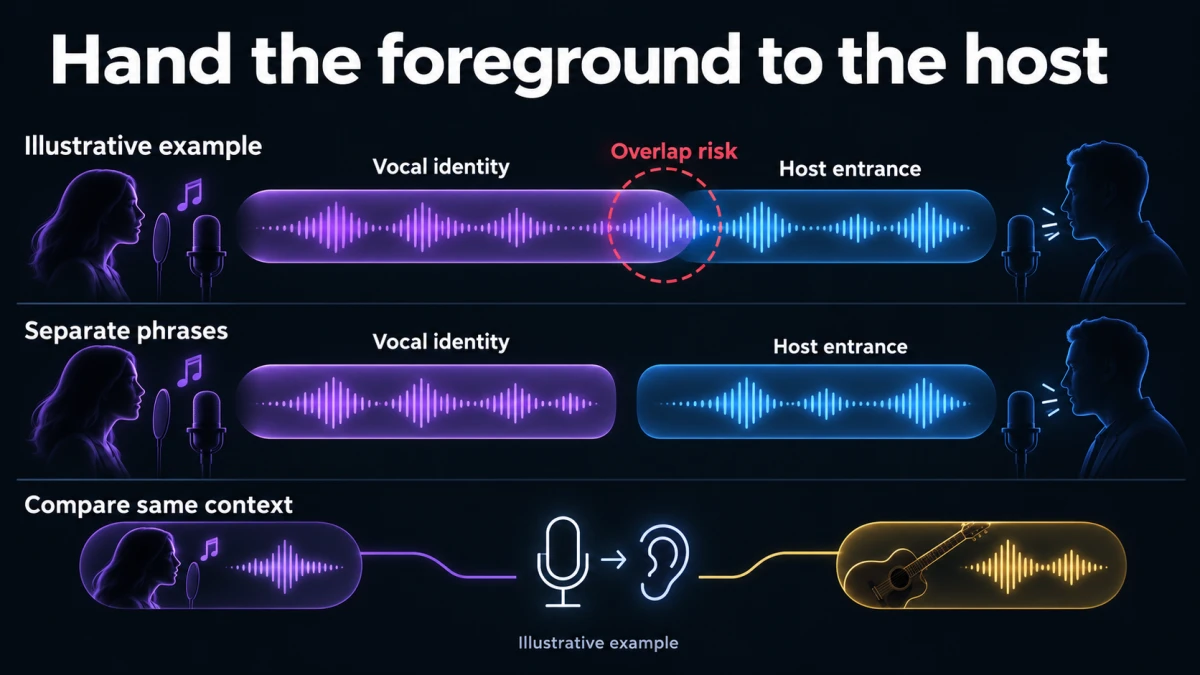
Illustrative example; not a measured product output.
Consider an invented podcast called Small Maps. Its proposed opening has a short music-only space before the host speaks. The producers want the music to carry a simple identity rather than remain unnoticed.
A vocal direction can be a reasonable candidate here, provided the phrase has a clear role and does not compete with the host. For example, an original proposed lyric might be “Small maps, new paths.” That is a constructed writing idea, not a generated performance or a claim that a model can deliver it with exact timing.
The competing instrumental direction uses a short recognizable motif without words. It may be easier to reuse under different opening sentences, while the vocal phrase could make the identity more explicit. The decision is a creative tradeoff to test, not a universal rule about memorability.
The crucial transition is the host's entrance. If the final sung word overlaps “Welcome to Small Maps,” the listener receives two versions of the title at once. Move the entrance, shorten the musical idea through an appropriate edit, or choose a candidate with a cleaner ending. Do not assume a requested duration ensures a usable handoff.
SCENARIO: Small Maps podcast opening — fictional
Foreground task: establish the show's identity, then yield to host.
Candidates: one short vocal identity phrase; one instrumental motif.
Language: reviewed English wording for the intended audience.
Required boundary: the final lyric and prominent musical gesture
finish before essential host speech begins.
Comparison: same host recording, same opening picture if any,
and a consistent playback level.
Record separately: identity preference and speech-comprehension issues.
Current evidence: proposed audition design, not a listening result.
If the vocal option is selected later, review pronunciation, unintended extra words, and how the phrase sounds after repeated episodes. A lyric that works once may become intrusive when heard frequently. That is something to observe with real playback, not to assume from the written phrase alone.
Scenario three: a game hub with uncertain dwell time
The fictional game Mosswalk has a quiet hub where players may stay briefly or browse for several minutes. Interface sounds and occasional character dialogue need to remain audible. The music must tolerate repetition and should not repeatedly announce a dramatic ending.
An instrumental direction is a practical starting hypothesis because it avoids repeating a lyrical statement at every cycle. But the real deciding factors are structural: whether the section loops coherently, whether its density leaves room for interface cues, and whether repeated phrases become tiring during the expected interaction.
A vocal track could still be intentional in a specific location or event. If the song belongs to an in-world performer, its foreground presence may serve the scene. That is a different brief from a general hub bed. Do not generalize one decision to every part of the game.
SCENARIO: Mosswalk hub — fictional
Foreground task: navigation, occasional dialogue, and interface cues.
Initial selection: restrained instrumental direction with a
loop-friendly passage, not a promise of a finished seamless loop.
Structural need: compatible entry and repeat points; no repeated
lyrical message or large ending gesture in the intended loop region.
Integration: test in the actual game audio system or a representative
mock-up; generation alone does not implement adaptive playback.
Current evidence: no generated track or in-game test exists yet.
If the track works once but not repeatedly, changing from vocal to instrumental may not be enough. A strongly cadential melody or abrupt texture reset can still announce every cycle. The loop edit and implementation need their own review in an external audio or game workflow that supports them.
Language is part of the music decision
For vocal material, review what the lyrics say and what the audience is likely to understand. A language unfamiliar to the editor is not automatically neutral texture. It still contains meaning that may need competent review for the intended market and context.
If a project needs several language versions, decide whether lyrics will be adapted, replaced, or removed. Translation can change phrase length, stress, and the fit with the music. A successful English demo is not evidence that another language version will preserve the same structure without adjustment.
For instrumental material, check for unintended vocal fragments or speech-like elements. Do not label a candidate “language-neutral” before listening to the actual output. Also distinguish the absence of lyrics from the absence of cultural associations; a musical style may still carry meaning that needs a thoughtful local review.
Use your own descriptive brief rather than requesting a recognizable person's voice or a specific artist imitation. If you supply lyrics, voice references, or other material, confirm the rights and permissions for that input and the intended processing. Do not turn a creative choice into an unexamined identity or licensing assumption.
Review the planned type before paying for generation
Recapo's AI music generator page describes separate vocal-song and instrumental directions and a workflow that creates a production card before paid submission. The card can organize the theme, structure, instrumentation, lyrics, and model suggestions. Review those details before confirming a task; a card is a plan, not evidence of how the audio will sound.
Check that the proposed type matches the decision record. An instrumental request should not quietly acquire a chorus. A vocal identity phrase should not become a long song structure if the project needs a short handoff. Verify the available model and confirmed cost without assuming fixed rates or unlimited free generation.
Once submitted, use the existing job's status and saved record to understand what happened. If completion, download availability, or charging is unclear, investigate that state before another submission. Do not use blind retries as a method for comparing directions.
The tool's music workflow does not by itself create a finished video, implement game playback, or guarantee a seamless loop. Use appropriate external editing or integration tools for those tasks and record the actual operations performed.
Design an audition that separates preference from function
Keep the surrounding material constant: the same narration, picture, host opening, or interaction mock-up. Compare at a sensible consistent level. Ask task questions before preference questions so “I like this genre” does not replace “I understood the instruction.”
For the studio video, ask what visitors should do next. For the podcast, ask where the musical identity ends and the host begins. For the game hub, test the intended repeated use and the audibility of important cues. Record actual observations when available; do not fill the sheet with expected successes.
If you want a blind comparison, hide identifying filenames and labels where practical and record any clues that remain. Do not describe a test as blind if the reviewer knows which option is supposed to win. A small local audition can support a production decision without pretending to establish a general audience effect.
Suppose, in a hypothetical podcast review, the listener prefers the vocal phrase but misses the host's first sentence. First check whether unequal playback levels or an overlapping entrance caused the problem. Correct those controllable differences and replay both candidates in the same context. If the opening remains unclear, preference alone should not override the essential listening task. You could reserve the vocal phrase for a standalone identifier before speech, redesign the transition, or choose the instrumental candidate for this use. Record the reason separately from the listener's genre preference. This is a proposed recovery branch, not an observation from a test performed for this article.
The related video audio quality checklist is useful for the broader delivery pass. The category choice should still be justified by the particular task, not by a blanket claim that songs are more engaging or instrumentals are always clearer.
A selection record you can reuse
PROJECT AND LISTENING TASK
Audience, language, and context:
Foreground information:
Music-only sections:
Repetition or variable-duration needs:

CHOICE
Vocal song / instrumental / designed combination / silence:
Why this choice serves the task:
What would make the alternative preferable:
Lyrics or vocal identity requirements:
Arrangement density and ending requirements:

ACTUAL AUDITION
Candidate and delivered-file identifiers:
Constant narration/picture/test context:
Comprehension observations:
Transition or loop observations:
Subjective preference, recorded separately:
Selected version and specific reason:
Unresolved issues:
Before release, check the selected track's actual words or absence of words, the intended foreground balance, its entry and exit, and its behavior under repetition where relevant. Verify the final exported or integrated version rather than relying on a music-only preview.
Keep creative suitability separate from use approval. Check applicable product and provider terms, input permissions, and the intended commercial or public context. Do not assume that choosing instrumental rather than vocal removes all rights questions, or that payment guarantees exclusivity or a blanket license.
The first decision is therefore not “Which kind of AI music is best?” It is “What must the audience listen to here?” Once that is clear, the choice between song and instrumental becomes a testable production decision rather than a genre preference presented as a rule.