Faceless Video Ideas With Revenue Paths to Test
Compare faceless video formats by revenue path, production effort, source rights, and repeatability, then test one idea with a small publishing batch.
By the Recapo.ai Editorial Team · Fact-checked July 10, 2026
No faceless-video category guarantees revenue. "Faceless" describes presentation, while income depends on platform eligibility, audience fit, contracts, conversion, product margin, source rights, production costs, taxes, and the specific channel's results.
This guide preserves the money-focused search intent but replaces niche rankings with a decision framework: identify possible revenue paths, document the sources and workload, model unit economics, and run a small publishing test. It is educational information, not financial or legal advice and not an earnings promise.
Information note: This is general information, not legal advice. Copyright outcomes depend on the facts and jurisdiction; primary sources were checked on July 10, 2026.
Official source map: For comparing faceless video revenue paths, the eligibility, monetization, and RPM points below are tied to YPP eligibility guidance, channel monetization policies, YouTube's RPM definition.
Scope of this guide: This page compares candidate faceless formats and the evidence each revenue path requires; it is not an earnings forecast. For operating economics after choosing a format, use how to make money with a faceless YouTube channel.
How to evaluate whether a faceless format can earn
Start with revenue that can be documented, not a generic niche RPM. For YouTube revenue, use the channel's own Analytics after eligibility. For sponsors, affiliates, memberships, products, or services, use actual agreements, qualified conversions, fees, refunds, support costs, and taxes.
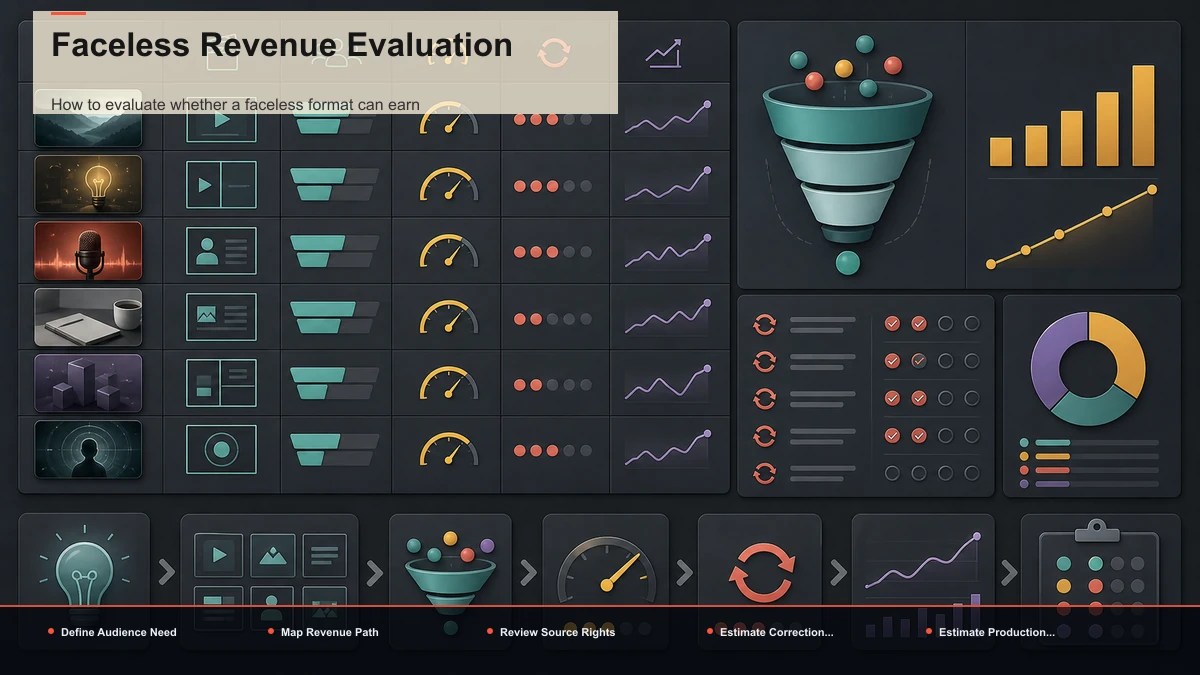
Score a candidate format on evidence rather than expected earnings:
- Audience need: what specific problem or interest does the format serve, and what evidence supports it?
- Revenue path: which current program, signed agreement, or product could generate revenue?
- Source rights: can every visual, voice, music track, quotation, and clip be documented?
- Research and correction burden: what expertise, primary sources, or review does the topic require?
- Production cost: how many hours and direct costs does one approved video require?
- Repeatability: can several materially different videos pass the same quality and policy review?
Model contribution by scenario: documented revenue minus production, software, contractors, rights, sales, fulfillment, refunds, and other direct costs. Before reliable data exists, label every figure as an assumption.
Compare revenue models without a niche RPM ranking
Some formats may support higher-value products, sponsors, or affiliate offers; others may be simpler to produce. That distinction does not establish a universal RPM order or prove that volume compensates for a lower rate. Audience geography, advertiser demand, format, season, eligibility, claims, conversion, and costs all vary by channel.
Use a low, base, and high scenario for each revenue path, then compare it with measured cost per approved video. A category with an attractive theoretical rate can still be a poor fit when sourcing, accuracy, policy, or production costs are high.
Faceless video formats and the evidence each needs
| Format | Possible revenue path to validate | Main production or source review | Evidence to collect |
|---|---|---|---|
| Finance or money education | YouTube revenue, qualified sponsors, products | Accuracy, regulated claims, credentials, disclosure | Analytics, signed agreements, legal/compliance review |
| Software and AI tutorials | Affiliates, sponsors, services, products | Current feature facts, demo rights, update burden | Qualified conversions, contracts, correction log |
| Business case studies | Sponsors, services, memberships | Primary sources, financial claims, defamation and privacy | Citations, contracts, costs, audience response |
| Book commentary | Affiliates, memberships, products | Edition rights, quotations, cover art, audiobook material | Source sheet, qualified sales, costs |
| History or documentary explainers | YouTube revenue, sponsors, memberships | Archival status, attribution, factual review | Item-level rights records and Analytics |
| Original stories or motivation | Products, memberships, sponsors | Script, voice, music, and visual licenses | Contributor terms, sales, retention, costs |
| Film, TV, anime, or sports commentary | YouTube revenue, sponsors, memberships | Third-party audiovisual rights, Content ID, legal review | Claim status, source sheet, Analytics |
| Travel, scenery, or cooking | Sponsors, affiliates, products | Original or licensed footage, location and contributor rights | Licenses, conversion, production cost |
| Podcast or interview clips | Sponsors, services, audience growth | Guest releases, music, excerpt context, substantive variation | Permissions, keeper yield, downstream traffic |
This table maps questions; it does not rank income, RPM, audience size, or legal risk.
Finance, software, and business explainers
These formats can connect naturally to services, software affiliates, sponsors, or products, but availability and profitability must be demonstrated. They also carry a higher fact-checking burden: financial statements, product features, prices, and regulations can be wrong or outdated.
Use primary sources, show the basis for demonstrations, disclose commercial relationships, distinguish education from individualized advice, and keep a correction process. Build the model from qualified conversions, signed agreements, actual product contribution, and channel Analytics rather than assumed advertiser demand.
Book, history, and documentary formats
These subjects can remain useful over time, but "evergreen" is not automatic. Facts, scholarship, public-domain status, translations, editions, archive terms, and audience interest all require review. A voiceover or summary tool does not create rights to text, scans, photographs, footage, or audio.
Document each source at item level, distinguish quotation from analysis, and track correction and clearance time as part of production cost. Validate revenue with actual channel and program records.
Recaps, original stories, scenery, cooking, and clips
These formats have different inputs and cannot be grouped under one earnings assumption. Recaps may depend on protected audiovisual works; original stories need contributor, voice, music, and image terms; scenery and cooking require footage and location or participant rights; podcast clips need releases and contextual editing.
Do not assume low effort, unlimited batchability, or that more posts compensate for weak demand. Measure approved output, rights and review time, audience response, and revenue evidence for each format separately.
A production test for one faceless format
- Choose a documented source. Record ownership, permission, contributor terms, music, and restrictions.
- Create a small batch. Produce several materially different candidates, not a promised number of clips.
- Review every draft. Check facts, originality, rights, captions, disclosure, framing, and platform policy.
- Record unit cost. Include research, scripting, voice, editing, corrections, software, contractors, and clearance.
- Publish comparably. Use a consistent observation window and record audience response and actual revenue signals.
- Decide from evidence. Continue only when the source, quality, workload, and economics are repeatable.
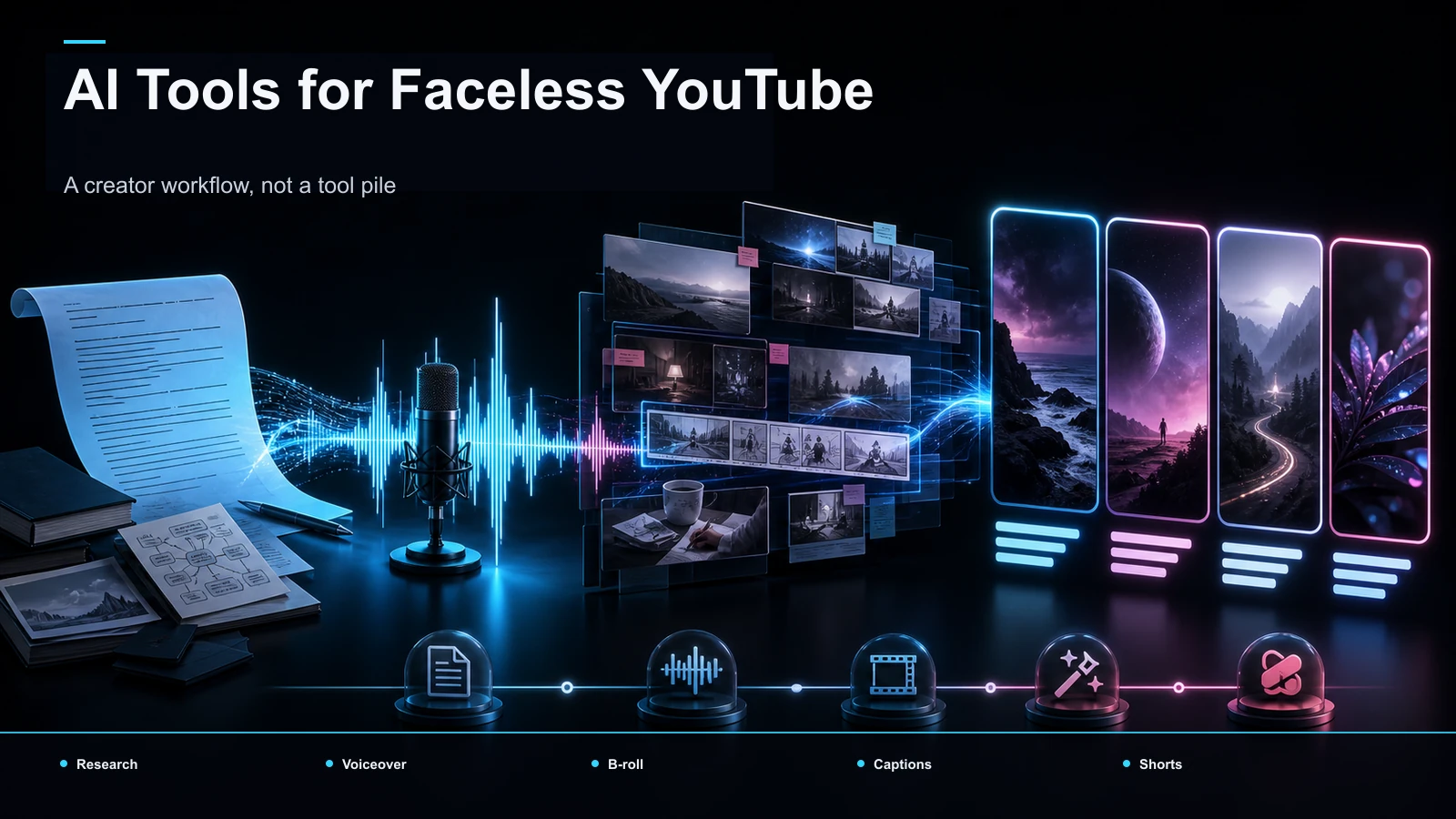
Recapo can support summaries, scripts, voiceover, clipping, captions, reframing, cover, and export in one browser workflow; processing and rendering run in the cloud. It does not supply source rights or guarantee monetization.
FAQ
Which faceless niche makes the most money? There is no reliable universal winner. Use channel Analytics, valid agreements, product margins, costs, and claim status instead of a niche RPM chart.
Are faceless channels eligible for YouTube monetization? Showing a face is not the deciding category. The channel must meet current eligibility and monetization policies, including originality and reused or inauthentic content requirements; copyright rules remain separate.
Can a channel earn without the creator's face or recorded voice? Yes as a production format, but the channel still needs rights to scripts, synthetic or recorded voices, music, images, and footage, plus any required disclosures. Revenue is not automatic.
How should I test an idea? Produce a small rights-reviewed batch, record unit cost and audience response at the same age, and count only revenue visible in a dashboard or valid agreement. Create a free Recapo account to test the production workflow; treat the result as evidence, not an earnings promise.
References and official sources