Write an AI Background Music Brief That Leaves Room for Voice
Write an AI background music brief around narration, section roles, and arrangement, with three fictional production cards and an in-context review plan.
“Warm, inspiring background music” can describe a track that works beautifully on its own and competes with every sentence in your video. The missing information is what the music must do while the audience is listening to someone speak.
A useful AI background music brief describes the video's sections, the role of the voice, the desired emotional direction, and the musical activity that should stay out of the way. Request a structure that supports the edit, review the production plan before any paid generation, and judge the resulting audio with the actual narration—not only in a music-only preview.
The brief is a set of production intentions, not a guarantee that a model will place every change at an exact time. Keep enough flexibility to revise the arrangement or edit the finished track in an appropriate audio tool.
Begin with the voice and the viewing task
Write down what viewers need to understand. A studio tour, a narrated tutorial, and a reflective interview need different kinds of support. “Make people feel excited” is less actionable than “keep the spoken instructions clear, then allow a modest lift during the silent demonstration.”
Mark the sections where speech carries essential information. Note names, numbers, unfamiliar terms, and calls to action that should not have to compete with a busy musical phrase. You do not need a technical frequency prescription to identify these moments; start with the words and their importance.
Also note the voice's character: conversational or formal, slow or quick, intimate or projected. This does not determine one correct genre, but it helps you evaluate whether a proposed arrangement leaves appropriate space. A dense lead melody can compete with a gentle speaker even when the music's overall level seems modest.
Decide whether the brief truly calls for an instrumental. If the video already contains narration, lyrics may create a second verbal message. That can be intentional, but it should be a conscious decision rather than an accidental result of requesting a song-like style. Wordless vocals can also attract attention; “no lyrics” and “no vocal textures” are different instructions.
Map the video into functions, not just seconds
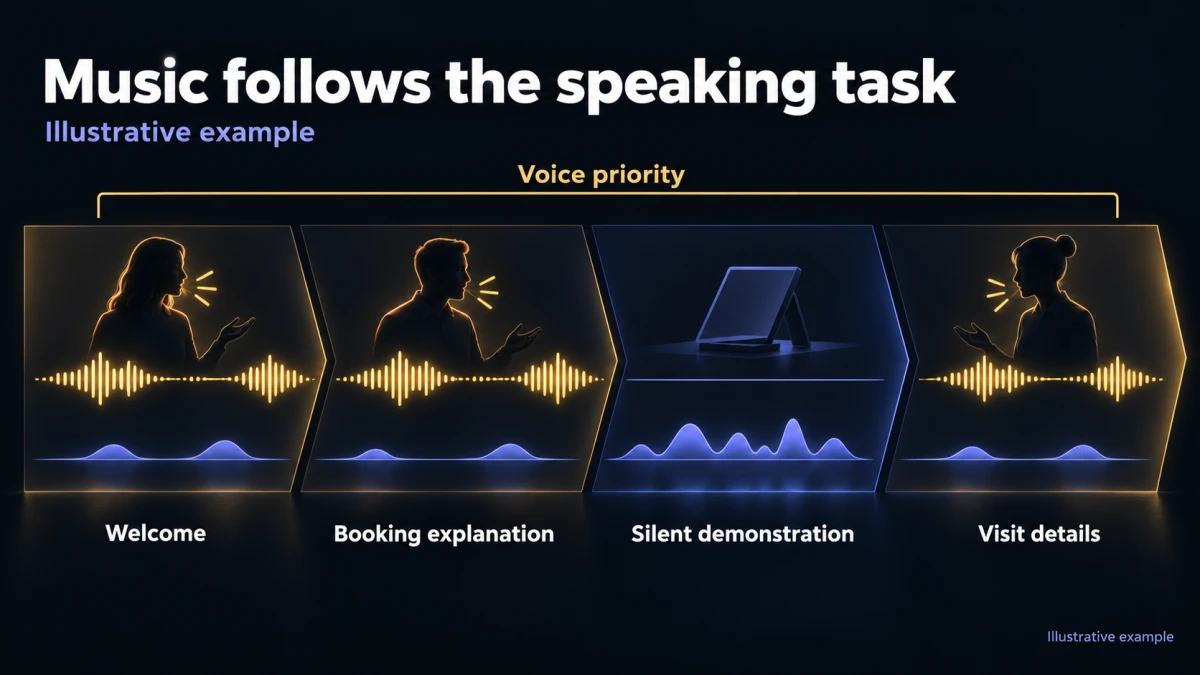
Illustrative example; not a measured product output.
Create a section map with start and end points, visual function, speech density, and the music's role. Treat the timing as a requested relationship to the edit, not a promise of sample-accurate generation.
For an original fictional example, imagine a sixty-second tour of a community print studio. The narration welcomes visitors, explains the booking process, pauses for a demonstration, and ends with visit information. No real video, generated track, or listening test is represented here.
| Proposed video section | What the viewer is doing | Voice requirement | Music role |
|---|---|---|---|
| 0–10 seconds: welcome | Identify the studio and setting | Clear opening sentence | Establish a restrained, inviting tone |
| 10–35 seconds: booking explanation | Understand how a visit is arranged | Continuous information, including a date reference | Stay sparse and avoid attention-grabbing changes |
| 35–48 seconds: silent print demonstration | Watch the process without spoken explanation | No narration in this planned section | Permit a modest increase in movement |
| 48–60 seconds: visit details | Hear the final practical information | Clear closing message | Reduce activity and end without a disruptive flourish |
The map explains why a single instruction such as “build throughout” would be unsuitable. The music may become more active in the demonstration, then needs to step back for the final information. Emotional progression and increasing loudness are not the same thing.
If the edit is not stable, use relative instructions: sparse under the booking explanation, lift during the silent demonstration, return to restraint for the closing voice. Update exact cue requests after the picture and narration are sufficiently settled.
Turn mood words into audible choices
Mood language is useful when connected to arrangement. “Warm” might suggest a rounded, unhurried accompaniment; “restrained” might mean few simultaneous parts and no prominent solo; “curious” might mean a small repeating motif rather than a dramatic crescendo.
You are not required to prescribe every instrument. Too many specific demands can create a contradictory brief. Choose the elements that determine suitability: instrumental or vocal, sparse or dense, steady or free rhythm, bright or subdued tone, and whether a lead line should remain secondary.
Write exclusions as production needs. “No dramatic risers under spoken instructions” is more useful than “do not make it bad.” “Avoid a new melodic hook during the address” ties the restraint to a viewer task. Keep exclusions focused; a long list of unrelated negatives can obscure the main direction.
Avoid asking for the exact sound or voice of a specific artist when a functional description will do. Describe instrumentation, energy, phrasing, and emotional role in your own terms. Review the rights and permissions associated with any supplied lyrics, audio references, or voices before including them in a project.
Three original production cards for the same video
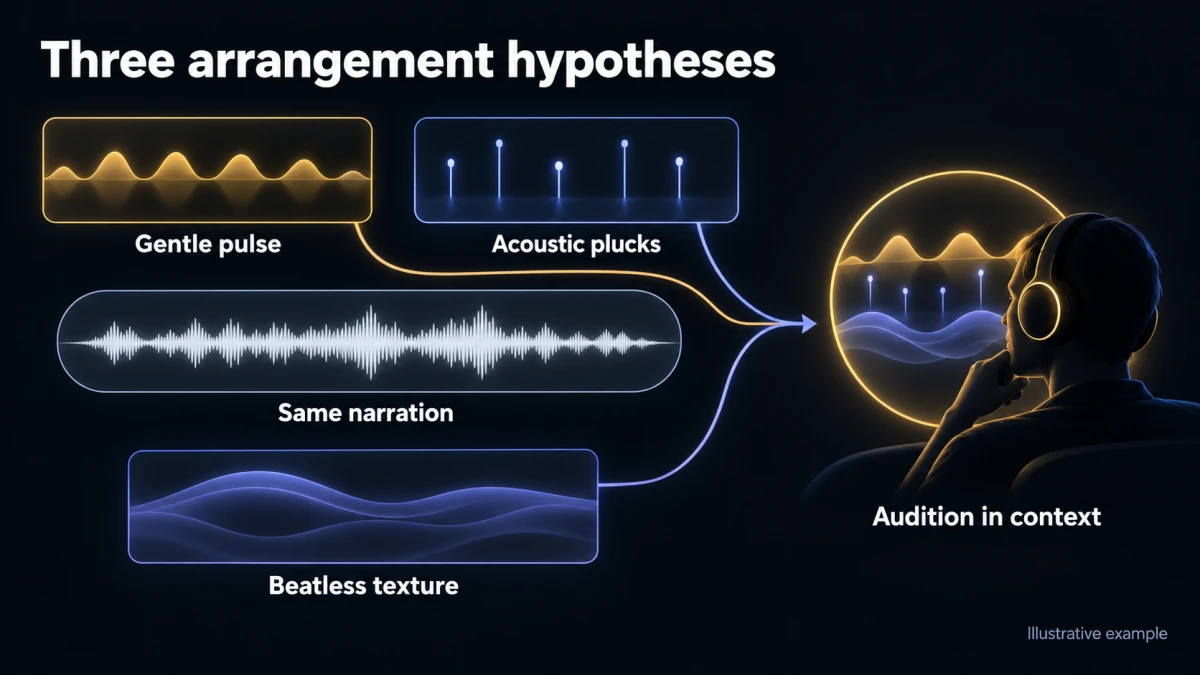
Illustrative example; not a measured product output.
These cards are alternative briefs for the fictional print-studio tour. They have not been submitted to a music model. The expected strengths and risks are hypotheses to evaluate, not listening findings.
Direction A: a restrained, gently rhythmic bed
Purpose: background for a narrated community print-studio tour.
Requested length: approximately 60 seconds, subject to actual output.
Type: instrumental; no lyrics or wordless vocal lead.
Character: welcoming, practical, quietly curious.
Arrangement: sparse rounded keyboard notes, a light repeating pulse,
and a soft supporting texture. No prominent solo melody.
Structure: establish the mood briefly; remain restrained under the
booking explanation; add a little movement during the silent print
demonstration; reduce activity for the closing visit information.
Avoid: dramatic impacts, large crescendos, busy fills, and a new hook
under the final spoken details.
Ending: a simple, controlled finish that leaves the voice intelligible.
Review priority: can every practical instruction be understood at
the intended playback level without raising the narration unnaturally?
This direction asks for movement without a strong foreground performance. The review risk is that the repeating pulse becomes too insistent or the keyboard attacks distract from consonants in the speech. If that happens, first decide whether the arrangement needs less activity; lowering the whole track may not solve an attention problem caused by its pattern.
Direction B: a lightly acoustic, human-scale accompaniment
Purpose: support the same tour with a modest handmade character.
Requested length: approximately 60 seconds.
Type: instrumental; no singing or vocal pads.
Character: calm, friendly, tactile rather than sentimental.
Arrangement: sparse acoustic plucks with a simple supporting bass
and very restrained percussion, if percussion is needed at all.
Structure: short introduction, low activity during instructions,
slightly fuller texture for the unvoiced demonstration, then a
lighter final section beneath the visit information.
Avoid: virtuosic runs, strongly accented strums, comic gestures,
and a sentimental climax that changes the tone of the narration.
Ending: uncomplicated and easy to place against the final image.
Review priority: does the acoustic texture support the studio's
practical message without becoming the feature of the video?
This card changes the material and texture, not the underlying communication task. Its risk is over-personalizing a straightforward tour or introducing plucks that repeatedly draw attention. Compare it with the same narration and picture rather than deciding from genre preference alone.
Direction C: a quiet, nearly beatless atmosphere
Purpose: leave maximum foreground space for the narrated tour.
Requested length: approximately 60 seconds.
Type: instrumental; no lyrics, humming, or vocal-like lead.
Character: spacious, neutral-warm, attentive.
Arrangement: a small number of sustained textures with slow changes;
minimal percussion and no strong rhythmic demand on the picture.
Structure: gentle opening, stable speech sections, a subtle tonal
opening during the silent demonstration, and a restrained close.
Avoid: ominous drones, large cinematic swells, sudden harmonic
turns, and long prominent tails that interfere with the ending.
Ending: compatible with a clean final voice phrase and picture hold.
Review priority: does the result remain supportive rather than
making an ordinary studio visit feel mysterious or solemn?
This direction may offer fewer rhythmic demands, but the emotional tone still needs checking. “Ambient” is not automatically unobtrusive. A strong sustained texture or unexpected change can dominate a scene even without drums or lyrics.
Review the production card before generating audio
Recapo's AI music generator page describes a workflow that turns creative input into a production card covering musical direction, structure, instrumentation, lyrics, and model suggestions. The card is reviewed before a paid task is submitted. A plan or card is not yet a generated track, and the page does not describe an automatic finished music-video workflow.
Check that the card reflects your actual use. Did an instrumental request become a vocal song? Did “restrained” become a large cinematic build? Does the proposed duration match your intention, and are the applicable model and confirmed cost clear before you choose to submit?
Correct the plan while it is still a plan. Do not knowingly generate the wrong direction merely to hear whether it might work. Keep a copy of the input and reviewed card so you can compare intentions with the eventual result.
Once a job is submitted, track its existing state. If progress, completion, or charging is unclear, inspect the available job record and use the support route as needed. Do not submit again blindly. This guide makes no fixed price, credit-rate, refund, or completion-time promise.
Listen with the video, then diagnose the reason for failure
First review the returned audio for basic suitability: expected type, usable structure, unwanted vocals, abrupt changes, and a workable ending. Then place it with the actual narration in an editor that supports the necessary audio controls. Do not assume the music-generation interface itself provides a timeline, waveform editing, or detailed mixing.
Compare the directions at a sensible, consistent playback level. A louder candidate can seem more exciting simply because it is louder. The question is not which standalone track impresses you most, but which supports the video while preserving the foreground information.
Listen to the densest speech passage and the closing details. If a listener must strain for the booking instruction, determine whether the issue is music level, arrangement density, a competing melody, the narration recording, or the edit. The remedy depends on the cause.
| Observation during a future review | Possible cause | Next decision |
|---|---|---|
| Speech is obscured throughout | Overall balance or a dense arrangement | Adjust the mix in an appropriate editor; consider a sparser direction |
| Only particular phrases lose clarity | Musical accents coincide with key words | Reposition or simplify the passage if supported, or revise the brief |
| Music feels wrong during the demonstration | Emotional direction does not fit the visual task | Change the relevant section's role rather than the whole genre label |
| Closing information feels rushed | A strong ending gesture competes with the voice | Request a more restrained ending or edit a suitable section externally |
| Unwanted singing appears | The actual output does not match the intended type | Reject or revise; do not call it an instrumental merely because lyrics are unclear |
These are diagnostic branches, not claims that any generated card above produced those problems. Save actual observations only after listening to an actual output.
Revise one meaningful variable at a time
If a track is close but too busy, a useful revision says where and how: “Keep the warm keyboard texture, but reduce rhythmic and melodic activity during the booking explanation.” Changing mood, genre, instruments, tempo, and structure at once makes it difficult to understand why the next version differs.
If the direction is fundamentally wrong, say so and return to the role map. A dark cinematic atmosphere is not a small mixing problem in a practical studio welcome. Rewriting the brief may be more appropriate than repeatedly lowering the level of the wrong emotional idea.
Keep the version reason with each card. “Version two removes the prominent lead during speech” gives a reviewer something to test. “Version two is better” does not. A version log also helps prevent an earlier rejected track from returning during a later export.
For the broader delivery review, the video audio quality checklist is a useful adjacent resource. The specific acceptance question here remains whether the background music serves the mapped sections without competing with the essential voice.
A reusable brief and acceptance checklist
VIDEO TASK
Audience and viewing purpose:
Foreground voice and language:
Essential spoken details:
Stable edit or provisional structure:

SECTION MAP
Range / visual function / speech density / music role:

MUSIC DIRECTION
Instrumental or vocal:
Emotional character:
Instrumentation and density:
Rhythm and lead-melody role:
Section changes:
Ending requirement:
Focused exclusions:

REVIEW
Production card matches the brief:
Model and confirmed cost reviewed before submission:
Existing job state understood before any new submission:
Actual output checked with narration and picture:
Observed issue / cause / next revision:
Selected version and reason:
Before using a track in a commercial or public project, check the applicable product and provider terms, permissions for your inputs, and the requirements of the intended use. Do not assume that “AI-generated” means exclusive, automatically cleared, or covered by a blanket music license. Keep that review separate from whether the arrangement sounds suitable.
The draft brief is ready when it identifies the video's sections, states the voice's priority, describes a coherent musical direction, and gives the reviewer observable questions. The audio is ready only after an actual output has been checked in context. Start with the busiest spoken section: designing around that constraint will usually clarify the rest of the brief.