Score a 30-Second Product Promo with AI Music
Plan AI music for a product promo with a cue sheet, two fictional scoring cards, checked beat-grid arithmetic, and practical landing-point repair steps.

The product demonstration finishes, but the music is still building. The call to action appears just as a new melody demands attention. The track may be appealing by itself while placing emphasis in the wrong places for the ad.
To use AI music for product ads, map the product reveal, demonstration, result, and call to action before writing the music brief. Request an appropriate arrangement and broad structure, then align the returned audio to the real edit in a suitable editor. Treat exact musical landing points as things to verify and adjust, not as guaranteed results of a prompt.
This guide develops a proposed score plan for a fictional thirty-second promo. No music has been generated or auditioned, and no advertising outcome is claimed.
Decide which moments deserve emphasis
A short promo does not need every cut to land on a beat. First identify the moments that matter to understanding the product. The opening should make the item recognizable. The demonstration should show its relevant action clearly. The result should be visible before the next instruction competes with it. The call to action should remain readable and audible.
Music can support those transitions, but it should not rewrite the product evidence. Do not accelerate a setup demonstration simply because a musical phrase ends early. Do not add a dramatic impact that makes an ordinary movement feel like proof of durability or power.
If the picture is still changing substantially, brief music by function rather than exact time. A stable rough cut with narration gives you a more useful basis for scoring than a target duration alone. Once you know where the essential actions fall, convert the functional map into a cue sheet.
Keep the product claim review separate. A suitable score cannot make an unsupported claim true. If the demonstration does not show the feature described in the script, resolve that problem before using music to make the sequence feel complete.
A fictional thirty-second product brief
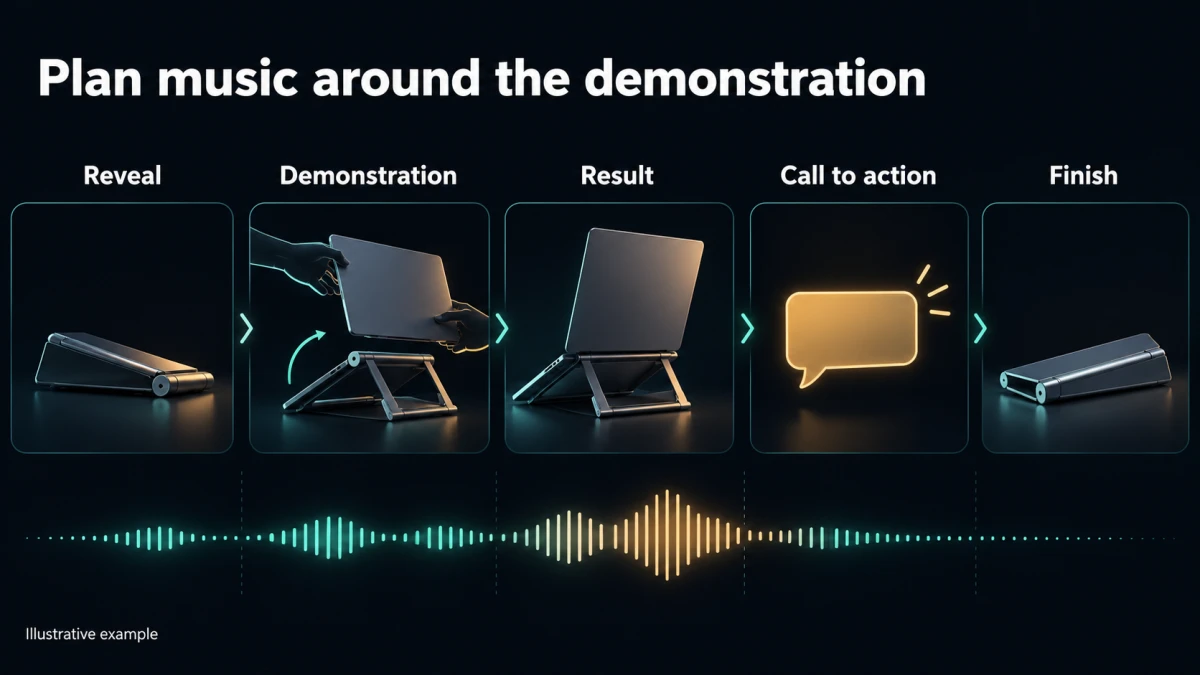
Illustrative example; not a measured product output.
Imagine an invented product called the Turnleaf desk stand. In this constructed design, a hinged support opens to hold a small notebook. The promo shows the opening action, a notebook placed on the stand, and a final view with a request to see product details. These are fictional design assumptions, not verified product specifications.
The proposed narration is descriptive: identify the stand, show how it opens, show the notebook in place, and invite the viewer to examine the details. There are no speed, strength, posture, productivity, or universal-fit claims.
| Proposed picture range | Viewer task | Voice and sound priority | Desired music behavior |
|---|---|---|---|
| 0–5 seconds | Recognize Turnleaf in its folded and open forms | Product name must be clear | A concise entrance without overwhelming impact |
| 5–15 seconds | Follow the opening and placement demonstration | Narration explains the actual action | Steady, restrained accompaniment; no distracting build |
| 15–22.5 seconds | Inspect the notebook resting on the stand | Brief descriptive line, then visual space | A modest lift that supports the completed state |
| 22.5–27.5 seconds | Read and hear the call to action | “View the product details” takes priority | Reduce activity and leave room for the message |
| 27.5–30 seconds | Recognize the final product image | No new claim introduced | A controlled finish with a usable tail or clean ending |
These ranges are an editorial proposal. A real demonstration might need more than ten seconds. If so, extend the video or simplify its scope rather than hiding necessary steps to fit the music plan.
Translate the cue sheet into a musical direction
Specify the role of the track first: a supporting instrumental for a clear product demonstration. Then describe the emotional character, density, broad instrumentation, rhythm, and ending. Add the cue priorities that matter most.
Avoid a brief that combines incompatible demands such as “minimal, constantly evolving, huge climax, completely unobtrusive, and many memorable hooks.” Choose which requirement wins when the model or arranger must make a tradeoff. Here, speech clarity and demonstration timing take priority over musical spectacle.
The result section can have more energy without necessarily becoming much louder. A new layer, a slightly more active pattern, or a change in harmony may provide a lift. These are creative intentions to evaluate, not claims about a guaranteed control exposed by a particular model.
The closing request should be explicit. A thirty-second file is not automatically a thirty-second arrangement with a satisfying finish. Ask for a usable ending, then inspect whether the returned audio actually resolves, fades, or cuts in a way that can serve the final image.
Two original scoring cards to compare
The following cards are proposed alternatives for the same fictional promo. They are not generated tracks and have not been listening-tested.
Direction A: restrained pulse with a clear structural lift
Use: a 30-second product demonstration for a small desk stand.
Type: instrumental, no lyrics or vocal lead.
Character: precise, light, practical, quietly optimistic.
Arrangement: a simple repeating pulse, restrained bass, and a
small number of bright but soft melodic notes.
Structure: concise entrance; steady low-density support through
the opening demonstration; a modest lift after the notebook is
placed; reduced activity for the call to action; controlled ending.
Tempo intention: a stable moderate pulse; if a numeric tempo is
supported and useful, use the planned 96 BPM direction below.
Priorities: speech clarity, complete demonstration, readable CTA.
Avoid: dramatic drops, busy fills, vocals, or a new lead hook
during the final product message.
This direction offers a rhythmic grid for editing. Its risk is that the grid becomes more important than the product action. Review whether the demonstration can remain truthful and legible without forcing cuts onto every accent.
Direction B: warm texture with fewer beat obligations
Use: the same 30-second product demonstration and narration.
Type: instrumental, without sung or wordless vocal textures.
Character: warm, calm, clear, tactile.
Arrangement: sparse sustained accompaniment with a small repeating
motif; little or no prominent percussion.
Structure: establish the tone quickly; stay restrained during
instructions; open slightly when the finished setup is shown;
settle beneath the CTA and leave a simple ending.
Priorities: the product and spoken explanation remain foreground.
Avoid: sentimental swelling, ominous textures, long intros,
and an ending that requires the picture to continue beyond the ad.
This direction gives the edit fewer strong beat commitments. Its risk is a vague or emotionally oversized background that does not distinguish the result from the setup. Judge it with the picture rather than assuming “ambient” means suitable for every shot.
A constructed beat-grid calculation
If a track actually has a stable tempo of 96 beats per minute and four beats per bar, the timing arithmetic is:
Seconds per beat = 60 / 96 = 0.625
Seconds per four-beat bar = 4 × 0.625 = 2.5
Bars in 30 seconds = 30 / 2.5 = 12
That creates possible boundaries at 5 seconds after two bars, 15 seconds after six bars, 22.5 seconds after nine bars, 27.5 seconds after eleven bars, and 30 seconds after twelve bars. Those positions match the proposed cue sheet because the example was deliberately constructed that way.
This is arithmetic, not evidence that a generated track will maintain 96 BPM, begin exactly on a downbeat, or organize itself into those phrases. A pickup, tempo drift, free introduction, or longer ending can change the usable alignment. Verify the actual audio before treating the grid as real.
Even with a stable grid, a bar boundary is not automatically a satisfying edit point. A melody may continue across it, a cymbal may ring through it, or the harmony may expect another phrase. Use the grid to locate candidates, then listen for musical continuity and compare the picture's needs.
For a concrete offset branch, suppose the first usable downbeat in a hypothetical delivered file occurs at 0.4 seconds. At the same stable 96 BPM, the two-bar candidate is at 5.4 seconds in that file, and twelve bars end at 30.4 seconds. Placing that downbeat at the video's start would align the grid but discard the preceding pickup; first check whether the pickup is musically necessary. Keeping the pickup instead shifts the candidate landings and extends the ending beyond the proposed picture. Re-mark those positions, then choose a suitable music edit or an expendable decorative picture adjustment. Do not shorten the product's essential demonstration to conceal the offset. Verify the revised entrance, joins, and ending by actual playback.
Review the production card and job state
Recapo's AI music generator publicly describes a creative-input stage, a production-card review, and a separate paid submission that can be tracked before saved deliverables are downloaded. Review the card's structure, instrumentation, vocal direction, model, and confirmed cost before choosing to proceed. The card is not the audio, and the music workflow does not automatically deliver a finished product video.
Keep the brief and card version together. If the reviewed plan introduces singing or a long opening that conflicts with the ad, correct the plan before submission. Do not treat a later audio repair as a substitute for reviewing an obviously unsuitable direction.
After submission, inspect the existing job record when status is uncertain. Preserve the task identifier and clarify completion or charging before considering another attempt. Do not blindly resubmit to see whether a preview appears. No current price, credit rate, refund outcome, or queue duration is assumed in this guide.
When the track is available, retain the delivered original and work on a copy. Detailed trimming, crossfades, gain automation, or beat alignment belong in an audio or video editor that supports those operations; they are not assumed controls in Recapo's music-generation interface.
Audition the two directions against the same picture
Use the same narration, picture cut, and intended playback level for the comparison. Note where each candidate supports or interferes with the product message. Do not call a louder track the winner before checking the balance.
Review four moments separately: the product-name entrance, the most information-dense demonstration line, the completed setup, and the call to action. A track can work in three of those places and fail in the fourth. Record the failure location so the next revision is specific.
Ask a reviewer what they understood about the product action and next step, then ask about music preference. Preference is useful, but it should not hide a comprehension problem. This is a proposed evaluation method; no blind listening results are claimed for the fictional cards.
If both candidates interfere with speech, return to the arrangement brief or mix rather than choosing the less bad one by default. If one fits the demonstration but lacks an ending, determine whether a permitted external edit can create a coherent close without damaging the main phrase. If not, revise the ending request before an authorized new generation.
Repair the landing point without falsifying the demonstration
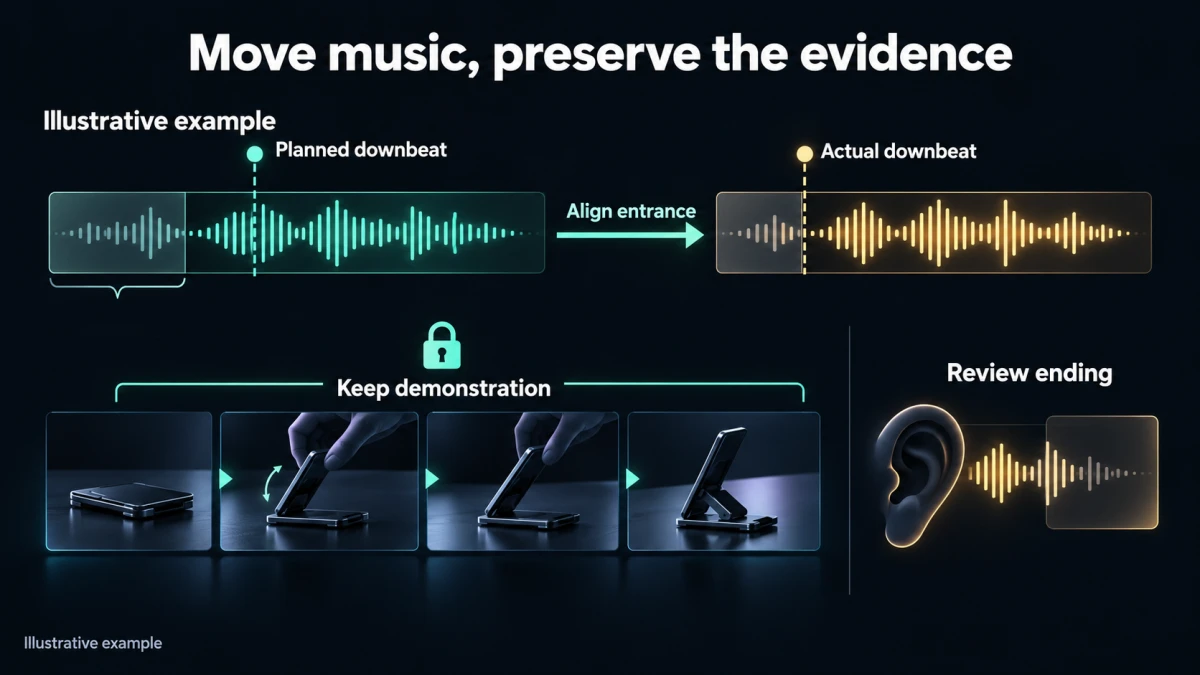
Illustrative example; not a measured product output.
When an accent arrives too early, first ask whether the picture cut can move without changing the evidence. A decorative product angle can often be shortened. A crucial locking or placement action may need to remain complete.
If the picture should not move, edit or reposition the music in a supported external workflow. Try a different start point, a musically compatible section, or a restrained transition. Preserve the original track so the change remains reversible. Listen through the join rather than assuming a visible grid guarantees a clean result.
When the music peaks under the CTA, reducing level may help, but a prominent new vocal-like motif or busy fill can still attract attention. Consider using a quieter section or revising the arrangement. The target is a clear message, not merely a lower meter reading.
If the ending is too long, do not cut off a ringing note without listening. Choose an appropriate resolution or shape a tail in an editor that supports it. Conversely, a dramatic final hit may feel stronger than the product demonstration warrants. A restrained close can be the more accurate creative choice.
Copy-ready cue and revision sheet
PROMO
Product and verified claims:
Picture version:
Narration version:
Requested total duration:

CUE
Picture range:
Viewer task:
Essential spoken words:
Music role:
Must-hit point or flexible region:
Evidence-sensitive action that must not be accelerated:

MUSIC CANDIDATE
Brief and reviewed production-card version:
Actual delivered file:
Actual tempo/structure observations, if checked:
Observed mismatch and location:
Repair: picture edit / audio edit / arrangement revision
External editing tool and changes actually used:

ACCEPTANCE
Speech and CTA understandable:
Demonstration remains complete and truthful:
Transitions and ending work in continuous playback:
Rights/terms review recorded for intended use:
Final audio and video versions identified:
Before delivery, replay the exported video from start to finish. Check for a clipped beginning, abrupt tail, late narration, mismatched captions, and a CTA that disappears before its message can be understood. Review alternate aspect ratios as separate outputs if the picture or text layout changes.
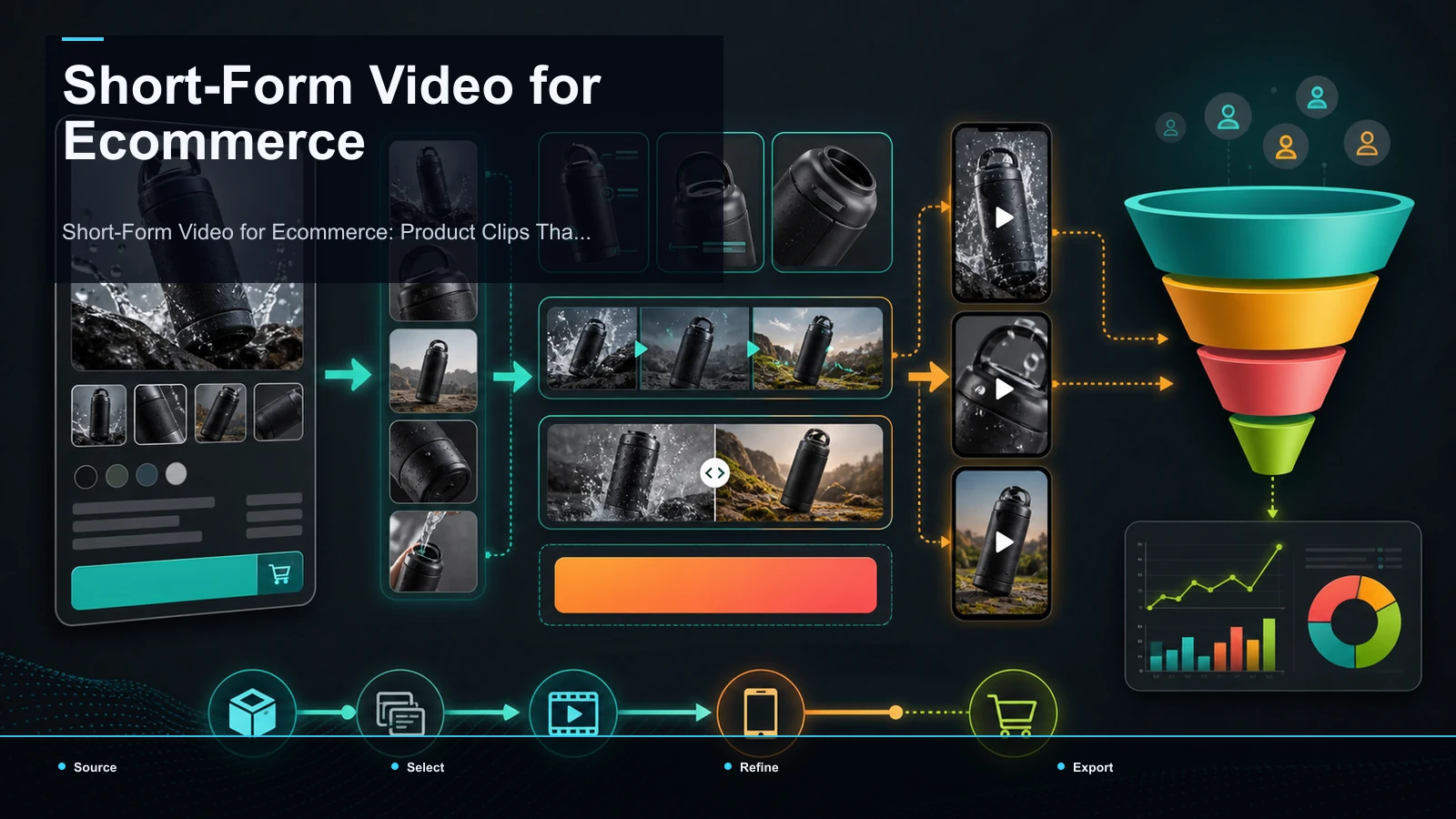
The broader guide to short-form video for ecommerce is a related next step for the video's wider use. Scoring remains one part of that work, not proof of advertising effectiveness.
Keep creative approval separate from use approval
Record the source of the generated track, the reviewed card, any supplied lyrics or references, the delivered version, and the intended distribution. Check the applicable terms and any provider conditions before commercial use. Do not infer a blanket music license, uniqueness, or exclusive rights merely from successful generation or payment.
If the use question is unresolved, keep the track out of the release-approved selection while the responsible person reviews it. If the creative question is unresolved, state the specific cue or balance problem instead of calling the track “almost done.” These are different gates and need different decisions.
The next practical step is to mark the completed product action and the start of the CTA on the picture. Those two points tell you where music should offer support—and where it should stop asking for attention.