Can I Use AI Music Commercially? A Rights-Check Workflow Before You Publish
Check AI music commercial-use rights before release. Review service and provider terms, input permissions, client delivery, and a practical evidence record.
You may be able to use AI-generated music commercially, but the answer depends on the service and model terms that apply to your generation, your inputs, and your intended use. A paid receipt does not, by itself, establish every right you need. Neither does a “royalty-free” label establish copyright ownership, exclusivity, or permission to use someone else's lyrics or voice.
The practical question is not simply “Is this AI music?” It is: Can this particular recording be used in this particular project, by these parties, in these markets, under the terms that actually apply?
This guide shows how to build a reviewable rights record before an advertisement, client video, podcast, game, or music release goes public. It is a production checklist, not legal advice or a legal clearance. If your project involves an identifiable person's voice, disputed source material, substantial distribution, or an ambiguous contract, involve a qualified professional for the relevant jurisdiction.
Separate four questions that often get merged
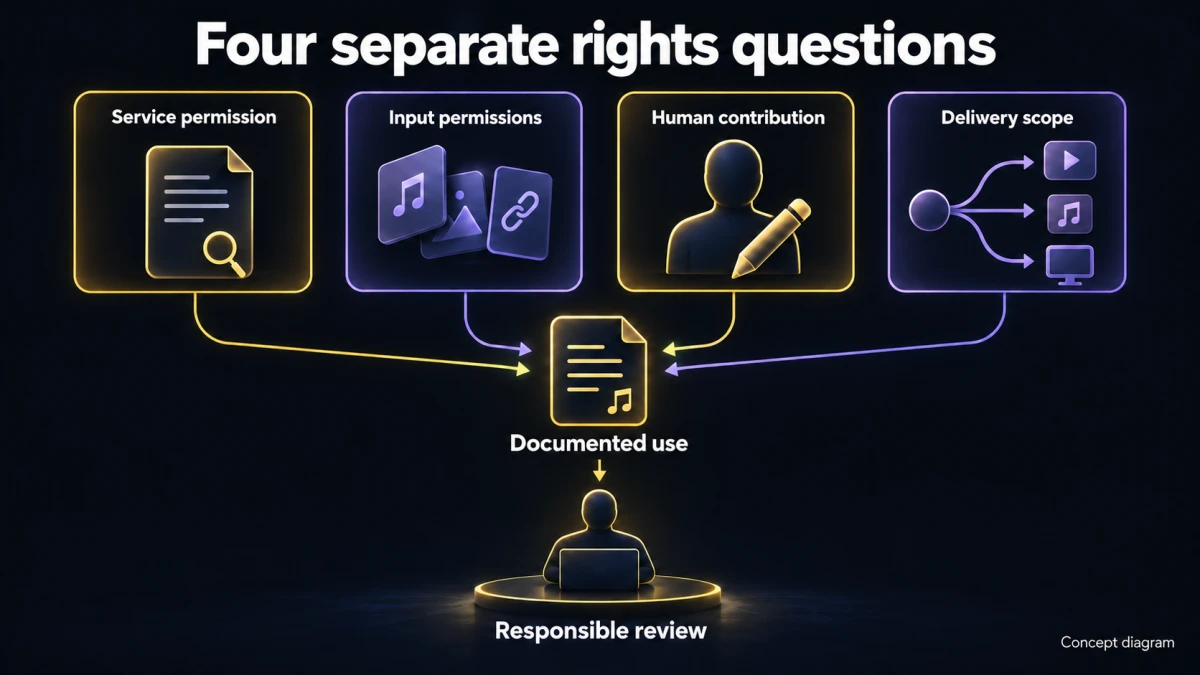
Concept diagram; not a product-interface screenshot.
Start with four separate decisions. A reassuring answer to one cannot automatically answer the others.
| Question | Evidence to look for | What it does not establish |
|---|---|---|
| Does the service permit this use of the output? | Applicable service, model, and plan terms | That all input material was yours to upload |
| Did you have the necessary input permissions? | Lyrics agreement, recording permission, voice consent, source license | That the output meets every platform's rules |
| What rights, if any, protect your own contribution? | Records of human composition, recording, arrangement, or editing; jurisdiction-specific advice | An exclusive right to everything generated |
| Can the planned recipient and distribution channel use the delivery? | Client scope, territory, media, transfer, and platform requirements | Immunity from claims or automated matches |
For example, a tool may permit use in a video while a client contract demands an exclusive worldwide music assignment. Those are different promises. Do not sign the second merely because you have evidence for the first.
Similarly, permission to upload a song to a collaboration folder is not necessarily permission to send it into a generation service. Identify what the source agreement actually covers. If you cannot explain the difference to the project owner, the review is not finished.
What Recapo's public pages currently say—and what remains conditional
As checked on October 8, 2026, section 5(b) of Recapo's Terms of Use says that Recapo does not claim ownership of generated output and does not restrict its use, including commercial use, provided the use complies with the terms, applicable laws, and applicable third-party terms. It also states that outputs may not be unique.
That is a conditional permission statement, not a promise of exclusive copyright or a guarantee that every possible commercial project is cleared. It also does not authorize reselling the service itself.
The FAQ on the AI music generator makes a narrower operational point: the page does not promise a licensing status, and users should review applicable provider terms and Recapo terms before commercial release or redistribution. Read these statements together. Do not turn the general terms into a universal “copyright-free music” claim, and do not conclude that the FAQ prohibits every commercial use.
Your next task is to identify the actual provider or model and any applicable additional conditions for the output in question. If that information is missing from the generation record, ask support to identify it. A generic list of models available today does not establish which model produced an older recording.
Keep the date of the terms review. Recheck before release if the production runs for a long time or the scope changes. This article's dated summary is not a substitute for reviewing the version that applies to your project.
Define the use before reading the license
“Commercial” is too broad to function as a production specification. Write a short use statement first:
Illustrative project: a 30-second product demonstration for a fictional desk-light brand, published on the brand's website and used in paid social advertising in two named markets. An agency supplies the finished video to the client. The music will not be sold as a separate track or submitted to a music-distribution service.
This statement is deliberately specific. It describes a constructed example, not a cleared real campaign.
Now ask what might change:
- Will the client receive only a mixed video or the underlying audio file?
- May affiliates, distributors, or franchisees reuse the track?
- Will the music appear in a game, where users hear it repeatedly and possibly extract assets?
- Will there be a podcast theme, a broadcast version, or an app version?
- Will a distributor require ownership declarations or exclusive control?
- Will the project use a vocalist whose identity matters to the audience?
- Is the track intended as a recognizable brand sound for several years?
A change in delivery can change the review. Handing a client a finished advertisement is not necessarily equivalent to handing over unrestricted rights to redistribute a standalone music library. Record the actual scope rather than choosing the broadest imaginable wording “just in case.”
Build the generation identity record
Before discussing the sound, make sure you can identify the file. Similar filenames are a surprisingly poor basis for rights review.
Create a record with:
- Service and account used.
- Provider or model, where identified.
- Generation date and job identifier.
- Plan or purchase context relevant to that job.
- Original output filename and a file checksum.
- Prompt and production card version.
- Any lyrics, references, recordings, or other uploaded materials.
- The exact file used in the edit, including later modifications.
- The project and intended distribution.
- The person responsible for approval.
You do not need to publish account identifiers or receipts. Keep them in a restricted project archive. A shareable client summary can refer to an internal record without exposing credentials, payment details, private prompts, or unrelated account history.
Checksums help answer a narrow question: whether two files are byte-for-byte the same. They do not prove authorship, permission, or legal safety. If a later export changes the file, keep both records and describe the relationship. Do not overwrite the original simply to make the folder look cleaner.
Read terms as an evidence chain, not a slogan search
Searching a page for “commercial use” is a starting point. It is not the whole review.
First identify the documents that apply: the service terms, any product-specific conditions, relevant plan conditions, and applicable provider terms. Record their titles, URLs, effective dates if given, and the date you accessed them. Save a permitted copy or a dated excerpt for your own records, rather than relying on a bookmark that may later display different wording.
Then read the surrounding clauses. Look for conditions concerning inputs, outputs, third-party rights, permitted use, redistribution, transfer, exclusivity, public sharing, termination, and changes to terms. If a document points to another applicable policy, include it in the record.
Write your conclusion in two columns:
| Supported by the reviewed document | Still unresolved |
|---|---|
| The service conditionally permits commercial use of compliant output | Whether the specific provider imposes additional conditions |
| The service does not claim output ownership | Whether the customer can claim exclusive rights in this recording |
| The output may be non-unique | Whether the client's contract accepts non-exclusive material |
This format prevents an empty cell from becoming an assumption. If a page does not address a requested use, record “not established,” not “allowed” and not “forbidden.”
Where language versions differ, check which version the terms designate as controlling. Recapo's terms identify English as controlling to the extent permitted by applicable law. The relevant English wording should therefore be part of a consequential review, even when the production team normally uses another language.
Audit every input, including the materials people forget
AI generation does not erase the provenance of inputs. Make an input inventory before submission whenever possible.
Lyrics. Distinguish your original lyrics, commissioned lyrics, public-domain material you have actually verified, and a song copied from elsewhere. A few edited words do not establish permission to use the rest. Keep the agreement for commissioned material and confirm that it covers the intended processing and release.
Reference recordings. A track obtained from a video, streaming service, or colleague is not automatically authorized as a generation reference. The fact that a file can be downloaded or extracted establishes access, not rights. If extraction is part of your workflow, the audio-extraction rights guide addresses that adjacent question; do not substitute an extraction workflow for a license review.
Voices. Record who supplied the voice and what they agreed to. Do not treat consent to record an interview as consent to create a synthetic singing identity. When the requested result resembles an identifiable person, pause for a specific rights and consent review.
Brand and client material. Confirm that the person uploading the asset is authorized to provide it to the service, not merely to view it inside the client's organization. Confidential launch materials require a separate data-use review.
Previously generated material. If you feed one service's output into another, preserve the chain. The second generation does not make the first service's conditions disappear. Record both outputs and both relevant sets of terms.
Reject an input when its provenance cannot be resolved in time. Replacing it with documented, permitted material can be a better production decision than building an entire campaign around an uncertain recording.
Check confidentiality before uploading unreleased material
Commercial permission and confidentiality are separate. A client may allow a track to be released publicly next month while prohibiting its use in a third-party system today.
Recapo's section 5 describes licenses for operating and improving the service and additional uses of content. Its public-sharing provisions also distinguish available sharing controls from the broader licenses in the terms. An available opt-out from automatic public display should not be represented as a blanket prohibition on all other uses.
For sensitive projects, review the actual terms and settings before sending unreleased lyrics, a client's signature sound, private voice recordings, or confidential campaign concepts. Ask the account owner or counsel whether those conditions fit the client's obligations. If they do not, use a workflow that does fit.
A sensible review record says what was checked and who accepted it. It should not say “private because paid” unless a specific applicable agreement actually supports that conclusion. Paying for access, restricting a sharing setting, and obtaining contractual confidentiality are not interchangeable events.
Copyrightability is not the same as permission to use
A service contract can address permitted use without resolving whether copyright protects every part of an output.
The U.S. Copyright Office's January 29, 2025 announcement about its AI copyrightability report explains that protection depends on sufficient human-determined expressive elements; simply supplying prompts is not enough. It also distinguishes AI assistance from works whose expressive elements are determined by a machine. That is a U.S.-specific explanation, not a global rule or a determination about your track. See the Copyright Office's original announcement.
For production, the important consequence is modest: do not promise a client ownership or exclusivity solely because you typed the prompt. Preserve your real creative contributions—original lyrics, composition, performed material, arrangement decisions, and edits—without exaggerating what those records establish.
Likewise, a concern about copyrightability does not automatically mean that someone else's underlying lyrics, recording, or identity can be used without permission. These are separate questions. If ownership, registration, exclusive licensing, or enforcement matters to the business, get advice about the actual work and jurisdictions.
Work through a conditional approval example
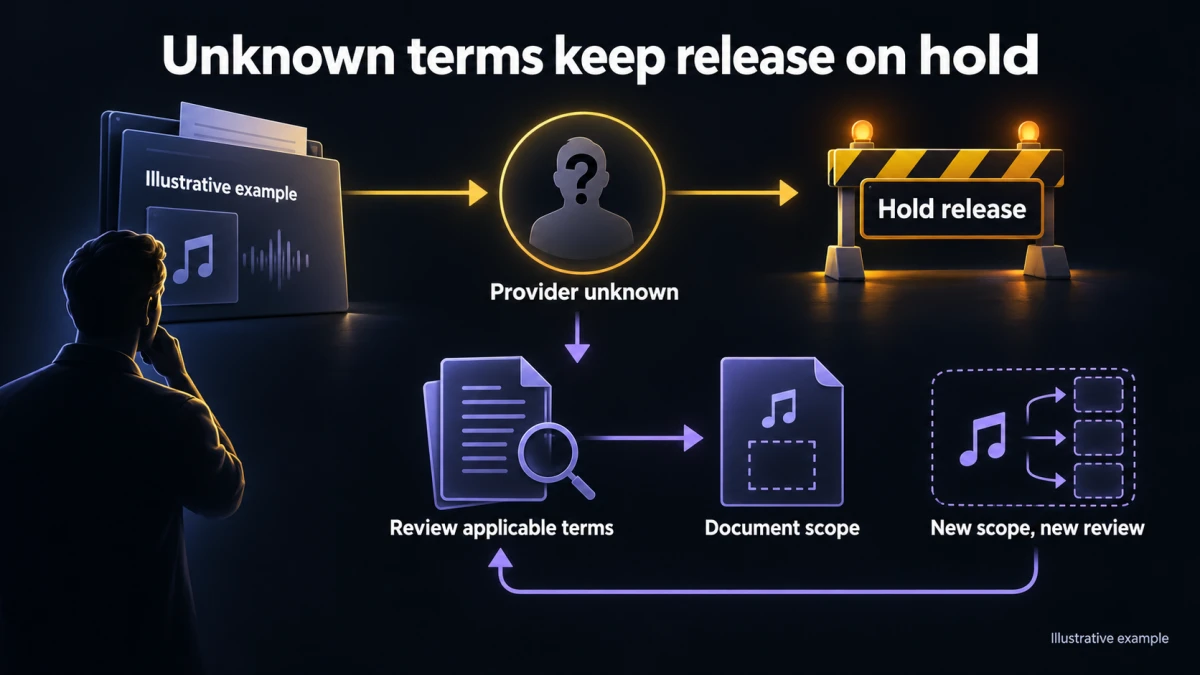
Illustrative example; not a measured product output.
Consider the fictional desk-light campaign again. The agency has an instrumental output, no uploaded reference recording, and a production card describing a restrained electronic background. The client wants the video for its website and paid social posts.
A useful review might unfold like this:
Initial record: service, job, date, plan, file, and intended channels are documented. The service terms have been reviewed. The provider applicable to this job has not yet been identified.
Decision: commercial release is held. Local or internal evaluation continues only to the extent already permitted by the applicable rights and terms; calling a use internal does not automatically authorize it. No permission to transfer the track, upload it to another processing service, or distribute it externally is inferred. The missing provider information is a real unresolved condition, not a paperwork nuisance.
Follow-up: support identifies the applicable provider and directs the agency to the relevant terms. The project reviewer checks the proposed video use, any transfer to the client, and restrictions affecting the delivery. The review records the answer rather than merely attaching a support message.
Scope change: the client now asks to register the music as its exclusive audio identity and distribute it as a standalone track. The previous review no longer answers the new question. The agency escalates those requests and avoids promising exclusivity while they remain unresolved.
No part of this example claims that a real output has passed clearance. It demonstrates how to avoid treating a conditional approval as permission for every future use.
Prepare a delivery note the client can actually use
A music handoff should explain the approved scope and its limits in ordinary language. Include the file identity, permitted project uses supported by the review, required notices if any, and unresolved restrictions. Keep detailed receipts and sensitive account information in the restricted archive.
A compact handoff template is:
- Project and delivery version:
- Music file and checksum:
- Generation service, model/provider, and date:
- Inputs supplied and their permission records:
- Documents reviewed and their dates:
- Approved use, recipients, channels, and territories:
- Standalone redistribution or exclusivity status:
- Conditions or required notices:
- Reviewer and approval date:
- Events that require a fresh review:
Complete each field with actual evidence. “None known” is not a substitute for checking the relevant documents. If the client needs a warranty your evidence cannot support, resolve the contract instead of quietly removing the field.
Also keep the music license record connected to the final video version. A reviewer cannot approve one instrumental and thereby approve a later replacement with different lyrics, references, or provider conditions.
If a platform flags the track after publication
An automated match is neither a complete legal judgment nor something to ignore. Preserve the notice, affected URL, claimed material, timestamps, and deadline. Match the notice to the exact delivered file and your existing rights record.
Review the platform's current response process and the actual basis for any challenge. Do not submit a dispute merely because the music was generated by AI or because your account was paid. A factual response needs relevant evidence and a responsible decision-maker.
If the review exposes a missing permission, stop further distribution within your control and choose an authorized replacement where appropriate. Keep the original evidence for review rather than deleting the record. For a consequential dispute, involve the client and qualified counsel before making representations on their behalf.
The aim is not to promise that a well-organized folder prevents every claim. It is to make the project understandable, traceable, and correctable when questions arise.
A release decision you can defend
Use three outcomes: approved for the documented scope, held pending a specific answer, or rejected for this use. Avoid the vague label “AI music cleared.”
Approve only when the relevant service and provider conditions, input permissions, intended delivery, and business requirements have been addressed by the responsible reviewer. Hold when a missing fact could change the answer. Reject when a known restriction conflicts with the project or the evidence cannot be obtained in time.
You can then make the creative decision on sound and fit without confusing it with the rights decision. A track should pass both. The right question is not whether AI music is commercially usable in the abstract, but whether you can explain why this file belongs in this release—and show the evidence behind that explanation.