Faceless Video for Affiliate Marketers: No-Camera System
Faceless videos for affiliate marketing, built as a repeatable system — script, AI voiceover, captions, clips and disclosure — so you can scale reviews.
By the Recapo.ai Editorial Team · Fact-checked July 10, 2026
Faceless videos for affiliate marketing let you build a review, comparison, or tutorial channel that earns commissions without ever appearing on camera — your voice, your research, and your on-screen visuals do the selling. The winning move in 2026 isn't chasing one viral clip; it's running a repeatable production system — script, voiceover, captions, clip, export — that ships honest, properly disclosed affiliate videos on a schedule. This guide hands you that system: the faceless formats that actually convert, the exact pipeline to produce each one, how to handle disclosure so your links stay live, and where a single browser workspace collapses four subscriptions into one editing lane.
Why go faceless as an affiliate marketer
Affiliate marketing without showing your face works because the buyer's real question is "is this product right for me?" — not "who is this person?" Faceless review videos put the product, the demo, and clear narration front and center, which is exactly what a purchase-ready viewer came to see. Take yourself out of the frame and the content gets easier to produce and easier to scale.
Concretely, going faceless removes four things that stall most affiliate creators:
- No on-camera friction. No lighting setup, no wardrobe, no re-recording because you fumbled a line. You edit text and audio, not your face.
- The product is the star. Screen recordings and B-roll carry more persuasion for a "should I buy this?" decision than a talking head ever will.
- Repeatability. A faceless format is a template. Once the pipeline is dialed, episode two is faster than episode one, and episode ten is a routine.
- Niche flexibility. No-face affiliate videos let you run software reviews on one channel and kitchen-gear roundups on another without your identity tying them together.
The trade-off is honesty pressure: with no personality on screen, trust rides entirely on the quality of your research and the clarity of your disclosure. That's the whole game, and it's where the system below is built to help.

The faceless formats that convert for affiliates
Not every faceless format sells. The ones that move affiliate links map to a specific buying decision the viewer is trying to make. Pick the format by the decision, not the other way around.
| Format | What the viewer is deciding | Faceless build | Where it lands |
|---|---|---|---|
| Single-product review | "Is this one worth buying?" | Screen recording or product B-roll + narrated pros and cons | YouTube long-form + Shorts |
| Head-to-head comparison | "Which of these two?" | Split-screen footage + narrated scorecard | YouTube, TikTok |
| "Best X for Y" roundup | "What are my options?" | Sequenced clips of 3–5 tools + ranked narration | YouTube, blog embed |
| Tutorial / how-to | "How do I actually get the result?" | Screen-capture walkthrough + step narration | YouTube, Reels |
| Problem → solution short | "Can this fix my specific problem?" | Hook + quick demo + link CTA | Shorts, Reels, TikTok |
Two honest notes. First, single-product reviews and comparisons convert hardest because the viewer is already deep in the funnel — they don't need convincing that the category matters, only that your pick is right. Second, the roundup format is the workhorse of faceless affiliate marketing videos because one script can carry several links, and one long roundup slices into a week of shorts. New to the underlying craft of building without a camera? Our guide on how to make faceless videos covers niche choice and script structure before you layer the affiliate angle on top.
The system behind faceless videos for affiliate marketing
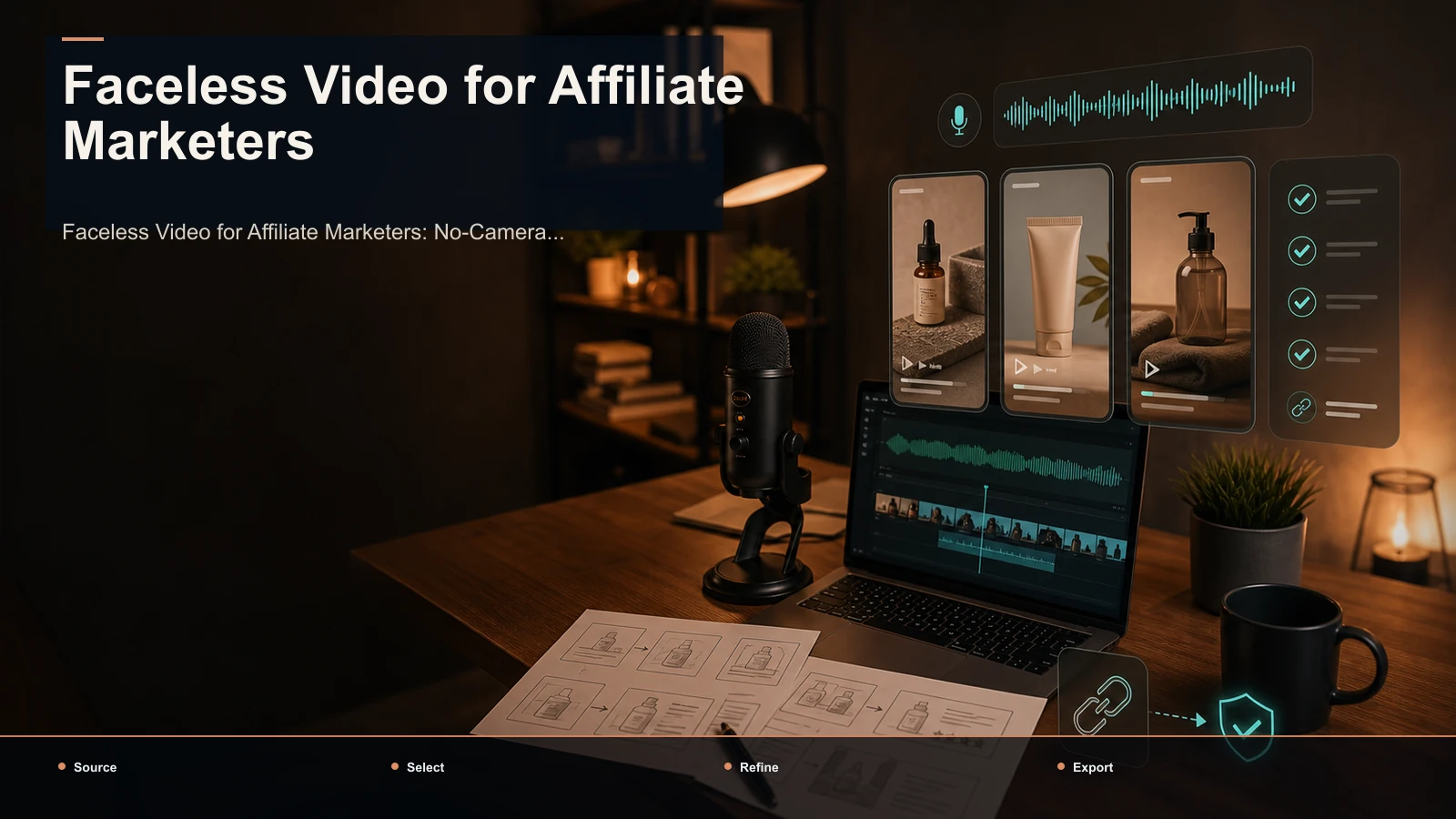
The reason most affiliate channels stall isn't talent — it's that every video is built from scratch. A system fixes that. Faceless video content for affiliates is really seven repeatable stages, and once you standardize them, output stops depending on motivation.
| Stage | Job | Faceless-specific note |
|---|---|---|
| 1. Angle & script | Pick one honest promise; write real pros and cons | Your genuine opinion is the moat; scripted hype gets skipped |
| 2. Voiceover | Turn the script into a consistent narration track | One brand voice across every episode builds recognition |
| 3. Visuals | Screen recordings, product shots, stock B-roll | Show the product doing the thing you claim it does |
| 4. Captions | Burn accurate subtitles for muted viewing | Proofread product and brand names every time |
| 5. Disclosure | On-screen + spoken affiliate disclosure | Not optional — see the disclosure section below |
| 6. Clip & reframe | Cut vertical shorts from the long cut | One review should feed a week of shorts |
| 7. Cover & export | Thumbnail, title, and description with the disclosed link | Export to each platform's aspect ratio |
Stages 2 through 7 are one continuous editing lane — that's the part where consolidating tools saves the most time, and it's the part we'll walk through next.

Build your first faceless affiliate video, step by step
Here's the repeatable run. Do it once slowly; after that it becomes muscle memory.
- Choose one product and one honest angle. Decide what you genuinely think and who it's for — "a solid budget pick for beginners," not "the greatest thing ever." Write the script around a real problem the product solves, and include the drawbacks. Reviews that admit limits convert better and age better.
- Write a hook that names the payoff in the first line. The opening seconds decide whether anyone hears your link. Lead with the decision the viewer is making ("Trying to pick between these two editors? Here's the one I'd keep") rather than a slow intro.
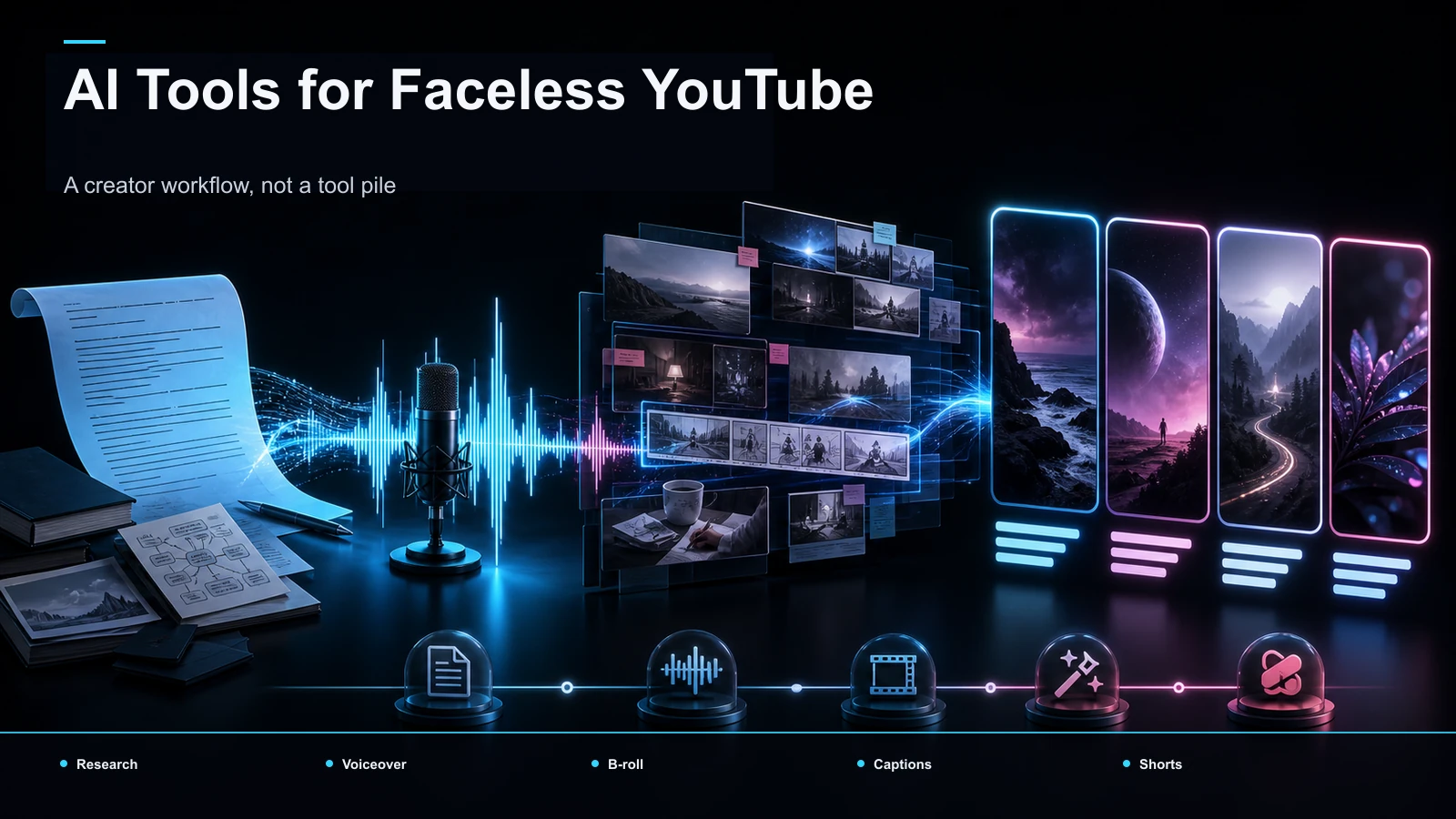
- Generate the voiceover. Turn your finished script into a clean, consistent narration track with a voiceover maker so you never have to record your own audio. Lock one voice and keep it across every episode — a stable narration voice is your faceless channel's identity.
- Assemble the faceless cut. Build the video around your narration, screen recordings, and product footage rather than pure generic stock. A browser-based AI video editor helps you assemble a narration-driven edit from your own material, so the result reads as a real review and not a template anyone could have made.
- Caption everything. Some feed views happen without audio, so subtitles carry the sell. Run auto captions, then proofread every product name, price claim you're quoting, and brand term — a mangled brand name on a review looks careless exactly where you need to look credible.
- Add your disclosure to the video itself. Put a clear on-screen line and a spoken mention that the video contains affiliate links. Do this in the edit, not just the description.
- Reframe and clip for shorts. Cut the long review into short, self-contained vertical moments for YouTube Shorts, TikTok, and Instagram Reels, each with its own hook and link CTA.
- Cover, title, export, publish. Add a thumbnail, write a searchable title and description, place your affiliate link with its disclosure, and export in the aspect ratio each platform wants.
Disclosure done right: the part most guides skip
This is where faceless affiliate marketing videos quietly get their links killed, so treat it as a production step, not an afterthought. In the United States, the FTC's Endorsement Guides require you to disclose any material connection — including affiliate commissions — clearly and conspicuously. Read the FTC's official endorsement guidance before you post; it is the regulator's rule, not a threshold any blog should invent for you.
The practical, faceless-safe pattern:
- Disclose in the video, not only the description. A viewer who watches muted or on a feed never opens your description. A brief on-screen line plus a spoken mention covers both. Because your face isn't on screen to build rapport, an explicit disclosure is what keeps a faceless review trustworthy.
- Put it before the link, not after. The disclosure should reach the viewer around the time your recommendation does — not buried at the end.
- Use the platform's own tools too. YouTube, TikTok, and Instagram each provide a paid-promotion or partnership label in their upload flow; check each platform's current creator policy and use its disclosure control where it applies. These settings sit on top of your in-video disclosure, not instead of it.
- Keep claims defensible. Only state prices, specs, or results you can point to on the product's own page, and phrase your opinion as opinion. Faceless doesn't mean unaccountable.
Get this right once and it becomes a template line in every script. Get it wrong and a single complaint can cost you the whole channel — which is a bad trade for skipping ten seconds of on-screen text.
Where Recapo fits in the faceless affiliate workflow
Let's be precise about the category. Recapo is a browser-based AI video workspace — it runs in the browser with no install, accepts MP4, MOV and other common formats, and handles up to 6GB total per task. Across the seven-stage system, it covers the connected middle of the chain in one place: summaries and scripts, AI voiceover, transcription and captions, turning long videos into clips, vertical reframing, and cover and export. For a faceless affiliate creator that's often four or five subscriptions collapsed into one browser tab — the argument is fewer tools in the chain, not out-scoring any single specialist at its one job.
Be equally clear about what Recapo is not. It isn't your screen recorder, so your raw product-demo footage still comes from a capture tool. It isn't an affiliate network or link manager — commissions, tracking links, and payouts live with your affiliate programs. And it isn't a prompt-to-video generator that invents an entire review from one sentence of stock; it's built to help you edit and assemble around footage and a script you actually steer, which is the honest, workflow with transparent disclosure to make review content.
The practical fit: Recapo earns its place when your affiliate channel is a recurring operation — script to voiceover to captions to clips, week after week — because that's a workflow, not a one-off. If you're publishing reviews and roundups on a schedule, the value is in the whole editing lane staying in one workspace instead of exporting between four apps per video. Pricing lives on the pricing page; check it there rather than trusting a number in any article, including this one.
Scale one review into a week of clips
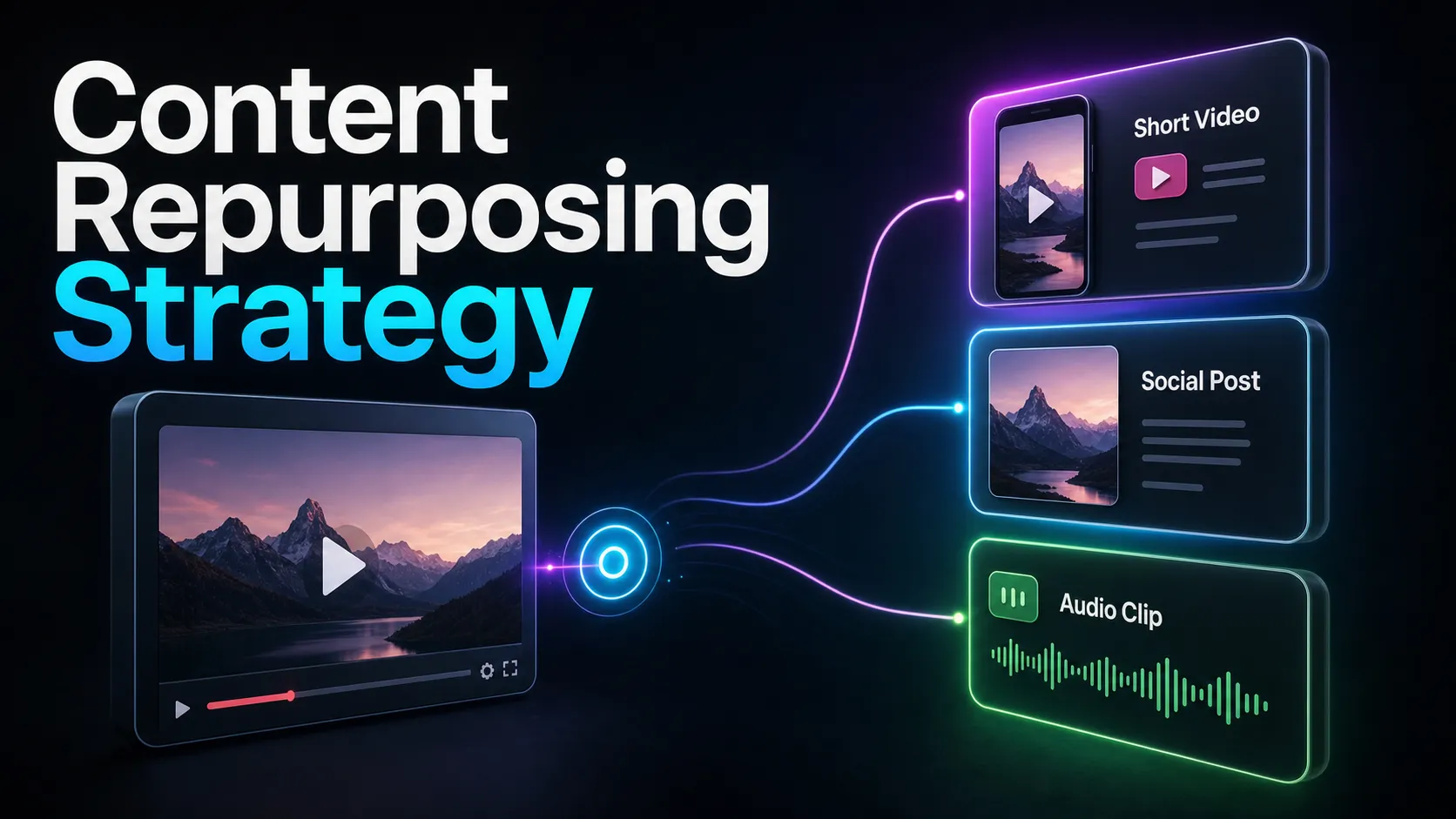
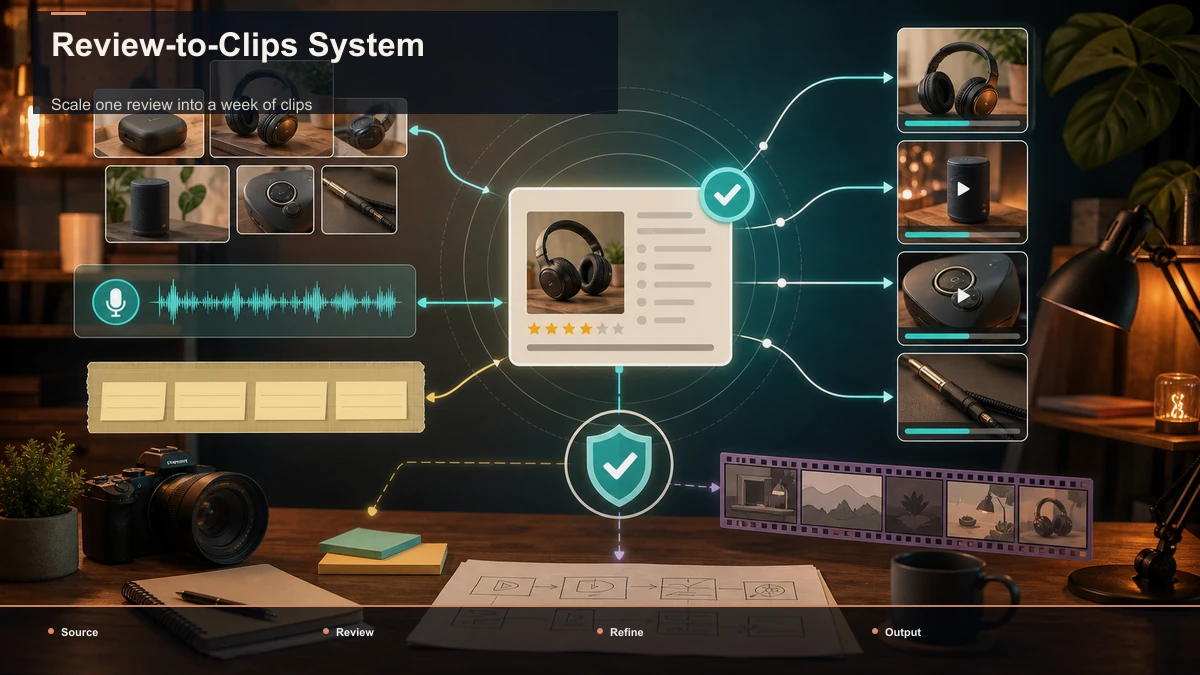
The reason affiliate creators plateau is that they treat each video as the finished product. It isn't — it's the source. One long faceless review is raw material for a week of shorts, and that repurposing multiplier is what turns a channel into a system. Cut the three sharpest moments — the verdict, the standout feature, the honest drawback — into vertical clips, give each its own hook and disclosed link, and post them across Shorts, Reels, and TikTok between long uploads.
The workflow stays inside the same editing lane: the clip-and-reframe stage you already ran for the long video produces the shorts, and the captions and disclosure travel with them. For a full framework on getting more distribution from every piece you make, see our content repurposing strategy guide. The point for affiliates specifically: more surfaces carrying a disclosed link means more chances for the commission, from work you've already done.
FAQ
Can you really do affiliate marketing without showing your face? Yes — reviews, comparisons, roundups, and tutorials all work as faceless video content for affiliates, because the buyer wants to see the product and hear a clear verdict, not see you. Voiceover, screen recordings, captions, and honest scripting carry the persuasion. The one thing you can't skip is disclosure: with no face on screen, an explicit affiliate disclosure is what keeps the content trustworthy.
Do I still need to disclose affiliate links in a faceless video? Absolutely, and arguably more visibly. The FTC's Endorsement Guides require clear and conspicuous disclosure of any material connection, and platforms provide their own paid-promotion labels — check the FTC's official guidance and each platform's current creator policy. Put a spoken and on-screen disclosure in the video itself, before the recommendation, not only in the description.
What tools do I need to make faceless affiliate videos? One reliable tool per job: a screen recorder for demos, a voiceover tool, an assembly/editor, a captioner, and a clipper for shorts. A browser workspace can cover the connected middle — voiceover, captions, clips, reframe, cover, and export — which removes most of the export-between-apps friction. You'll still bring your own screen capture and your affiliate program's link tracking.
Which faceless format converts best for affiliate marketing? Single-product reviews and head-to-head comparisons can address late-stage buying questions; measure qualified conversions in your own affiliate dashboard. "Best X for Y" roundups can cover several products, but efficiency and conversion depend on research, disclosure, source rights, and the approved clips produced from the script. Match the format to the decision your viewer is making.
How many faceless affiliate videos can I realistically produce each week? That depends on your pipeline, not your motivation. Once the seven stages are standardized and the editing middle lives in one workspace, one long review plus three to five repurposed shorts per week is a sustainable cadence for a solo creator. The bottleneck is usually research and scripting — the parts that should stay human — not the production.
Ready to run affiliate reviews as a real content operation instead of one-off uploads? Create a Recapo account, take one product review through the full chain — script and summary, AI voiceover, auto captions, clips, vertical reframe, and cover — and time it end to end. If a single browser workspace saves you the four exports you're doing per video today, you'll feel it on the very first upload.