AI Voice Over for YouTube Videos: How to Do It Right
AI voice over for YouTube videos, done right: script for the ear, fix pronunciation, pair captions, disclose AI, and a self-test to pick a voice over generator.
By the Recapo.ai Editorial Team · Fact-checked July 10, 2026
AI voice over for YouTube videos is now good enough to carry a whole channel — but only if you treat it as a workflow, not a one-click button. The gap between narration that sounds human and narration that gets skipped in three seconds comes down to four things you control: the script you feed the model, how you fix pronunciation, the captions you pair it with, and how you disclose it to stay inside YouTube's rules. This is a tool-and-method guide, not a soft sell. You'll get the exact steps to turn a script into a natural voice track, the fixes that kill the flat "robot reading a list" feel, and a self-test to judge any YouTube voice over generator on your own content instead of a marketing feature grid.
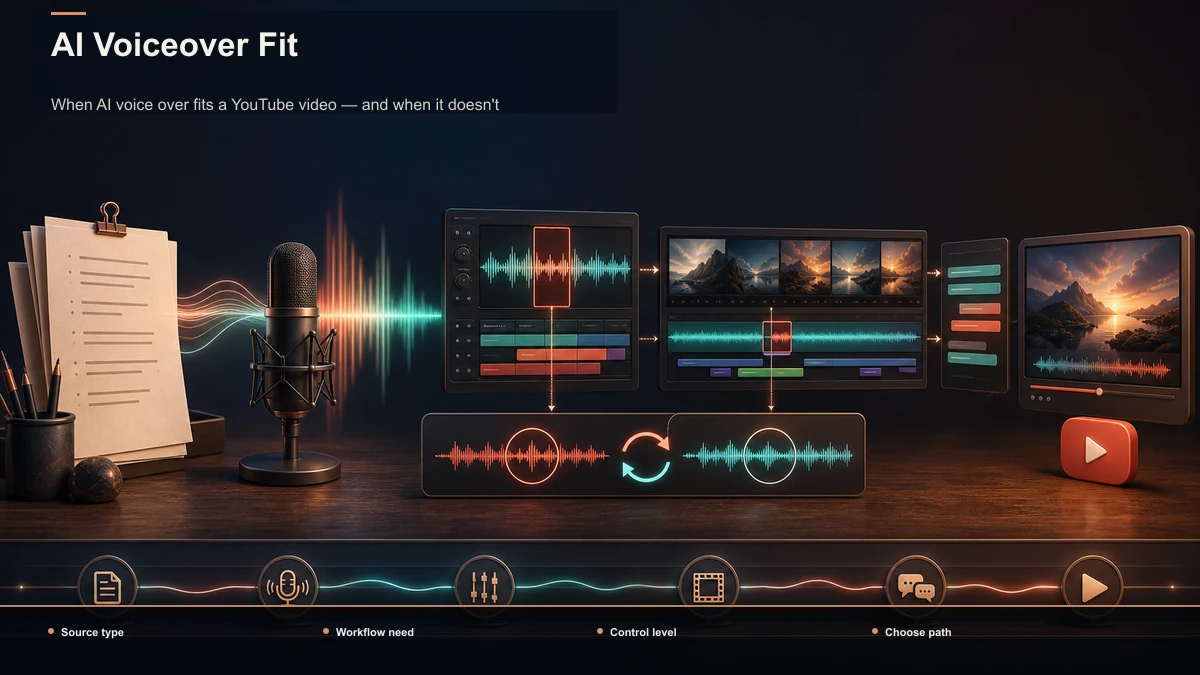
When AI voice over fits a YouTube video — and when it doesn't
Being honest about fit is the fastest way to get good results, so start by matching the tool to the job. AI narration earns its place in some formats and quietly costs you views in others.
| Video type | AI voice over fit | Why |
|---|---|---|
| Faceless explainers, tutorials, list videos | Strong | Narration-driven, no on-camera persona to break |
| Documentary-style recaps and summaries | Strong | A steady, neutral read suits long-form |
| News, "top 10," and update channels | Good | Fast turnaround and a consistent voice across episodes |
| Personal vlogs, reactions, opinion pieces | Weak | Viewers come for your voice and your reactions |
| Comedy timing, emotional storytelling | Weak | AI still misses true comedic beats and emotional swings |
The pattern is simple: AI voice over shines when the value is the information, not the personality. If your channel's draw is you, keep your own voice for the moments that carry emotion and let AI handle the utility segments — cold-open intros, factual recaps, or a scripted segment you'd otherwise skip. Many creators building a faceless channel run AI narration end to end; if that's your model, our guide on how to make faceless videos covers niche and format choices before you ever generate a track.
Write the script for the ear, not the eye
Here's the biggest lever, and most people never touch it. Flat, robotic YouTube AI voiceover usually isn't the model's fault — it's the script. Text written to be read on a page sounds wrong the moment it's heard. Rewrite for the ear with five habits:
- One idea per sentence. Long, clause-stacked sentences make any voice — human or AI — run out of breath and rhythm.
- Use contractions. "You'll," "it's," "don't." Spelled-out formal English ("you will," "it is") reads stiff and stops sounding like speech.
- Punctuate for pauses. A period is a full stop, a comma is a short beat. Add a line break where you want the voice to breathe. Most engines honor that structure.
- Cut written-only words. "Utilize," "aforementioned," "in order to" — nobody talks like that. Swap in "use," "that," "to."
- Read it aloud yourself first. If you stumble on a line, the AI will too. Fix the trip-ups before you generate anything.
A quick before-and-after:
Before (written for the eye): "Utilizing this methodology, creators are able to significantly increase their content output."
Scope of this guide: This is an end-to-end YouTube voiceover production workflow from script review to export. If a chosen voice sounds robotic or inconsistent, use the diagnostic steps in how to make an AI voice sound natural.
After (written for the ear): "Use this method and you'll make a lot more videos. Here's how."
The second version isn't dumbed down — it's paced for a listener, and that pacing is what makes an AI voice sound like a person instead of a screen reader.
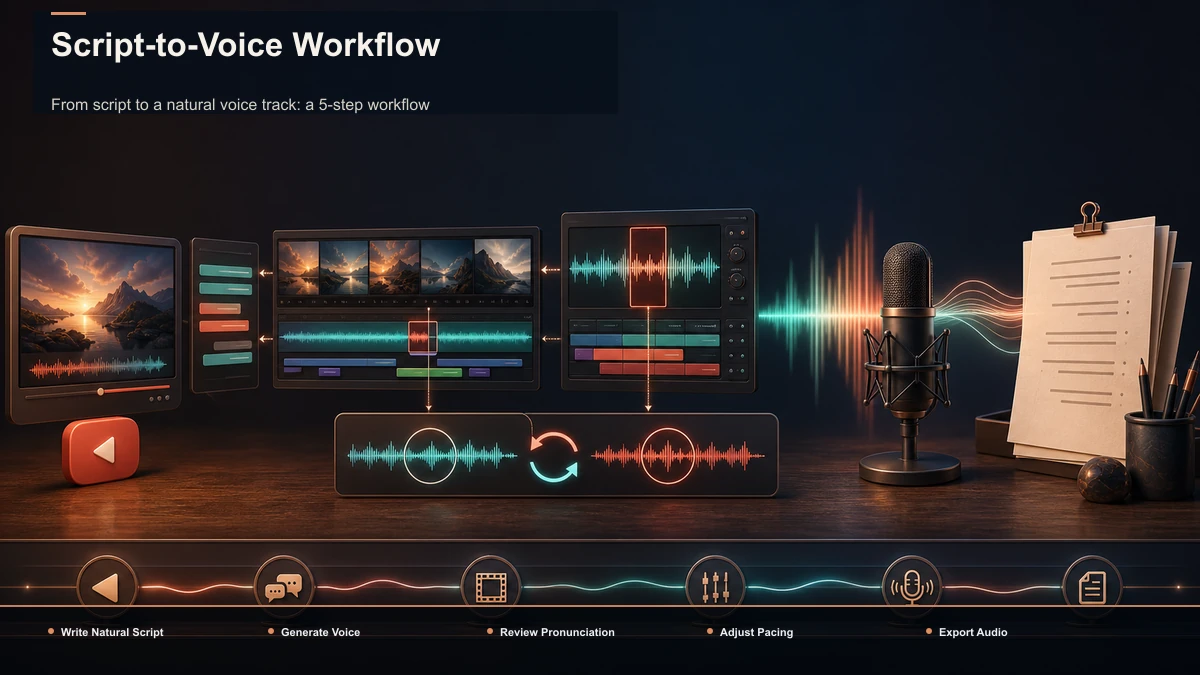
From script to a natural voice track: a 5-step workflow
Once the script reads well aloud, generating the voice is fast. Here's the repeatable lane:
- Paste the finished script into a text-to-voice tool. A text to speech video tool turns your written script directly into a spoken track in the browser — no microphone, no recording setup, no re-takes.
- Choose a voice and lock it. Audition a few, then commit. A voiceover maker lets you set a single voice you reuse across every episode, because a consistent narrator is part of your channel's identity — switching voices mid-series feels like a different show.
- Set the pacing. Slightly slower than you think for tutorials, a touch faster for high-energy list videos. Match the speed to how much the viewer needs to absorb.
- Generate section by section, not all at once. Render the intro, then the body, then the outro separately. It's far easier to regenerate a 15-second segment that came out wrong than to redo a 10-minute block.
- Drop the track onto your timeline and align it to visuals. Cut the video to the voice, not the other way around — the narration is your spine.
For a deeper breakdown of pacing, voice consistency, and stitching narration into a series, see our AI narration workflow for creators. The whole point of running this in one browser workspace is that steps 1 through 5 stay in a single tab instead of bouncing between a TTS site, an audio editor, and a video app.
Fix the words AI gets wrong
Every AI voice mispronounces something, and on YouTube one botched brand name in the first ten seconds reads as "low effort." The fix is to spell tricky words the way you want them heard, not the way they're spelled. Keep a small cheat-sheet for your niche — you'll reuse it every episode.
| What trips up AI voices | Example | Fix in the script |
|---|---|---|
| Acronyms | SEO, API, ROI | Decide letters vs. word: write "S-E-O" or "seh-oh" |
| Brand and channel names | Recapo, Nginx | Respell phonetically: "reh-KAH-poh," "engine-x" |
| Numbers and years | 2026, $4.99 | Write "twenty twenty-six," "four ninety-nine" |
| Homographs | read, live, lead, bass | Reword the sentence or respell for the intended sense |
| Foreign names and places | people, cities | Spell them out phonetically, syllable by syllable |
The efficient move: before you generate the full track, render a 20-second test built entirely from your hardest words. Fix them in the script, regenerate only that snippet, and move on. Doing this once per script catches nearly every "wait, that sounded wrong" moment before it reaches the timeline.
Captions aren't optional for AI-voiced videos
Viewers can encounter YouTube, Shorts, Reels, and TikTok content with the sound off. An AI voice with no captions loses those viewers completely. There's a second reason captions matter more for synthetic narration: if the voice mispronounces a niche term you didn't catch, accurate on-screen text corrects the record for readers.
You have an advantage most editors don't — the exact script. That means captions can be near-perfect from the start:
- Run auto captions on the finished cut to time text to the audio automatically.
- Paste your script in as the source of truth so spelling, names, and jargon match what you wrote.
- Proofread the fastest, most jargon-heavy 30 seconds — that's where errors hide.
- Style them to hold attention without covering faces or key visuals.
For the full captioning walkthrough — formats, styling, and burning subtitles in — see how to add subtitles to a video. Skipping captions on an AI-voiced video throws away the muted audience you worked to reach.
Disclose AI narration and keep the video monetizable
Two YouTube policies touch AI voice over, and both are the platform's to define — read them on YouTube's own Help pages rather than trusting any number a blog invents.
- Altered or synthetic content disclosure. YouTube asks creators to disclose realistic altered or synthetic content during upload. AI narration laid over real-looking footage can fall within scope, so check the current disclosure menu and rules before you publish.
- Monetization originality. The YouTube Partner Program requires original, authentic content, and recent policy specifically flags mass-produced, repetitious uploads as ineligible. AI voice over as a tool is fine; churning out interchangeable auto-generated videos on a template is the actual risk.
The practical stance: disclose when the upload flow asks, keep a human steering the research, script, and edit, and never let "AI voice" quietly turn into "AI everything, same template, every time." Used that way, AI narration is a production shortcut, not a compliance problem.
The voice over generators people compare — and how to test them yourself
Search "youtube voice over generator" and you'll meet the same names on nearly every results page. Here's each at its stable, publicly-known positioning — nothing about specific prices, quotas, or feature checklists, because those change constantly and you should verify them on each vendor's own site.
| Tool | Publicly known as |
|---|---|
| ElevenLabs | Known for realistic AI text-to-speech voices |
| Murf | Known for AI voiceover aimed at business and marketing |
| Speechify | Known for text-to-speech reading |
| LOVO | Known for AI voices with a built-in editor |
| Clipchamp | Known as a browser-based editor with TTS built in |
Don't decide from that grid — decide from your own content. Run this self-test, because it exposes the two things marketing pages hide: real output quality on your niche, and monetization risk.
- Take your hardest 200 words. Your real script, packed with your worst names and acronyms — not a sample.
- Generate the same passage in each contender with a comparable voice and pacing.
- Count the corrections each one needs: mispronunciations, awkward pauses, unnatural emphasis.
- Time script-to-usable-track, including fixes and regenerations. That number is your weekly reality.
- Confirm the license in writing for monetized use on YouTube, Shorts, Reels, and TikTok — synthetic voices can carry usage terms.
- Judge on your channel's voice, not a demo reel. Whatever wins on your script beats whatever wins a feature list.
Where Recapo fits, honestly: it's a browser-based AI video workspace — no install, accepts MP4, MOV, and other common formats, and handles up to 6GB total per task. For AI voice over specifically it covers the connected middle of the chain in one tab — script and summary, AI voiceover, transcription and captions, turning long videos into clips, vertical reframing, and cover and export. It isn't a voice-cloning lab or a keyword-research suite, so bring those if you need them. The value shows up when your channel is a recurring operation — script to voice to captions to clips, week after week — because that's a workflow, not a one-off. Pricing lives on the pricing page; check it there, not in any article.
FAQ
Is AI voice over allowed on YouTube, and will it hurt monetization? AI voice over is allowed. Monetization risk comes from how you use it, not the fact that you do. YouTube's Partner Program requires original, authentic content and excludes mass-produced, repetitious uploads — check the current rules on YouTube's own Help pages. Use AI narration to speed up a video you research, script, and edit yourself, and you're using it with editorial oversight.
How do I make AI narration sound natural instead of robotic? Fix the script before you blame the voice. Write short sentences, use contractions, punctuate for pauses, and read it aloud yourself first. Then spell tricky names and acronyms phonetically, generate section by section, and set pacing to match the content. Most "robotic" AI voiceover is text written for the eye being read out loud unchanged.
Do I need to disclose AI voice over on YouTube? YouTube asks creators to disclose realistic altered or synthetic content during upload. AI narration over real-looking footage can fall within that scope, so review the disclosure menu and current guidance on YouTube's Help pages when you publish. Treat disclosure as routine, not a red flag — it keeps you inside the rules.
Which AI voice over generator should I use for YouTube? There's no universal winner — it depends on your niche, your language, and how much correction you're willing to do. Instead of trusting a ranking, run the self-test above: same hard 200-word passage in each tool, count the fixes, time the workflow, and confirm the license for monetized use. The tool that needs the fewest corrections on your script is your answer.
Can I fix mispronounced words without re-recording the whole video? Yes — that's the advantage of AI voice over. Respell the problem word phonetically in the script, regenerate only that short section, and drop the corrected snippet back onto your timeline. You never re-render the full track, which is why a 20-second pronunciation test up front saves so much time.
Building AI voice over into a real YouTube workflow — not a one-off experiment? Create a Recapo account, paste one finished script, and run it end to end: text to a natural voice track, auto captions from that same script, then clip and reframe the long video into Shorts. Time how long a complete, captioned, AI-narrated video takes from script to export. If keeping the voiceover, captions, and clips in one browser tab saves you the exports you're doing today, you'll feel it on the very first upload.