Fair Use for Movie Recap Videos: What Actually Protects You
Are movie recaps fair use? An honest guide to the four factors, the clip-length myths, how Content ID really behaves, and a workflow to lower your risk.

Are movie recaps fair use? Sometimes — but "movie recap" is not a magic legal category that automatically shields you. In the United States, fair use is decided case by case under four factors, and plenty of recap channels get claims, strikes, or lawsuits because they assumed a label or a stopwatch trick made them safe. This guide walks through those four factors as they actually apply to recap and summary videos, debunks the clip-length myths that circulate on forums, explains how YouTube's Content ID behaves in practice (it is not the same thing as the law), and gives you a concrete editing workflow to reduce your risk. One thing up front: this is general information, not legal advice — for a specific project, talk to a qualified attorney in your country.
Key Takeaways
The short answer: "it depends," and here is what it depends on
Fair use is a legal defense, not a permission slip. It does not exist until someone challenges you and a court (or, in practice, a platform's process) weighs your specific video. That is the single most important thing to internalize about movie recap copyright rules: there is no pre-approval, no safe word, and no runtime that flips a switch from "infringing" to "legal."
The doctrine is US-specific. It lives in Section 107 of the US Copyright Act. Other countries use different frameworks — the UK, Canada, and Australia use "fair dealing," which is narrower and category-based, and many jurisdictions have no equivalent flexible exception at all. If your audience or your company sits outside the US, do not assume American fair use travels with you.
So when someone asks "are movie recaps fair use," the honest answer is: a transformative critique or analysis that uses limited material and does not substitute for the film has a real fair-use argument; a start-to-finish plot retelling built on the movie's own footage and audio has a weak one.
The four fair-use factors, applied to recaps
US courts weigh four factors together — no single one is decisive, and they interact. Here is what each one asks and how it plays out for recap content specifically.

| Factor | The question courts ask | Helps a recap | Hurts a recap |
|---|---|---|---|
| 1. Purpose & character | Is the use transformative? Commercial or not? | Criticism, commentary, analysis, parody, education; adding new meaning | Pure entertainment retelling; monetized re-hosting with no added insight |
| 2. Nature of the work | Is the source creative or factual? | Using it to comment on the work | Films are highly creative — this factor usually leans against you |
| 3. Amount & substantiality | How much, and is it the "heart" of the work? | Short, purposeful excerpts tied to your point | Long stretches, or the climax/twist that is the film's core value |
| 4. Market effect | Does your video harm the market for the original? | Drives interest, does not replace viewing | Lets people skip watching the movie entirely |
Notice that Factor 2 usually tilts against recappers, because movies are exactly the kind of creative expression copyright most strongly protects. That means Factors 1, 3, and 4 have to do the heavy lifting — which is why the transformative question matters most.
Transformative vs. substitutive: the line that matters most
Courts repeatedly return to a simple test: does your video replace watching the film, or does it add something new? That distinction ties Factor 1 and Factor 4 together, and it is where most recap channels win or lose.

A video that narrates the entire plot in order, over the movie's own footage and score, with your voice mostly describing what is on screen, leans substitutive — a viewer can watch it instead of the film. A video that uses limited clips to support original criticism, comparison, historical context, or genuine analysis leans transformative — it gives the audience something the film itself does not.
Practical implications:
High-risk vs. low-risk recap patterns
No pattern is "guaranteed legal" — fair use is always fact-specific — but some editorial choices consistently strengthen your position and some weaken it.

| Lower-risk pattern | Higher-risk pattern |
|---|---|
| Short, purposeful clips illustrating a point you are making | Long continuous stretches of the film |
| Your original script carries the video; footage supports it | Footage carries the video; narration just describes it |
| Genuine analysis, critique, comparison, or context | Straight plot retelling with no added viewpoint |
| Withholding or lightly referencing the ending | Revealing the full climax and resolution |
| Mixing in your own commentary, B-roll, and graphics | Wall-to-wall studio footage with a voiceover on top |
| Licensed, public-domain, or promotional material where possible | Ripped copies of the full theatrical release |
The right column is not "illegal" and the left column is not "bulletproof." But if you are choosing how to build a channel that survives, spend your effort making videos look like the left column.
Myths that get channels claimed, demonetized, or sued
Forums are full of confident, wrong advice. Here are the recurring myths behind most "how to avoid copyright on movie recaps" searches — and why they do not hold up.
- "Anything under 5, 10, or 30 seconds is automatically fair use." False. There is no magic duration in the law. Courts look at amount and substantiality — a few seconds of the pivotal twist can weigh more heavily against you than a minute of a throwaway scene.
- "If I credit the studio, it's fine." Attribution is polite and sometimes required elsewhere, but giving credit does not create a fair-use right. You can be perfectly transparent about the source and still infringe.
- "If I don't monetize, I'm safe." Non-commercial use helps under Factor 1, but it is only one input. Non-commercial infringement is still infringement, and non-monetized videos still get Content ID claims and takedowns.
- "Mirroring, zooming, pitch-shifting, or speeding up the clip beats the system." These tricks are aimed at fooling automated matching, not at satisfying the law. Manipulating footage to evade detection does nothing for your fair-use argument and can make you look like a bad-faith actor if a dispute escalates.
- "Reaction or recap is a category, so it's automatically transformative." No genre is automatically anything. A lazy reaction that just replays the film is substitutive; a thoughtful one that adds real commentary may be transformative. The label does not decide it — the content does.
How Content ID actually works (and why it is not the law)
This is where creators get the most confused, so let's separate two systems that people constantly mix up.
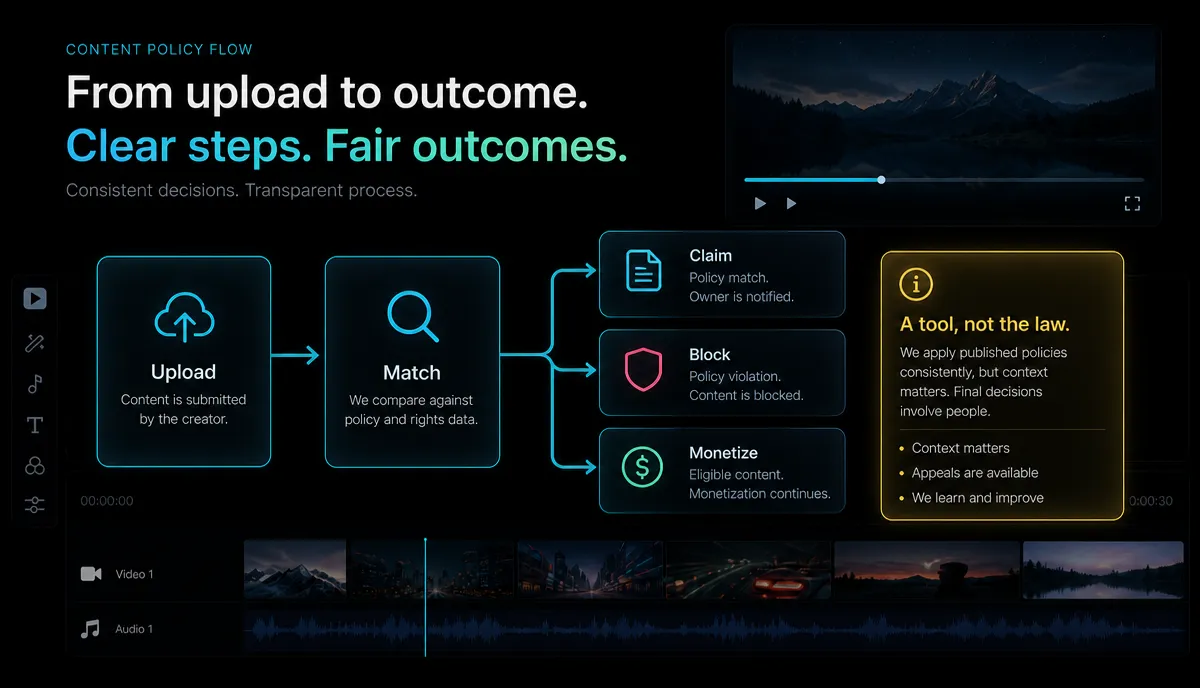
Content ID is YouTube's automated matching system. Rights holders upload reference files; YouTube scans uploads for matches in video and audio. When it finds one, the rights holder's chosen policy kicks in automatically — typically one of: block the video (in some or all regions), monetize it by running ads and sending the revenue to the rights holder, or track its viewership. You usually receive a "Content ID claim," which is not the same as a copyright strike.
Key realities that surprise people:
The takeaway: build videos that are actually defensible, and treat Content ID as a business-operations layer sitting on top of the legal question, not as a substitute for it.
A practical risk-reduction workflow
You cannot eliminate risk, but you can stack the deck. Here is a workflow that keeps the transformative value high and the borrowed material lean. Recapo is a browser-based editing workspace, so these steps run start to finish without installing anything.
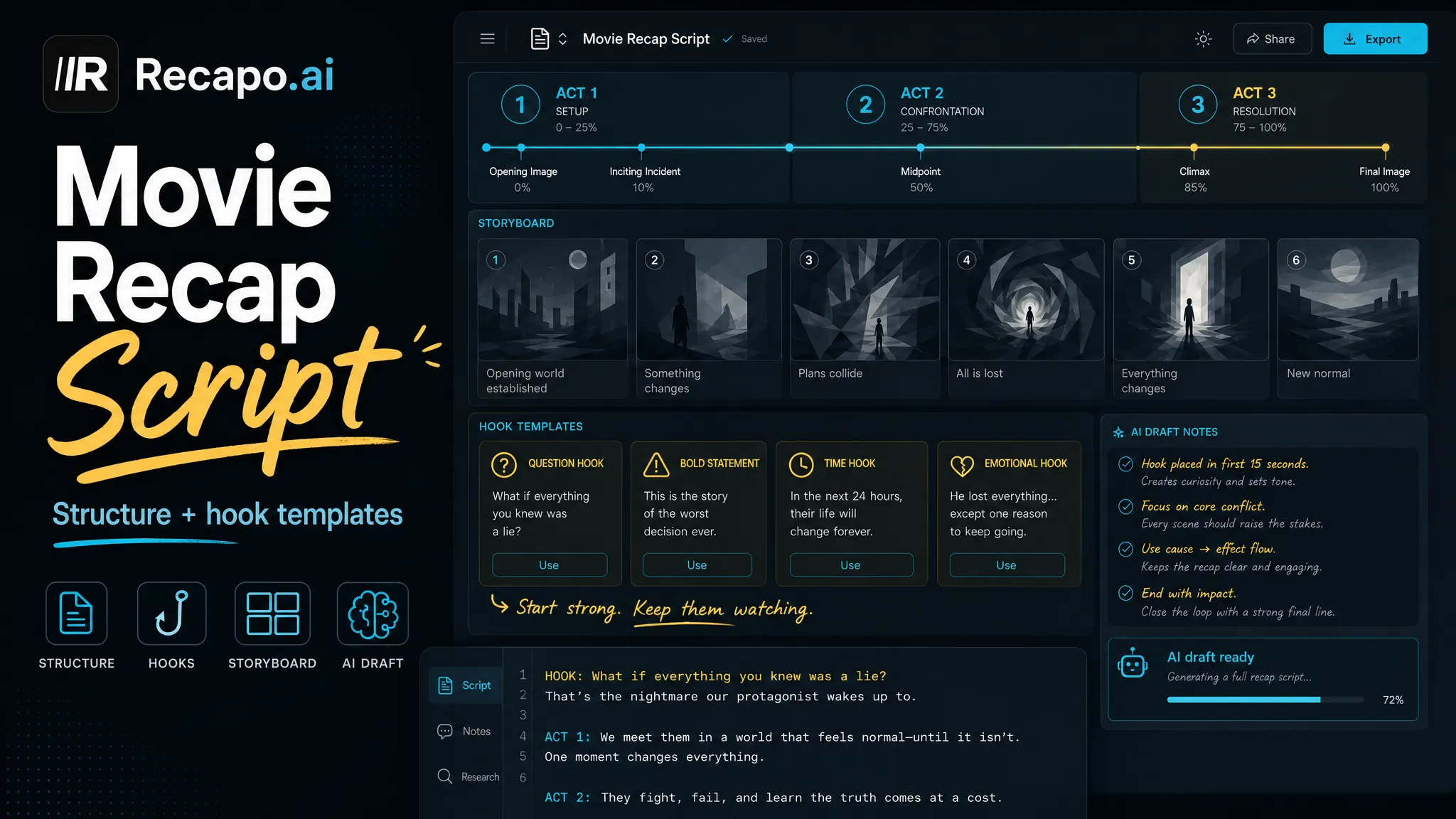
- Start from your own script, not the footage. Write the analysis or angle first so the movie's material is illustrating your point rather than the other way around. If you need help structuring a beat sheet, the plot summary generator turns your notes into a clean outline you can then rewrite in your own voice — see how to write a movie recap script for the full method.
- Map only the moments you truly need. Use the scene breakdown generator to identify the specific beats your commentary references, so you pull short, purposeful excerpts instead of long stretches. Less material, more purpose — that is Factor 3 working in your favor.
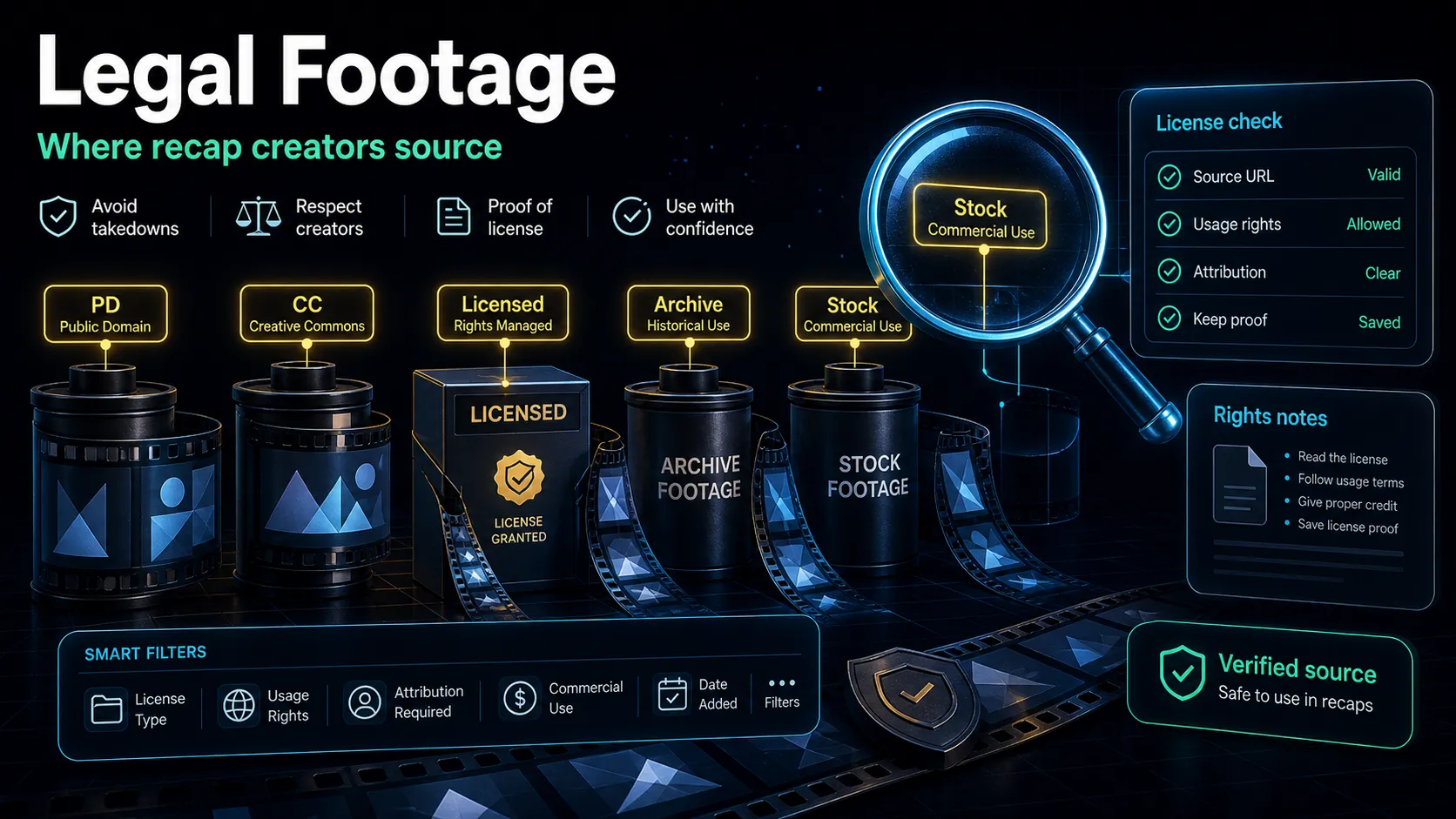
- Source material you have a right to use. Where possible, lean on licensed, public-domain, or official promotional assets rather than a ripped theatrical copy. Where to find licensed footage for recaps covers legitimate options.
- Build your own layer. Record original narration or an AI voiceover, and add your own graphics, B-roll, on-screen analysis, and captions. The more of the runtime that is yours, the stronger your position.
- Withhold the payoff. Reference the ending without spooling out the full climax. Point viewers toward the film for the resolution — this helps Factor 4 and keeps you out of "heart of the work" territory.
- Publish clean, and keep records. Export a vertical or horizontal cut for your platforms, and keep a note of your sources and licenses. If you run a faceless channel, how to start a faceless movie recap channel has a repeatable production loop.
None of these steps converts a plot dump into fair use. What they do is push your videos toward the transformative, limited-use, non-substitutive end of every factor — the end where a fair-use argument actually lives.
FAQ
Are movie recaps fair use on YouTube? There is no blanket answer. A transformative recap that adds criticism or analysis, uses limited material, and does not replace watching the film has a genuine fair-use argument under US law. A full plot retelling built on the movie's footage has a weak one. YouTube itself does not decide fair use; only a court does. Fair use for YouTube recap channels is a spectrum, not a checkbox.
Is there a clip length that is automatically legal? No. The "under X seconds is fine" rule is a myth. The law looks at how much you use and how important that portion is. A few seconds of the central twist can hurt you more than a minute of a minor scene. Duration is one input, never a guarantee.
Does giving credit or saying "no copyright infringement intended" protect me? No. Attribution and disclaimers do not create legal rights. You can name the studio, disclaim intent, and still infringe. What matters is whether your use is transformative, limited, and non-substitutive — not what you write in the description.
What is the difference between a Content ID claim and a copyright strike? A Content ID claim is an automated match that usually affects monetization or visibility and does not, by itself, endanger your channel. A copyright strike is a formal legal removal request that can lead to channel termination if you accumulate several. They are separate systems with very different stakes.
How do I lower my risk without a lawyer? Make the video transformative: lead with your own script and analysis, use short purposeful clips, prefer licensed or public-domain material, add original narration and graphics, and avoid dumping the full ending. This does not guarantee anything, but it moves every fair-use factor in your favor. For high-stakes projects, still consult an attorney.
Fair use rewards creators who add real value and punishes those who just re-host. If you build recaps around your own script, analysis, and voice — with the film's material kept short and purposeful — you are working with the law instead of against it. Recapo gives you a browser-based place to write the script, break down only the scenes you need, add captions and voiceover, and export for YouTube, TikTok, Shorts, or Reels. Create a free account and build your next recap the defensible way. (Reminder: this article is general information, not legal advice — for any specific project, consult a qualified attorney.)