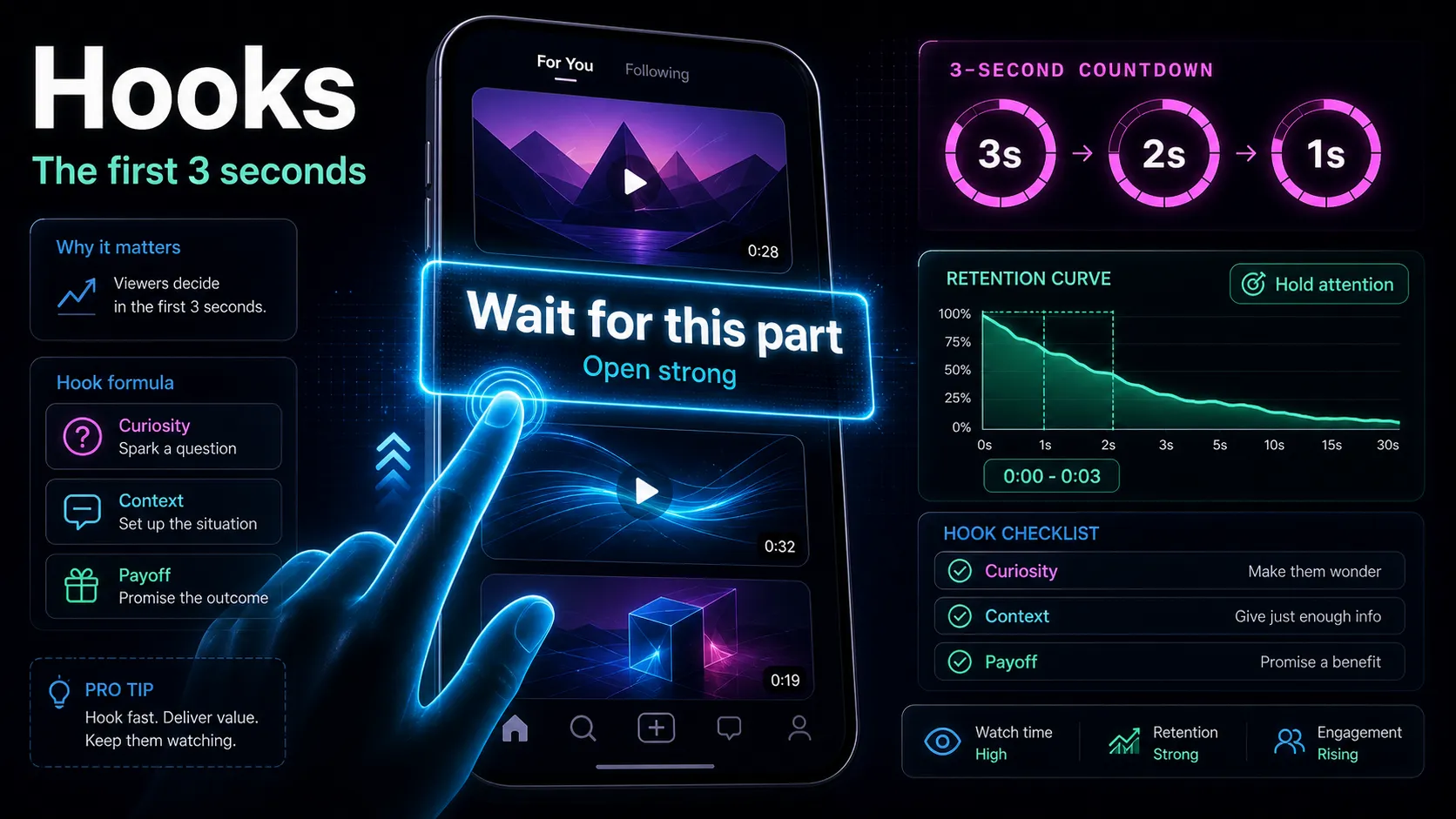
Recap Video Hook Formulas to Test
Use five recap-video hook structures, then test each against one audience promise without treating a fixed opening threshold as a guarantee.
By the Recapo.ai Editorial Team · Fact-checked July 10, 2026
A recap hook can state a story question, claim, comparison, or time-compression promise, but no formula or three-second rule guarantees that viewers continue. The opening must accurately match the video, remain understandable to the intended audience, and use source material with a documented basis.
This guide offers five structures as writing prompts, then shows how to compare them with the same story and channel data. It separates performance testing from copyright review; neither a hook formula nor an editing treatment creates permission to use third-party footage.
Information note: This is general information, not legal advice. Copyright outcomes depend on the facts and jurisdiction; primary sources were checked on July 10, 2026.
Official source map: For testing recap hooks, the discovery, fair-use, and Content ID points below are tied to YouTube discovery guidance, YouTube's fair-use guidance, Content ID documentation.
Key Takeaways
Why a recap needs its own hook formula
Tutorial openings often promise a result, while a recap opening usually frames a story question, stake, interpretation, or compression promise. The useful distinction is whether a new viewer can understand the subject and what the video will deliver without prior context.
A story gap is one drafting model: pose a question, stake, or claim that the video later resolves. It is not a proven five-second mechanism or a guarantee of retention. Use it only when the source and the finished video can support the promise accurately.
When audio is unavailable, on-screen text can preserve the premise and improve accessibility. Put essential wording in the opening section, then preview its timing, contrast, line breaks, and placement instead of assuming every promise belongs on the first frame.
What a recap hook needs to communicate
The opening should identify enough of the subject, tension, or promised payoff for the intended viewer to understand why the story matters. Some videos can do that immediately; others need more context. YouTube does not publish a universal three-second hook threshold.
Draft multiple accurate versions, preview each with the first section of the edit, and reject any promise the video cannot fulfill. Keep the text short enough for the actual screen and reading context, not an arbitrary word count.
Five recap video hook formulas to test
These five structures are prompts to test, not a ranking. Every example is fictional and generic; replace it with accurate wording based on material you have a documented basis to use.
| Cold open | "Wait — what led to this?" | Thrillers, horror, twist-heavy plots | "He'd already buried the body by the time the neighbors woke up." | Unanswered question | "I need to know why." | Mysteries, character studies, morally grey stories | "Why would a man burn down the only house he ever loved?" | Counterintuitive claim | "That can't be right — prove it." | Analysis recaps, hot-take channels | "The villain was right, and the movie quietly agrees." | Stakes-first | "What happens if they fail?" | Action, survival, ticking-clock plots | "One wrong answer and the whole town is gone by sunrise." | Time-compression promise | "Give me the whole thing, fast." | Series recaps, catch-up videos, 60-second recaps | "Three seasons, one betrayal, sixty seconds — starting now." |
1. The cold open — drop them mid-story
Skip the setup and open on the aftermath or the most charged moment, then let the recap rewind to explain it. The gap is causal: the viewer sees a shocking result and has to know what led there.
Test it when the story has a moment that remains understandable outside its original sequence. Reject the version if it misrepresents the source, reveals more than intended, or depends on missing context.
2. The unanswered question
Open on a question that the video can answer and that a new viewer can understand. Some stories support one central "why" or "how"; others need a claim, comparison, or setup instead.
Use it for mysteries and character studies. Keep the question specific; a vague "what happens next?" opens no real gap.
3. The counterintuitive claim
Open by asserting something that contradicts the obvious reading of the story, then spend the recap defending it. The gap is a challenge: the viewer wants to see whether you can back it up.
Use it for analysis or hot-take channels where your point of view is the product. The honest constraint: the recap has to actually earn the claim, or it curdles into clickbait.
4. Stakes first
Lead with what's at risk and how little time there is to fix it. The gap is dread — the viewer stays to find out whether the worst case lands.
Use it for action, survival, and ticking-clock plots. It falls flat on low-stakes stories, so don't force danger that isn't there.
5. The time-compression promise (the recap intro hook)
State the format and scope directly: how much material the video covers and in what runtime. This gives the viewer a concrete expectation, but it does not guarantee that the compression will be useful or engaging.
Use it for series catch-ups and 60-second recaps. Then honor the promise: if you say sixty seconds, don't run three minutes.
Test one primary promise at a time
Stacking several unrelated promises can reduce clarity, but there is no public rule that every opening must contain exactly one hook. Start with one primary promise so the test is interpretable; add another line only when it supplies necessary context and the combined opening remains coherent.
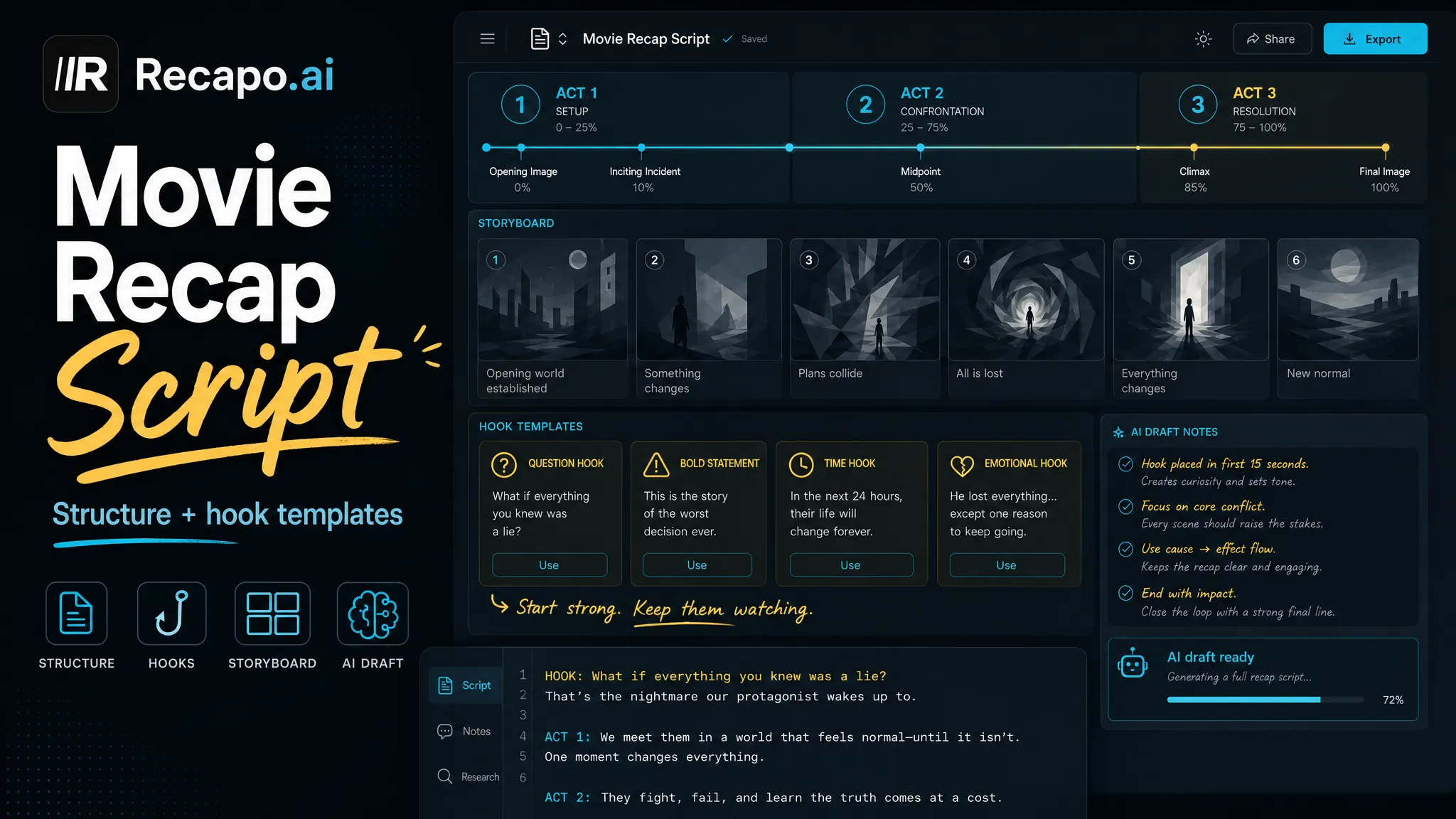
Choose a structure that matches the story and build the rest of the video to fulfill its promise. Compare alternative openings on similar content and at the same observation age. For how the opening connects to the full narrative, see how to write a movie recap script.
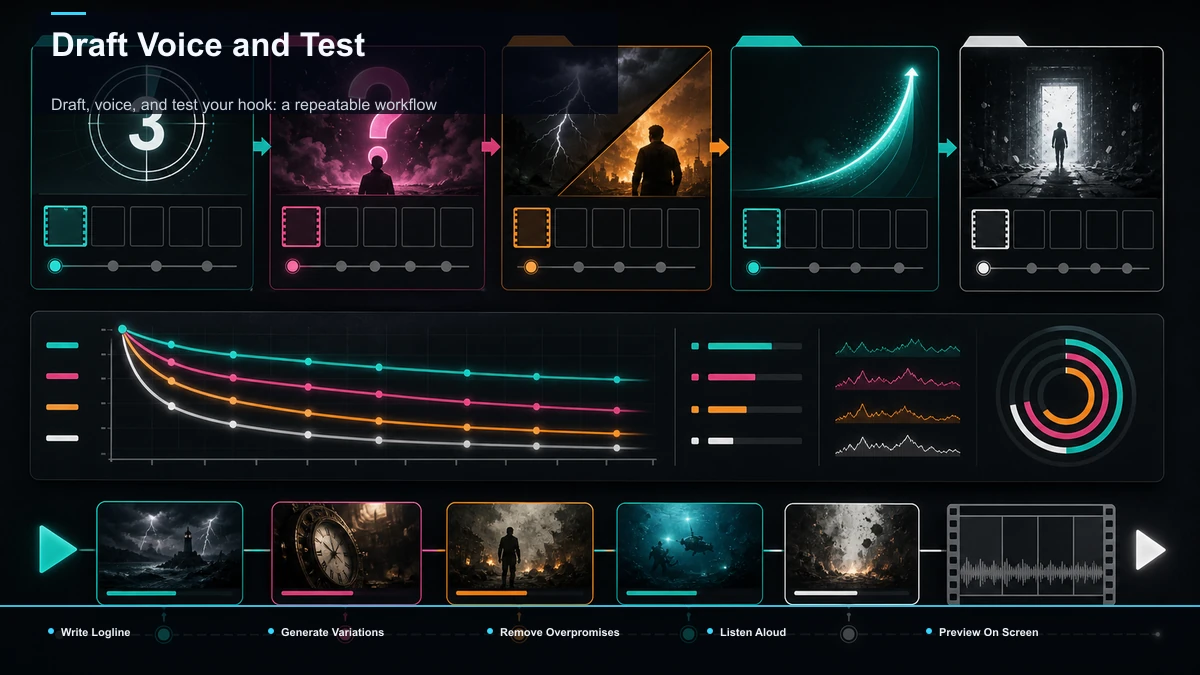
Draft, voice, and test your hook: a repeatable workflow
Draft several accurate openings, then select one with editorial review and channel evidence:
- Write the logline. In one sentence, what is this recap actually about? You can't hook a story you can't summarize.
- Generate variations. Apply several formulas to the same logline. A hook generator can produce draft angles, but each output still needs accuracy, rights, tone, and duplication review.
- Cut the overpromises. Run each candidate through the self-test below and delete anything the video can't pay off.
- Hear it out loud. Read the leading versions or use a voiceover maker to compare clarity, pace, pronunciation, and emphasis in the actual opening.
- Preview it on screen. Add essential wording where it remains readable when audio is unavailable, then check the real device and interface placement.
Use this four-question self-test on every candidate before you commit:
Review source rights before using hook footage
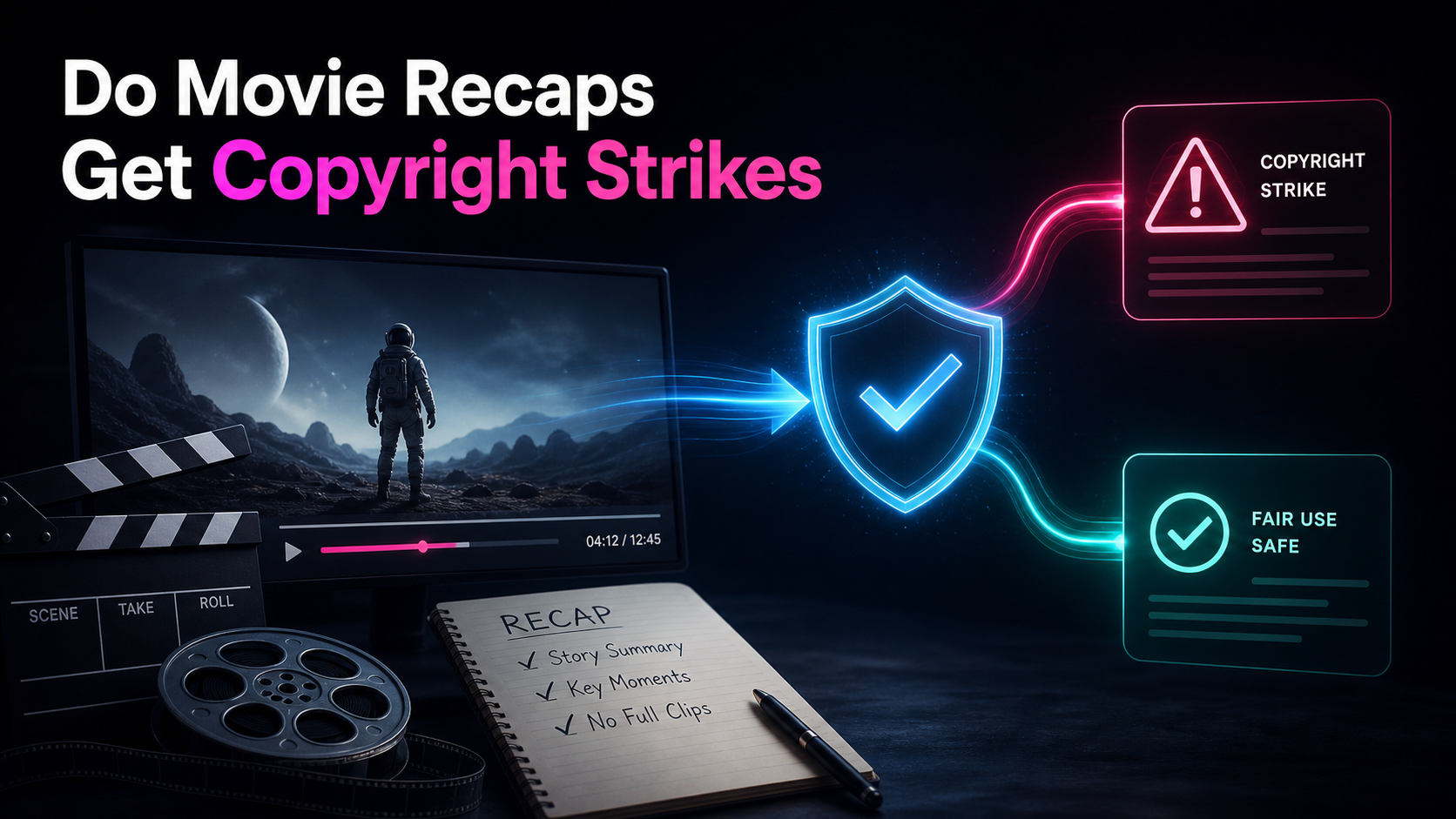
YouTube Content ID compares uploaded audio and video with reference files supplied by participating rights holders. A match may generate a monetize, block, or track policy; a copyright strike is a separate legal removal process.
Leading with original narration or commentary can clarify the editorial purpose, but it does not grant rights, stop fingerprint matching, or guarantee fair use. Document each image, clip, music cue, and quotation; use original, licensed, verified public-domain, or otherwise permitted assets where possible; and read any notice before responding.
Copyright exceptions are fact-specific and jurisdiction-specific. No clip length, crop, caption, or "transformative" label guarantees the result. This is general information, not legal advice.
FAQ
What is a recap hook formula? It is a reusable writing prompt such as a cold open, unanswered question, counterintuitive claim, stakes-first line, or time-compression promise. It is not a platform requirement.
How long should a recap hook be? Long enough to make the real premise understandable and short enough for the intended screen. Test alternatives; there is no universal three-second limit.
Can I use more than one hook? You can test different structures, but each published opening should make a coherent promise. Stacking lines is not automatically harmful; judge clarity and audience response.
Will hook footage receive a copyright claim? It can. Content ID can match audio or video regardless of the opening formula. Original narration and editing do not guarantee avoidance or determine fair use.
Test several openings on one documented story
Write several accurate framings, preview them with the edit, keep the source record beside each visual, and compare results against your channel baseline. Create a free Recapo account to test hook drafting, voiceover, captions, vertical framing, cover, and export in one browser workflow. The tool supports production; it does not control distribution or copyright outcomes.
References and official sources