Best AI Voice for YouTube: How to Choose
There's no single best AI voice for YouTube — choose by niche, test candidates on the same script, and check commercial licensing.
By the Recapo.ai Editorial Team · Fact-checked July 10, 2026
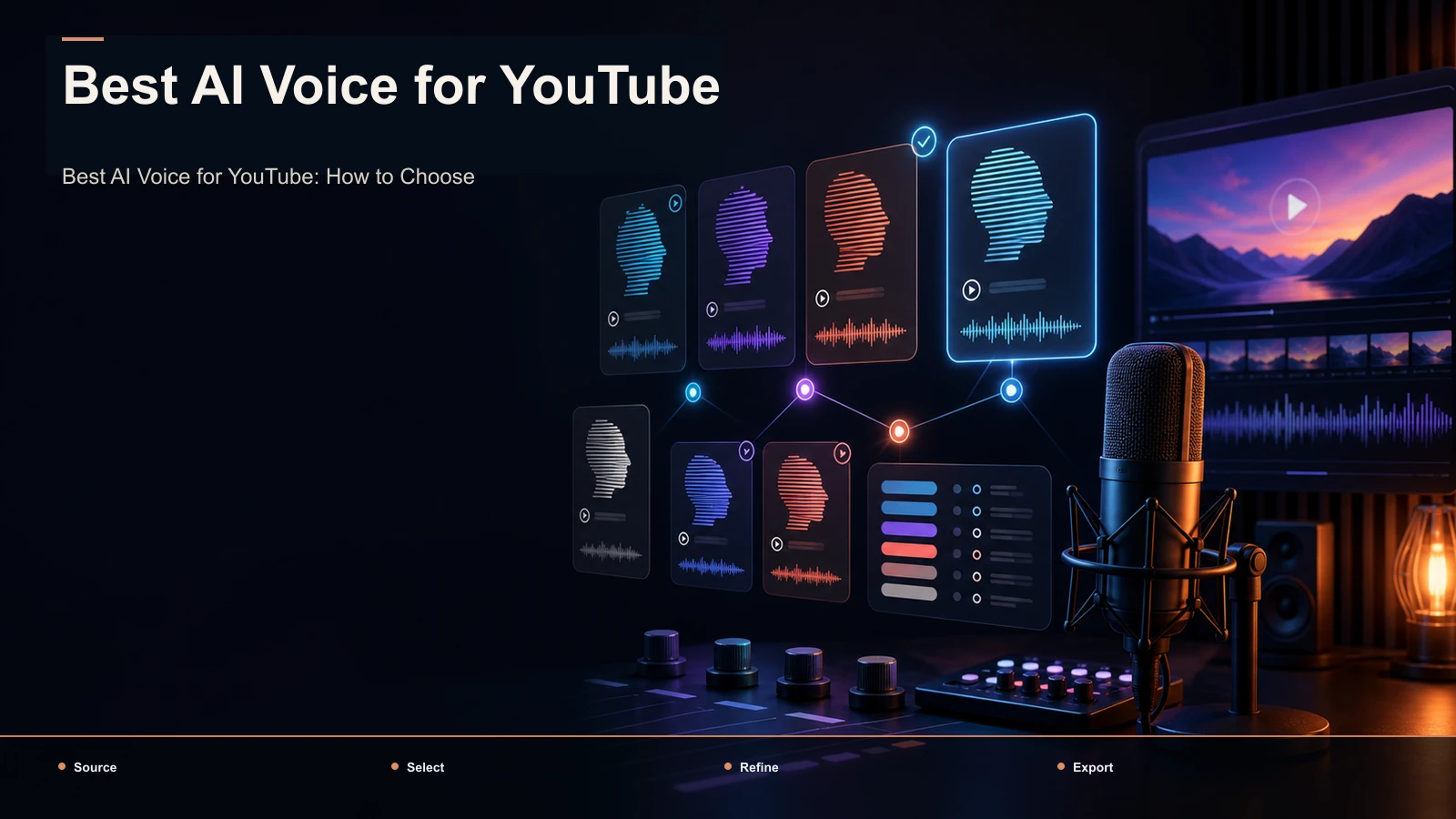
Searching for the best AI voice for YouTube usually means one specific thing: you're about to commit a whole channel to a narration voice, and you don't want to pick wrong. Here's the honest framing this guide is built on — there is no single best AI voice for YouTube, because the right voice depends on your niche, how long your typical audio runs, and whether the license actually covers a monetized channel. Instead of crowning one voice, this guide gives you a neutral way to choose: match the voice to your channel type, test candidates on the exact same script, and verify commercial rights before you stack a hundred videos on top of one voice.
Scope of this guide: This page compares voice-selection criteria across YouTube formats. For sustained story pacing, names, and recap-specific audition passages, use AI voices for recap narration.
Key Takeaways
- There's no universal "best" AI voice for YouTube — the right pick is a fit between your niche, your audio length, and your licensing needs.
- A voice that sounds great in a 10-second demo can drift, mispronounce, or turn robotic across an 8-minute narration. Long-audio stability is the real test.
- Pick one voice and keep it. A consistent voice becomes your channel's audio identity, the way viewers recognize you before they see the thumbnail.
- Commercial licensing is not optional. Confirm each vendor's terms cover monetized use, and follow YouTube's own disclosure rules for synthetic content.
- Recapo fits by generating a consistent channel voiceover inside your editing workflow — not as a standalone voice-cloning lab.
Why there's no single "best AI voice for YouTube"
Type the query and the results are almost entirely vendor pages and brand-owned rankings — each one, unsurprisingly, concluding that its own voice wins. That's the first thing to discount. A "best ai voice generator youtube" list written by a voice company is a sales page, not a comparison.
The deeper reason there's no universal winner is that a YouTube voice does a job, and the jobs differ wildly. A calm, measured voice that's perfect for a meditation channel would tank a high-energy gaming channel. A crisp, neutral narrator that suits finance explainers sounds cold reading a horror recap. "Best" only means anything once you attach it to a niche, an audio length, and a budget. So the useful question isn't "which voice is best?" — it's "which voice is the best fit for the channel I'm actually building?"
Match the voice to your niche
Start here, because niche fit decides more than any spec sheet. Below are common YouTube lanes and the voice qualities that tend to land in each. Treat it as a starting hypothesis, then confirm with the same-script test further down.
| Channel niche | Voice qualities that fit | What to avoid |
|---|---|---|
| Faceless explainer / educational | Clear, neutral, steady pacing, good on jargon | Over-emotive delivery that distracts |
| Movie / TV / anime recap | Warm, expressive, slight drama, natural pauses | Flat monotone that kills tension |
| Finance / news / commentary | Authoritative, crisp, unhurried | Casual or overly bright tone |
| Storytelling / documentary | Rich, textured, capable of long even passages | Voices that drift over multi-minute reads |
| Tech tutorials / how-to | Friendly, articulate, precise on terms | Robotic seams between sentences |
| Gaming / hype / entertainment | Energetic, dynamic range, personality | Slow, corporate-sounding narration |
| Calm / wellness / ASMR-adjacent | Soft, smooth, low-variance | Sharp consonants and hard cuts |
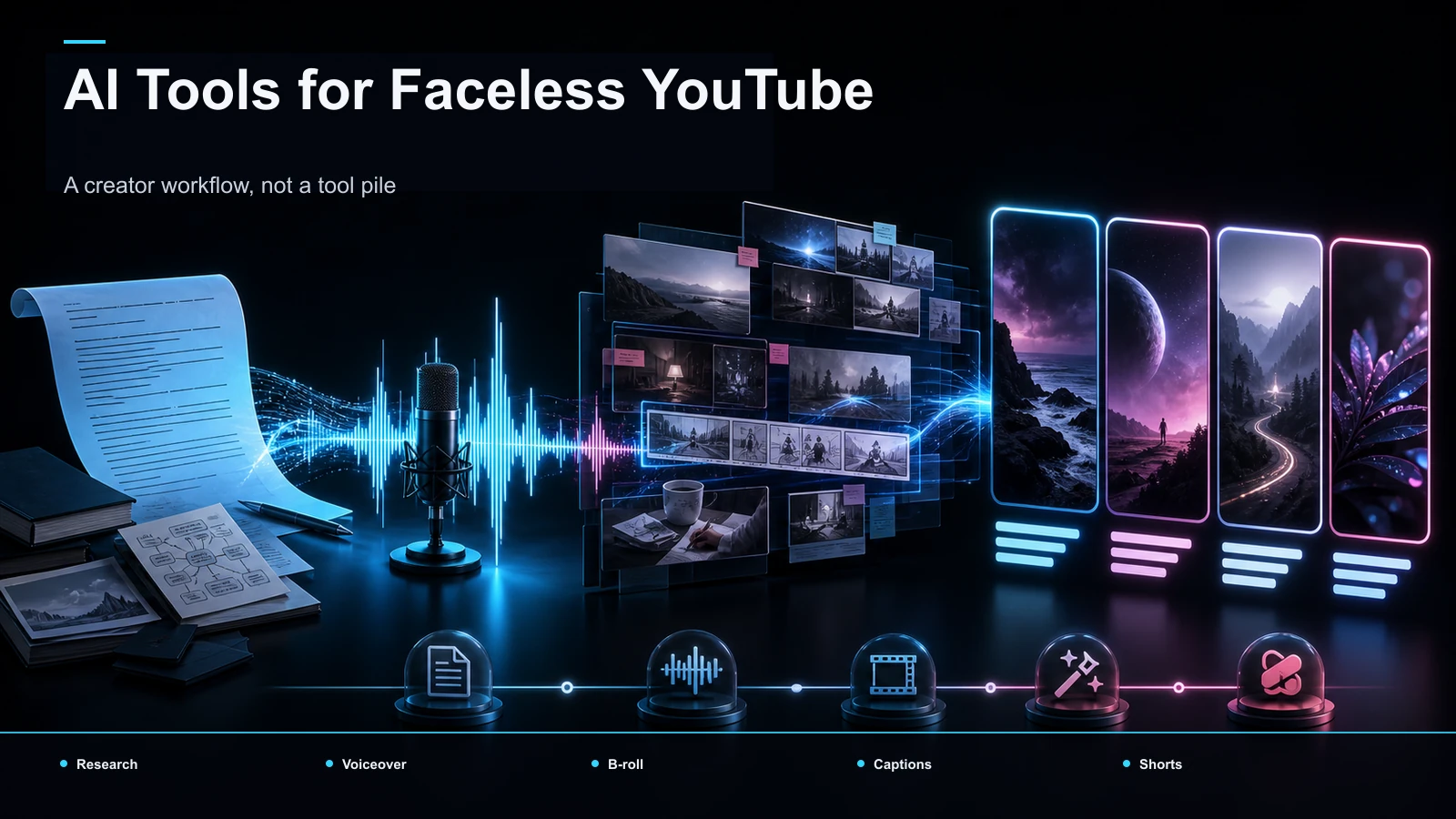
If you run a faceless channel, this table is your most important filter — an ai voice for faceless channel work has to carry the entire video alone, with no face, no gestures, nothing else to hold attention. The voice is the personality. Get the niche match right and half the battle is over. For a wider view of the faceless stack around the voice, the best AI tools for faceless YouTube channels covers the pieces that surround narration.
The three things that separate a good YouTube voice
Once you've narrowed by niche, three factors decide whether a voice actually survives a real channel. Demos hide all three, which is why so many creators pick a voice that sounds great for one line and falls apart by video ten.
1. Long-audio stability. Most demos are a single polished sentence. YouTube narration runs minutes. Some AI voices develop artifacts, shift energy, or mangle a name three paragraphs deep. The best youtube narration voice for you is the one that holds up across your actual video length, not a 10-second clip. Always test a passage as long as your typical script.
2. A consistent voice identity. Your voice is a recognizable signature. If you swap voices between uploads — or the same "voice" sounds different from one generation to the next — you erode the audio brand viewers subscribe to. When you finally choose an ai voice youtube setup, commit to one voice and keep every setting identical so episode 50 matches episode 1.
3. Commercial licensing. This is the one creators skip and regret. A voice being free to generate does not mean it's cleared for a monetized channel. Read each vendor's terms for commercial and ad-supported use before you build on it. Separately, YouTube requires creators to disclose meaningfully altered or synthetic content in certain cases — check YouTube's own official policy pages for the current disclosure requirements rather than any third-party summary. Getting licensing wrong doesn't cost you a video; it can cost you the channel.
How to run a same-script voice test
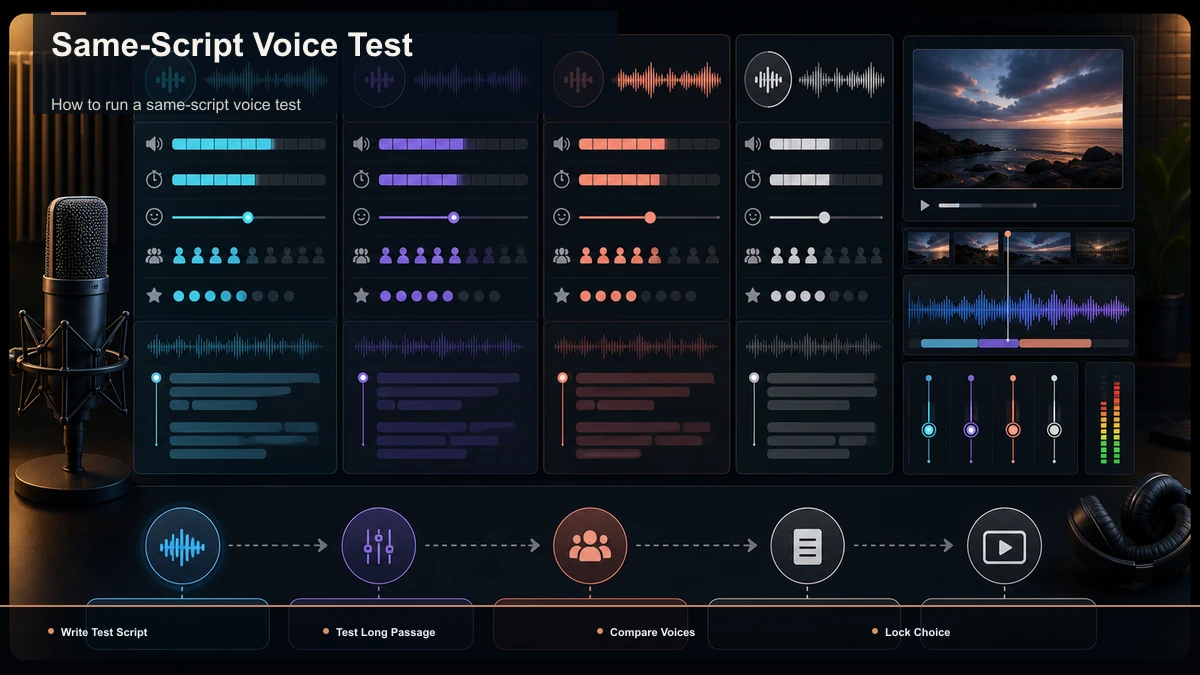
The only comparison that counts is your script, in your niche, at your real length. Vendor demos are cherry-picked; your test shouldn't be. Run every candidate through the same steps so results are truly comparable.
- Write one representative script. Use a real 60–90 second passage from your channel — including the names, numbers, and jargon your niche actually uses. Don't test on a generic paragraph.
- Generate the identical script in every candidate. Same words, same punctuation. You can draft narration from your script inside Recapo's text-to-speech video tool to hear it against your footage rather than in isolation.
- Listen on a phone speaker, not headphones. Most of your audience watches on a phone, often in noisy places. A voice that's fine in studio headphones can turn thin or harsh on a phone.
- Stress-test a long passage. Now feed 3–5 minutes of continuous narration and listen for drift, energy dips, robotic seams, and mispronounced names. This is where weak voices break.
- Check pronunciation of your niche's hard words. Character names, brand names, technical terms, foreign words. If a voice botches a name that appears every episode, it's disqualified.
- Confirm the license before you fall in love. Verify commercial/monetization rights on the vendor's current terms page. A great voice you can't legally monetize is not an option.
- Decide, then lock it. Pick the voice that needs the least babysitting on your real script, and record the exact settings so every future video matches.
Score every voice the same way
To keep the test honest, grade every candidate on the same dimensions instead of going by first impression. Each row is something you test yourself — never a number pulled from a comparison article, including this one.
| Dimension | Why it matters for YouTube | How to test it yourself |
|---|---|---|
| Niche fit | A mismatched tone repels your exact audience | Play it to someone in your target audience, watch their reaction |
| Long-audio stability | Narration runs minutes, not seconds | Generate 3–5 min continuous, listen for drift |
| Naturalness | Robotic seams break immersion | Count the sentences that sound machine-stitched |
| Pronunciation | One botched recurring name is fatal | Feed your niche's hardest words and names |
| Consistency | Your voice is your audio brand | Generate the same line twice, compare |
| Emotional range | Recaps and stories need dynamics | Test a tense line and a calm line back to back |
| Licensing clarity | Monetization depends on it | Read the commercial-use terms on the vendor page |
| Workflow fit | A voice you can't get into your edit costs hours | Try moving one clip's audio into your editor |
The last row ambushes people. A voice can be perfect and still cost you hours if it lives in a separate app and you're constantly exporting and re-importing audio. Where the voice lives in your workflow matters almost as much as how it sounds.
Where the popular options sit
You'll see the same names repeatedly, so here's a positioning-level map — not a feature ranking, and deliberately with no invented prices, quotas, or limits, because those change and vary by plan. Use it to know what each tool is built around, then run your own same-script test.
| Tool | Positioning in one line | Best to self-test if you want… |
|---|---|---|
| ElevenLabs | Known for highly realistic AI voices and voice cloning | Maximum naturalness and custom cloned voices |
| WellSaid Labs | Positioned around studio-style voices for business narration | A clean, corporate-neutral narrator |
| NarrationBox | Marketed as a text-to-speech tool for long-form narration | A narration-first workflow |
| CapCut | A browser/mobile video editor with built-in text-to-speech | Voice bundled inside a general editor |
| HeyGen | Known for AI avatars and presenters with synced voice | An on-screen synthetic presenter, not just audio |
Two rules for reading this grid. First, positioning tells you the starting point, not the verdict — a tool built for realism can still fumble your niche's names, and a general editor's built-in voice can be plenty for a tutorial. Second, verify everything that costs money or affects rights on the vendor's own current pages. Never take pricing, quotas, watermark, or export details from a comparison article — including this one.
Where Recapo fits — and where it doesn't
Recapo isn't a standalone voice-cloning lab, so let's be precise about where it helps. Recapo is a browser-based video workspace, and AI voiceover is one stage inside it — which means your narration lives in the same tab as your clipping, captions, and reframing, not in a separate app you export from.
That workflow fit is the honest reason to consider it. If you run a faceless or narration-led channel, you can generate a consistent voiceover with the voiceover maker, then keep that same voice on every video so your channel sounds like one show. Because it's browser-based, there's nothing to install, and it accepts MP4, MOV, and other common formats up to 6GB total per task — enough for full-length source videos you're narrating over or recapping. If you want the full narration-in-context playbook, AI voice-over for YouTube videos walks through fitting a generated voice to real footage, and how to record and review a YouTube voiceover covers the mixing craft that keeps a voice clear.
Where it doesn't fit: if your priority is cloning your own voice with fine-grained emotional control, or you need the deepest possible catalog of celebrity-style voices, a dedicated voice specialist may go further on that one axis. Recapo's strength is a consistent, hands-off channel voice sitting right next to the edit — pricing lives on the pricing page so you can weigh it against your volume.
FAQ
What is the best AI voice for YouTube? There isn't one universal answer, because "best" only means something once you attach it to a niche, an audio length, and a license. A recap channel wants a warm, expressive narrator; a finance channel wants a crisp, authoritative one; a wellness channel wants something soft and steady. Decide your niche first, then run the same-script test above on two or three candidates and keep the one that needs the least cleanup on your real script.
What's the best AI voice for a faceless YouTube channel? For a faceless channel the voice carries the entire video, so prioritize long-audio stability and a tone that matches your niche over raw novelty. Test a full-length passage, not a demo line, and listen for drift and robotic seams across several minutes. Then lock that exact voice and its settings so every upload sounds like the same channel — consistency is what turns an ai voice for faceless channel into a recognizable brand.
Can I use AI voices on a monetized YouTube channel? Often yes, but it depends on two things you must verify yourself. First, the voice vendor's license has to permit commercial and ad-supported use — read their current terms, don't assume. Second, YouTube has its own rules about disclosing meaningfully altered or synthetic content; check YouTube's official policy pages for the current requirements. Clearing the voice license and following YouTube's disclosure rules are separate steps, and you need both.
How do I keep the same voice across all my videos? Choose one voice, write down every setting you used to generate it, and reuse that exact configuration on every video. Drift usually comes from switching voices between uploads or nudging settings each time. Working inside a single editor where the voiceover, clips, and captions live together makes it much easier to keep episode 50 sounding like episode 1 than juggling a separate voice app.
Do AI voices sound robotic over long narration? Some do, which is exactly why the long-passage test matters. A voice can nail a polished 10-second demo and then develop artifacts, energy dips, or seams once you push it past a few minutes. Always generate 3–5 minutes of continuous narration from your own script before committing, and judge it on a phone speaker the way your audience will actually hear it.
Choose your voice by testing your own script
A quick way to decide whether a voice fits your channel is to run your real script through it — at your real length, on a phone speaker — not to trust a vendor's demo or a ranking. If you want that voice to live right next to your clips and captions, Recapo lets you generate a consistent channel voiceover in the browser, keep it identical across every upload, and export without installing anything. Create your free account, drop in a real 3–5 minute script, and let the same-script test decide. Your niche fit, your pronunciation, and your monetization terms will tell you what no listicle can.